Daily Read / Chemistry & Molecular Shapes
Chemistry & Molecular Shapes · Read a science news report; distinguish evidence, analogy and scientific limits
Science News: Why Can a Molecule Have a Left and a Right Hand?
A new Nobel Prize story about mirror-image molecules explains how molecular shape influences chemistry, medicine and the evidence scientists use.
Device/browser voice. Pronunciation and availability vary.
The news: a prize for chemistry's mirror puzzle
On October 7, 2026, the Nobel Prize in Chemistry was awarded to Henri Kagan and Kensō Soai. The award recognised research that helps chemists understand and control which mirror-image form of a molecule appears during certain reactions. Their discoveries were made over many years; the prize announcement is the recent news.
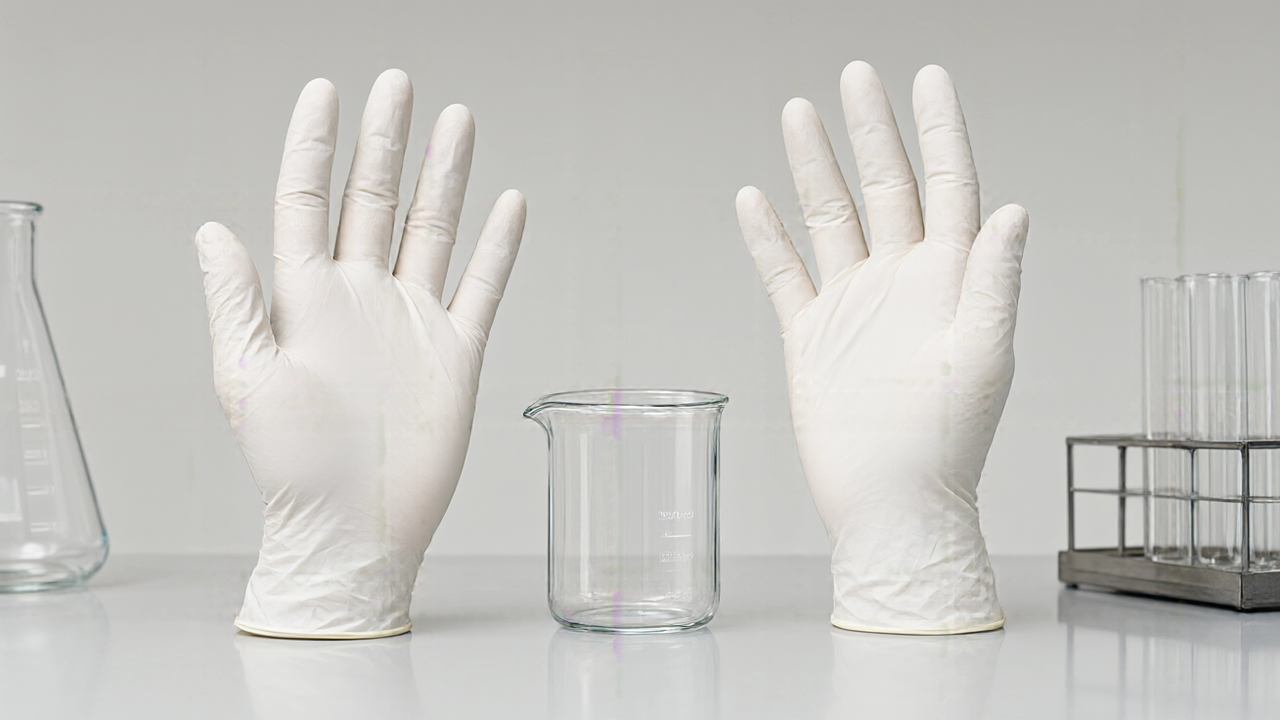
Why does this matter? Try holding up your two hands. They look similar, but a left glove cannot fit your right hand properly. Some molecules also have two three-dimensional forms that look like mirror images but cannot be placed exactly on top of one another. Scientists call this property chirality, or handedness.[1]
Same ingredients, different shape
A molecule is a group of atoms joined together. Two mirror-image forms can contain the same kinds and numbers of atoms, yet arrange them differently in three-dimensional space. They are not two different ingredients. The difference is how the parts point in space.
Scientists call a pair of these non-overlapping mirror-image molecules enantiomers. Not every molecule has this property. The glove comparison helps us imagine the difference, but it is only an analogy: real molecules are tiny three-dimensional structures, not actual hands.[2]
Why tiny differences can matter
Living cells contain molecules with very specific shapes. Some proteins can recognise one molecular form differently from its mirror image, a little as a right-handed glove suits one hand better than the other. That means molecular handedness can matter when scientists develop medicines and other useful chemicals.
However, it would be wrong to say that one handed form is always good and the other always dangerous. The effect depends on the particular molecule and how it interacts with a living system. This is why the exact shape and evidence from testing matter more than a simple rule.[1]
A surprising way to favour one side
A catalyst helps a chemical reaction proceed without being used up overall. Kagan studied how relatively small differences in the handedness of catalysts could sometimes lead to surprisingly large differences in the handedness of products. Chemists call these nonlinear effects.
Soai discovered important examples of autocatalysis: a product of a reaction can also help drive that same reaction forward. In certain reactions this can strengthen an initial preference for one mirror-image form. It does not mean that every chemical reaction behaves this way.[3]
What the prize does not prove
The discoveries show ways to produce or amplify one molecular handedness under particular conditions. They do not settle every question about why life uses certain molecular shapes. Scientists continue to investigate how the first strong preferences may have arisen on the early Earth.
This news is a useful reminder about scientific language. An award announcement reports recognition of earlier research. An experiment supplies observations. A model explains how results might happen. A good reader keeps these separate rather than treating an exciting headline as proof of every possible claim.[2]
Explore the instructional diagram
Fast lesson
Use these checks before you answer the practice questions.
Identify the announced date and prize recipients, then separate the recent announcement from the decades-long research it recognises.
Use left and right gloves to model mirror-image geometry; remind learners that molecules are not hands.
The prize recognises findings in particular reactions; it does not answer all origins-of-life questions.
Common mistakes
Why this fails: Enantiomers have the same atom types and chemical connectivity, but differ in three-dimensional arrangement.
Why this fails: Effects vary by substance and biological context; sweeping statements overreach the evidence.
Why this fails: A Nobel announcement honours research carried out earlier.
Word Lab
Use the meaning, hear the word, then try it in your own sentence.
chirality
nounthe property of having a mirror image that cannot be matched exactly by rotating the original
Chirality makes the left and right forms different.
molecule
nountwo or more atoms bonded together
A water molecule contains atoms joined by bonds.
atom
nouna basic unit of an element
Many substances are made of atoms.
mirror image
nounthe reflected form of an object or shape
Her left hand resembles a mirror image of her right.
enantiomer
nounone of two molecular structures that are non-superimposable mirror images
Each enantiomer has a mirror-image partner.
catalyst
nouna substance that speeds a reaction without being consumed overall
A catalyst can help a reaction proceed faster.
reaction
nouna process that rearranges atoms and changes substances
A reaction can produce a new substance.
autocatalysis
nouna reaction in which a product helps catalyse that same reaction
Autocatalysis can amplify a reaction's effects.
amplify
verbmake an effect or difference larger
The reaction can amplify a small imbalance.
recognise
verbidentify something by its particular features
Some proteins recognise molecular shapes.
analogy
nouna comparison that clarifies one relationship without making two things identical
The glove analogy helps explain chirality.
evidence
nouninformation that can support or test an explanation
Experimental evidence can support a claim.
Check your understanding
Choose an answer, explain your choice, and then check. Hints and retries are welcome.
Try the questions here. Public practice does not save a learning record.
Support · Understand the headline
Support · Understand the headline practice
Use facts and vocabulary from the short news report.
1. Which two researchers received the 2026 Chemistry Nobel?
2. What year was the prize announcement?
3. What does 'molecular handedness' describe?
4. What simple everyday analogy introduces handedness?
5. What is an enantiomer?
6. Does every molecule come in a left-handed and right-handed form?
Practice · Explain the chemistry
Practice · Explain the chemistry practice
Connect shape to chemistry and living systems.
7. Why can two forms with the same atoms behave differently?
8. Why is the glove comparison not a perfect model?
9. How can some proteins treat mirror-image forms differently?
10. What is a chemical catalyst?
11. What does autocatalysis mean?
12. What is an example of an unsupported claim?
Think · Science and evidence
Think · Science and evidence practice
Distinguish discoveries from their recognition and identify overclaims.
13. Did the prize announcement mean the discoveries all occurred on October 7?
14. What kind of research result is associated with Kagan?
15. What kind of reaction did Soai investigate?
16. Why is the word 'sometimes' important here?
17. Is a press announcement the same thing as a controlled experiment?
18. Name one reliable source for the 2026 prize facts.
Stretch · Transfer the idea
Stretch · Transfer the idea practice
Challenge explanations and make a cautious claim.
19. A student says all mirror images fit over their originals. How can you challenge this?
20. A medicine works in one molecular form. Is the other necessarily poisonous?
21. Explain what it means to amplify a small difference.
22. Why would scientists study molecular shape when developing medicines?
23. What remains uncertain about the history of life?
24. Write one accurate headline that avoids an overclaim.
Practice answer key
- 1. Henri Kagan and Kensō Soai.
The prize was announced on October 7, 2026. - 2. 2026.
The article gives the date explicitly. - 3. Some mirror-image molecular shapes cannot be superimposed.
Chirality refers to three-dimensional shape. - 4. A left glove and a right glove.
A left glove does not fit a right hand properly. - 5. One of a pair of non-superimposable mirror-image molecular forms.
The forms share atom kinds and connectivity but differ spatially. - 6. No.
Some molecules are not chiral. - 7. Their three-dimensional shapes interact differently with other molecules.
Shape matters for some molecular interactions. - 8. Molecules are not made of gloves or tiny hands.
It models non-overlapping shapes, not the actual atomic structure. - 9. Their own three-dimensional structures can fit the forms differently.
Biological recognition depends on molecular geometry. - 10. A substance that helps a reaction proceed faster without being consumed overall.
Catalysts change reaction rates. - 11. A reaction product also helps catalyse the same reaction.
A product can encourage additional product formation. - 12. All left-handed molecules are harmful.
The source explicitly warns against a universal rule. - 13. No.
The Nobel announcement recognises earlier work. - 14. Nonlinear effects in asymmetric synthesis.
A small change in catalyst handedness can sometimes lead to a larger product difference. - 15. Autocatalysis that can amplify a molecular-handedness preference.
The reaction product helps drive the same reaction. - 16. The reported behaviour depends on particular reactions and conditions.
The results are not universal. - 17. No.
An announcement reports a conclusion or honour; experiments provide observations and measurements. - 18. The American Chemical Society or the French Academy of Sciences.
Both published dated reports about the award. - 19. Compare your left and right hands or gloves.
Some mirror images cannot match exactly when rotated. - 20. No.
The effect must be tested for that specific molecule and biological context. - 21. A small starting imbalance becomes a larger one.
Certain chemical processes can increase an initial preference. - 22. Different shapes may interact differently with proteins or other targets.
Three-dimensional fit can affect biological activity. - 23. Why early life came to favour particular molecular handedness.
The prize-winning chemistry does not settle all origins-of-life questions. - 24. 2026 Chemistry Nobel Honours Research on Mirror-Image Molecules.
A good headline states the recognised science without implying a final answer to everything.
Related skills
Put it in your own words
This draft is not saved when you leave or refresh the page.
Check your own explanation
This is self-review, not automatic marking.
Compare with a model response
On October 7, 2026, chemists Henri Kagan and Kensō Soai were named winners of the Nobel Prize in Chemistry for work on reactions that can favour one mirror-image molecular form. Some molecules are chiral, meaning their mirror images cannot be made to overlap exactly, much like left and right gloves. These forms may interact differently with biological molecules, so chemists care about controlling their shapes. Kagan investigated nonlinear effects, while Soai studied autocatalysis that can amplify a preference in certain reactions. The prize recognises past work, not a discovery made on announcement day, and it does not settle every question about why life favours particular molecular shapes.
Sources and revision notes
Source check: 2026-10-13. Grade guidance is an editorial suggestion, not a standardised reading score.
- American Chemical Society — 2026 Nobel Chemistry Prize (Oct 7, 2026)
- Nature — Chemistry Nobel for Mirror-Image Molecules (Oct 7, 2026)
- Académie des Sciences — Kagan and Soai (Oct 7, 2026)
What changed in this edition?
New October 13 science-news reading replaces the repetitive condensation topic with a dated Nobel chemistry report. Facts checked against ACS, Nature and the French Academy of Sciences. Story, examples and practice questions are original.