Daily Read / Measurement
Measurement · Explain a cause-and-effect chain (warming → expanding → rising) and read a labelled scale, including temperatures below zero
How Does a Thermometer Work? Why the Red Line Goes Up and Down
Why does the red line in a thermometer climb on a warm day and sink on a cold one? Learn how expanding liquid, a narrow tube and a scale measure temperature.
Device/browser voice. Pronunciation and availability vary.
A line that moves by itself
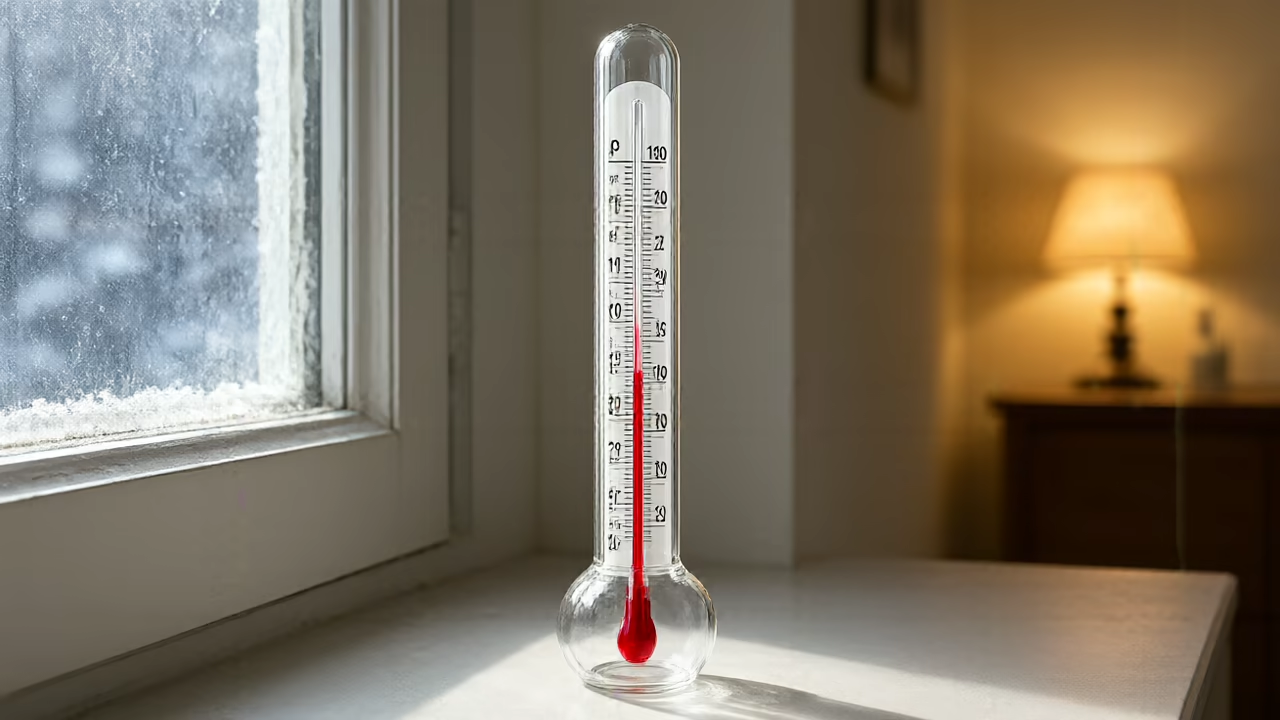
Look at an outdoor thermometer on a cold November morning. A thin red line stops beside a number on the scale. Bring the thermometer inside, and after a few minutes the line has crept higher. Nobody pushed it. So what made it move?
The answer is a cause-and-effect chain. Science Buddies, writing for Scientific American, explains that a thermometer like this has a liquid-filled reservoir at the end of a narrow tube. When the liquid warms, it expands and rises in the tube. When the liquid cools, it contracts and falls. A higher level means a higher temperature.[2]
Cause: things grow when they warm
To expand means to take up more space. To contract means to take up less. Science Buddies says scientists call this thermal expansion and contraction: matter tends to change its volume when its temperature changes. Volume is the amount of space something fills.
Not everything changes by the same amount. According to Science Buddies, gases change volume the most, liquids change a medium amount, and solids change too little to be useful in an everyday thermometer. That is why the moving part of a thermometer is a liquid, not a piece of solid metal or glass.[2]
Effect: the bulb and the narrow tube
Most of the liquid sits in the bulb, the round reservoir at the bottom. When the bulb warms, all that liquid expands at once. It cannot spread out sideways, because the glass holds it in. The only way out is up the tube.
The tube is very narrow on purpose. Science Buddies says a narrower tube makes a more accurate thermometer. Here is one way to picture it: if you pour one spoonful of water into a wide bowl, the level barely changes, but the same spoonful poured into a thin straw makes a tall column. A tiny change in the bulb becomes a movement you can see.[2]
Making the numbers
A tube of moving liquid only tells you warmer or colder until someone adds a scale. Chris Woodford, a science writer for the website Explain that Stuff, describes how it is done. The maker marks the liquid level at two fixed points: the temperature of melting ice and the temperature of boiling water. Then the space between the marks is split into equal steps.
On the Celsius scale, water freezes at 0 °C and boils at 100 °C, so there are 100 equal steps between them. Woodford explains that the scale works because the liquid expands by an amount that is directly related to the temperature change. The scale was devised by Anders Celsius, a Swedish scientist.
The scale keeps going below zero. In an Ontario winter, the line might stop at −10 °C, which is read as "minus ten degrees Celsius". Below zero, the bigger the number after the minus sign, the colder it is, so −10 °C is colder than −5 °C. To read any thermometer, keep your eye level with the top of the liquid. Looking from above or below can make the line seem to sit at a different mark.[1]
Why the liquid is often red
Older thermometers often used mercury, a silvery metal that is liquid at room temperature. Woodford notes that mercury is toxic. It is safe while sealed inside the glass, but a broken thermometer could let it out. Many thermometers now use alcohol, usually coloured red, which Woodford says is generally safer.
Alcohol has another advantage in a cold country. Woodford says pure alcohol freezes at a much lower temperature than mercury: about −114 °C, compared with about −40 °C for mercury. A frozen liquid cannot rise or fall, so an alcohol thermometer can measure colder air.[1]
Thermometers without liquid
A digital thermometer works in a completely different way. Woodford explains that it uses a metal probe. As the metal warms or cools, it lets electricity pass through it more or less easily. A tiny computer chip measures that change and turns it into a number on the screen. Electronic thermometers respond almost instantly, though their readings can jump around a little.[1]
Measuring the weather fairly
Weather services want their numbers to describe the air, not the sunshine on a hot sidewalk. The Bureau of Meteorology, Australia's national weather agency, keeps its thermometers in a Stevenson screen. This is a white box with slatted sides called louvres. The louvres let air flow through, while the box shields the thermometer from rain and direct sunlight. The white paint helps the box absorb less heat.
Placement matters too. The Bureau sets its screens over grass, not concrete, and away from buildings and trees, which can reflect or absorb heat. The thermometer sits 1.2 m above the ground, because the Bureau says the temperature near the ground can differ by as much as 7 °C from the temperature 2 m up. Many of its stations now use electronic sensors that send their readings automatically.[3]
Explore the instructional diagram
Fast lesson
Use these checks before you answer the practice questions.
Ask your child to explain the rising line in three linked steps: what changes first (temperature), what that causes (expanding), and what you see (the line rises). Then reverse it for a cold day.
Point out that the thermometer scale is a number line standing up. Practise counting up and down across zero, for example from −6 °C to 4 °C, before reading real thermometers.
If you have an old silver-liquid thermometer at home, do not use it for experiments. A red-liquid or digital thermometer is the better choice for the activity.
Common mistakes
Why this fails: Below zero, the bigger the number after the minus sign, the colder it is.
Why this fails: The liquid itself takes up more space when it warms, and the narrow tube is the only place it can go.
Why this fails: Looking at an angle can make the line seem beside a different mark. Keep your eye level with the top of the liquid.
Word Lab
Use the meaning, hear the word, then try it in your own sentence.
thermometer
nouna tool that measures temperature
The thermometer on the porch read −10 °C.
temperature
nounhow hot or cold something is, measured in degrees
The temperature dropped below zero overnight.
expand
verbto become bigger and take up more space
The liquid expands when the bulb warms.
contract
verbto become smaller and take up less space
In ice water, the liquid contracts and falls.
volume
nounthe amount of space something takes up
Warm liquid has a slightly larger volume.
reservoir
nouna place where a supply of liquid is stored
The bulb is the thermometer's reservoir.
scale
nouna set of evenly spaced marks and numbers used for measuring
Read the scale beside the top of the red line.
fixed point
noun phrasea temperature that always stays the same, used to mark a scale
Melting ice is one fixed point on the Celsius scale.
accurate
adjectivecorrect and exact
A narrower tube makes a more accurate thermometer.
toxic
adjectivepoisonous and harmful to living things
Mercury is toxic if it escapes from broken glass.
probe
nouna thin tool that is put into or against something to measure it
The digital thermometer's metal probe went into the soup.
louvres
nounrows of slanted slats that let air through but block sun and rain
Air flows through the louvres of the white box.
Check your understanding
Choose an answer, explain your choice, and then check. Hints and retries are welcome.
Try the questions here. Public practice does not save a learning record.
Support · Find it in the text
Support · Find it in the text practice
Each answer is stated in the article. Point to the sentence.
1. What does the word expand mean?
2. Which changes volume the most when heated: gases, liquids or solids?
3. What is the bulb of a thermometer?
4. At what temperatures does water freeze and boil on the Celsius scale?
5. Who devised the Celsius scale?
6. How high above the ground does the Bureau of Meteorology place its thermometers?
Apply · Cause and effect
Apply · Cause and effect practice
Use 'because' or 'so' and a detail from the article.
7. Why does the red line fall when you put the bulb in ice water?
8. Why is a solid not used as the moving part of an everyday thermometer?
9. Why do the marks on a Celsius thermometer need to be equal steps?
10. Why should your eye be level with the top of the liquid?
11. Why is mercury safe in a sealed thermometer but a worry if the glass breaks?
12. Why is a Stevenson screen painted white?
Reason · Chains and scales
Reason · Chains and scales practice
Build cause-and-effect chains, read the scale and test claims.
13. Complete the chain: the bulb cools → ? → the line falls.
14. The line moves from −10 °C to −2 °C. Did it get warmer or colder, and by how many degrees?
15. Put these in order from coldest to warmest: 3 °C, −12 °C, 0 °C, −4 °C.
16. A town in the far north can drop below −40 °C. Should its outdoor thermometer use mercury or alcohol? Why?
17. How are a liquid thermometer and a digital thermometer alike, and how are they different?
Practice answer key
- 1. To take up more space.
See 'Cause: things grow when they warm'. - 2. Gases.
Science Buddies says gases change the most, liquids a medium amount and solids too little. - 3. The round reservoir at the bottom that holds most of the liquid.
See 'Effect: the bulb and the narrow tube'. - 4. It freezes at 0 °C and boils at 100 °C.
See 'Making the numbers'. - 5. Anders Celsius, a Swedish scientist.
See the second paragraph of 'Making the numbers'. - 6. 1.2 m.
See 'Measuring the weather fairly'. - 7. Because the liquid cools and contracts, so it takes up less space and drops down the tube.
This is the opposite of the warming chain. - 8. Because solids change volume too little to show a useful movement.
See 'Cause: things grow when they warm'. - 9. Because the liquid expands by an amount directly related to the temperature change, so each degree moves the line the same distance.
Woodford explains this in 'Making the numbers'. - 10. So you do not see the line beside the wrong mark, which can happen when you look from above or below.
This is the reading tip at the end of 'Making the numbers'. - 11. Because mercury is toxic, and it can only harm people if it gets out of the glass.
See 'Why the liquid is often red'. - 12. So the box absorbs less heat and the reading describes the air.
See 'Measuring the weather fairly'. - 13. The liquid contracts and takes up less space.
The middle step is the change in volume. - 14. Warmer, by 8 degrees.
Count up from −10 to −2 on the scale: 8 steps. - 15. −12 °C, −4 °C, 0 °C, 3 °C.
Below zero, larger numbers after the minus sign are colder. - 16. Alcohol, because Woodford says mercury freezes at about −40 °C, while alcohol freezes far lower and can keep moving.
A frozen liquid cannot show changes. - 17. Alike: both measure temperature. Different: a liquid thermometer shows a line that rises as the liquid expands; a digital one uses a metal probe whose electricity changes with temperature and shows a number almost instantly.
Name one likeness and one difference.
Related skills
Put it in your own words
This draft is not saved when you leave or refresh the page.
Check your own explanation
This is self-review, not automatic marking.
Compare with a model response
A liquid thermometer has a bulb full of liquid at the bottom of a very narrow tube. When the air around the bulb warms, the liquid expands, so it takes up more space. Because the glass holds it in, the only place it can go is up the tube, and as a result the red line rises. When the air cools, the liquid contracts and the line falls. The narrow tube makes a small change easy to see, which makes the thermometer more accurate. The scale was made by marking melting ice at 0 °C and boiling water at 100 °C and splitting the space into equal steps. Below zero, −10 °C is colder than −5 °C, because the bigger number after the minus sign means colder. A digital thermometer is different, because it uses a metal probe and electricity instead of a moving liquid.
Sources and revision notes
Source check: 2026-10-30. Grade guidance is an editorial suggestion, not a standardised reading score.
- Explain that Stuff — Thermometers (Chris Woodford)
- Scientific American / Science Buddies — Measure Up with a Homemade Thermometer
- Bureau of Meteorology — Ask BoM: How Is Temperature Measured?
What changed in this edition?
The liquid-filled reservoir at the end of a narrow tube, rising when warmed and falling when cooled, the term thermal expansion and contraction, gases changing volume most, liquids moderately and solids too little for an everyday thermometer, and a narrower tube giving a more accurate thermometer come from Science Buddies' activity published by Scientific American. Calibration with two fixed points (melting ice and boiling water) and equal steps, 100 Celsius divisions, expansion directly related to temperature change, Anders Celsius as a Swedish scientist, mercury being toxic but safe when sealed, red alcohol thermometers being generally safer, freezing points of about −114 °C for pure alcohol (ethanol) and about −40 °C for mercury, and electronic thermometers using a metal whose electrical resistance changes, read by a microchip and responding almost instantly with some fluctuation, come from Chris Woodford's Explain that Stuff article. The Stevenson screen with louvres, its white exterior, shielding from rain and direct sun, siting over grass away from buildings and trees, the 1.2 m height, the up-to-7 °C difference near the ground, and automatic electronic sensors come from the Bureau of Meteorology. The November morning, the spoonful-in-a-bowl-and-straw comparison, the −10 °C Ontario example, and the advice to read at eye level are this lesson's illustrations and general measuring advice, not claims from the sources. The diagram is a simplified schematic, not to scale.