Daily Read / Reading for Cause, Evidence & Fair Tests
Reading for Cause, Evidence & Fair Tests · Separate observations from explanations, trace cause and effect, and recognise what one test cannot prove
The Paper Bridge Test: What Does the Evidence Prove?
Read an original classroom engineering story, compare trial results, and learn how to support a cause-and-effect explanation without overstating what one test proves.
Device/browser voice. Pronunciation and availability vary.
A bridge made from one sheet
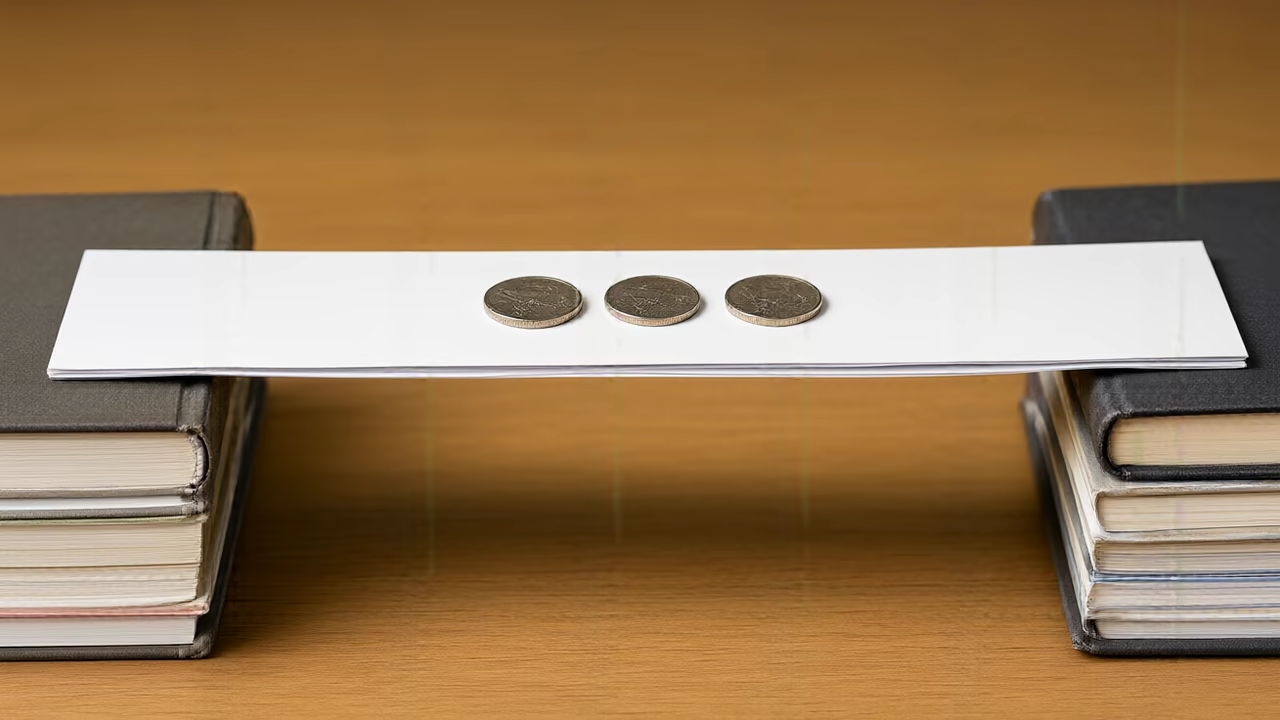
This is a fictional classroom story with invented test results. During a paper-building challenge, Nia and Leo put two books on a table with a 20-centimetre gap between them. Their task was to make a bridge across the gap using one sheet of ordinary paper. They could change the shape of the paper, but the books, the gap and the kind of paper had to stay the same. Small coins would be placed on the bridge one at a time.
Nia laid the sheet flat between the books. It sagged near the middle. She added coins carefully until a fifth coin made the bridge collapse. In their notebook, the pair wrote: 'Flat sheet: four coins stayed in place; the fifth coin caused collapse.' This sentence described their observation. It did not yet tell them why the paper bent.[1]
A new shape and a surprising result
Leo folded a fresh sheet of the same paper into several even ridges, like a small accordion. The folded sheet still crossed the same gap, resting on the same books. Nia placed the same kind of coins near the middle in the same order. The folded bridge held twelve coins before collapsing when they added the thirteenth.
'Folding made the paper stronger,' Leo announced. Nia replied, 'Maybe the ridges helped spread the load and resist bending. But we should say exactly what we saw first.' They wrote down the results from the two trials and labelled their idea an explanation, not an additional observation. The bridge's shape had changed; that change might help explain the difference.[1]
One comparison is a beginning
The teacher asked what would happen if they used heavier coins on the folded bridge. Leo suggested that they might get a different result. Nia noticed that comparing a flat bridge with light coins to a folded bridge with heavier coins would mix two changes. If the results differed, the class would not know which change mattered.
They repeated the trials three more times, using fresh sheets of the same paper, the same coin type, the same gap and the same placement method. Results varied a little because the folds and coin positions were not perfectly identical. Across their invented classroom trials, the folded design held more coins each time. That pattern supported the claim that the shape helped, but the tests still did not prove that every folded paper bridge everywhere would outperform every flat one.[2]
Write what you know—and what you would test
Back at their desks, the pair wrote a careful conclusion: 'In our classroom trials, the folded paper bridge carried more of the same coins across the same gap than a flat paper bridge. We think the folds helped the paper resist bending. We would need more carefully controlled trials before making a wider claim.' They included the results as evidence rather than saying the teacher had proved their idea.
For a next experiment, Nia proposed comparing two folded patterns while keeping the paper size, book gap and coins unchanged. Leo wanted to photograph where each bridge first bent. They realised that a good investigation does not end with the most exciting number. It asks whether the comparison was fair, whether the observation supports the explanation, and what new evidence would make the conclusion stronger.[2]
Explore the instructional diagram
Fast lesson
Use these checks before you answer the practice questions.
Have the reader underline measured counts separately from ideas about causes.
A fair test changes the shape while keeping paper, coin type, gap and method comparable.
Use 'in these trials' rather than 'always'; the story's numbers are invented.
Common mistakes
Why this fails: Coin counts are observed; resistance to bending is a proposed explanation.
Why this fails: Different coins would prevent a clean comparison of paper shape alone.
Why this fails: Trials offer support under tested conditions, not certainty in every setting.
Word Lab
Use the meaning, hear the word, then try it in your own sentence.
observation
nounsomething directly seen, counted or measured
Four coins stayed on the flat bridge.
evidence
nouninformation that supports or tests a conclusion
The recorded coin counts were evidence.
conclusion
nouna judgement based on available information
Their conclusion described the trials.
explanation
nounan account of why something might happen
Their explanation involved the folded ridges.
collapse
verbto fall down because support fails
The paper bridge collapsed under the fifth coin.
ridge
nouna raised narrow fold or line
The folded paper had several ridges.
load
nounweight or force carried by a structure
The bridge carried the coin load.
variable
nouna factor that can change in an investigation
Paper shape was the variable they changed.
constant
nouna factor deliberately kept unchanged
They kept the book gap constant.
trial
nounone attempt in an experiment
They repeated each trial.
pattern
nounsomething that repeats or appears regularly
A pattern appeared across trials.
inference
nouna reasoned idea that goes beyond what was directly observed
The reason for bending was an inference.
Check your understanding
Choose an answer, explain your choice, and then check. Hints and retries are welcome.
Try the questions here. Public practice does not save a learning record.
Support · Find the recorded result
Support · Find the recorded result practice
Quote what the story states, without adding a new explanation.
1. What distance separated the two books?
2. How many coins stayed on the flat bridge in the first trial?
3. How many coins stayed on the folded bridge in its first trial?
4. What kind of paper did both first designs use?
5. What does the story record about the thirteenth coin?
6. Was the class testing the effects of colour or shape?
Apply · Link evidence to claims
Apply · Link evidence to claims practice
State what was measured and which idea goes beyond measurement.
7. Is 'folds may resist bending' an observation or an explanation?
8. Name two conditions the students kept the same.
9. Why is 'all folded bridges are stronger' too strong?
10. What did repeating trials add to the evidence?
11. Name the two types of information in 'held twelve coins, perhaps because folds resisted bending'.
12. What must stay comparable when testing a new folded design?
13. Why should the conclusion mention the classroom?
Reason · Improve the experiment
Reason · Improve the experiment practice
Decide what a fair next comparison needs.
14. What is wrong with using different weights of coins for the two paper shapes?
15. Give one reason trial counts might vary a little.
16. Write one sentence that accurately describes the findings.
17. If two folded patterns carry different loads, what additional test would help?
18. Can repeated trials alone guarantee a fair test?
19. How could the students make coin placement more consistent?
Practice answer key
- 1. 20 centimetres.
The first section explicitly says the gap was 20 centimetres. - 2. Four.
The fifth coin caused collapse. - 3. Twelve.
The thirteenth coin caused collapse. - 4. The same ordinary paper.
They changed the shape rather than the paper type. - 5. The folded bridge collapsed when it was added.
The record states that twelve coins stayed in place and the thirteenth caused collapse. - 6. Shape.
Both sheets were ordinary paper; the deliberate difference was whether the sheet was flat or folded. - 7. An explanation.
It proposes why the pattern occurred, not a directly recorded count. - 8. The 20-centimetre gap and coin type.
They also controlled paper type and method of placing coins. - 9. The students only tested particular designs and conditions.
A local classroom pattern does not establish a universal law. - 10. A pattern across attempts rather than reliance on one result.
Replications give a basis to judge consistency. - 11. A recorded observation followed by a possible explanation.
Twelve is the count; the bending mechanism is not independently measured. - 12. Paper type and size, coin type, gap, and placement method.
Keeping other conditions comparable helps focus the test on fold pattern. - 13. Because the evidence came from limited classroom trials.
The evidence does not establish a universal rule about every bridge. - 14. It changes coin weight and bridge shape together.
A fair comparison should isolate the paper shape. - 15. Small differences in folding or coin placement.
The story says the attempts were not perfectly identical. - 16. In the fictional trials, the tested folded shape held more of the same coins across the same gap.
The statement names the scope and controlled comparison. - 17. Repeat both patterns under identical conditions.
Replication and control can strengthen the comparison. - 18. No; the trials must also keep relevant conditions comparable.
Repetition cannot isolate an effect if multiple variables change. - 19. Mark the same placement position on every bridge and use the same procedure.
Standard placement reduces unintended differences between attempts.
Related skills
Put it in your own words
This draft is not saved when you leave or refresh the page.
Check your own explanation
This is self-review, not automatic marking.
Compare with a model response
In this fictional classroom experiment, Nia and Leo compared two shapes of the same kind of paper. Their flat sheet held four coins before the fifth collapsed it. Their first folded sheet held twelve coins before the thirteenth collapsed it. They kept the same book gap and coin type. The folds may have helped resist bending, but that idea is an explanation rather than a directly measured fact. The children repeated the tests and saw the same general pattern. Their result does not prove every folded bridge is stronger. I would next compare two fold patterns using the same paper, gap and coins.
Sources and revision notes
Source check: 2026-10-22. Grade guidance is an editorial suggestion, not a standardised reading score.
- Science Buddies — What Are Variables? (instructional background only)
- Science Buddies — Define Your Variables (instructional background only)
What changed in this edition?
Original fictional reading scenario, with invented names, trials and coin counts; sources support teaching controlled variables and fair experimental comparisons, not the story's specific numerical outcomes.