Daily Read / Weather & Flight
Weather & Flight · Trace a cause-and-effect chain
Why Do Airplanes Leave White Trails?
Follow a white aircraft trail from hot, moist exhaust to condensation, freezing and an ice-crystal cloud, then explain why some contrails vanish quickly while others persist.
Device/browser voice. Pronunciation and availability vary.
A white line that is really a cloud
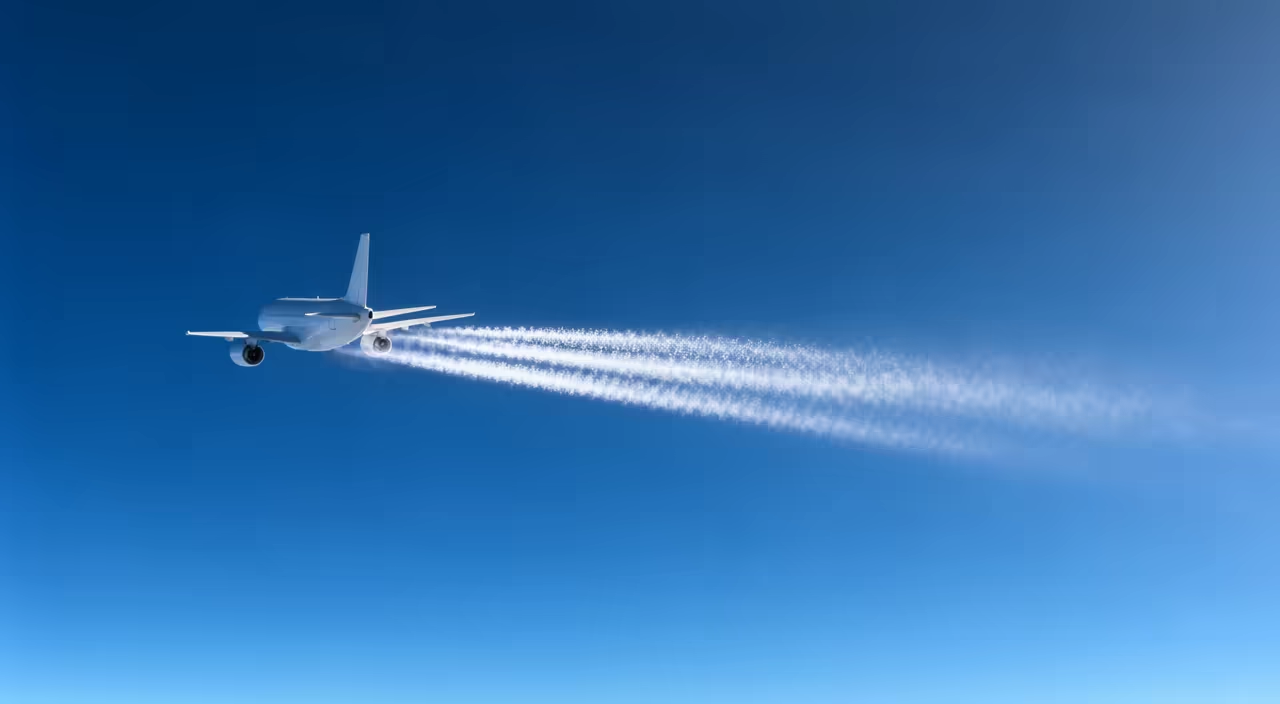
Look up after a high-flying jet and you may see a bright white line stretching across blue sky. That line is called a condensation trail, or contrail. It is not a painted stripe left behind the aircraft; it is a narrow cloud of tiny ice crystals.
The Federal Aviation Administration explains that contrails form when hot, moist aircraft exhaust mixes with cold, humid air high in the atmosphere. NASA describes the same basic ingredients: water vapour, tiny particles and sufficiently cold air.[1]
Step 1: add water vapour and tiny particles
Burning jet fuel produces water vapour. Aircraft exhaust also contains very small particles, and the surrounding atmosphere already contains natural particles. These particles can act as surfaces on which water begins to condense.
This matters because a cause chain needs more than one ingredient. Water vapour supplies the water, while particles help provide places where droplets and then ice crystals can form.[1]
Step 2: mix with very cold upper air
At cruise altitude, the surrounding air can be far below freezing. As the hot exhaust plume mixes with that cold air, it cools rapidly. Water vapour can condense onto tiny particles, and the droplets quickly freeze into ice crystals.
NASA’s educational material compares the process with cloud formation: water vapour and condensation nuclei combine under the right conditions. A contrail is therefore closer to a high ice cloud than to ordinary smoke.[2]
Step 3: the crystals become visible
A single microscopic ice crystal would be hard to notice from the ground. A large collection of them scatters sunlight and becomes visible as a white line behind the aircraft.
The visible trail follows the aircraft’s path at first, but winds can move and stretch it. The shape you see later may no longer sit directly behind the aircraft that created it.[3]
Why some trails vanish and others persist
Cold air alone is not enough. The humidity of the upper atmosphere strongly affects what happens next. In drier air, ice crystals can disappear quickly and the contrail may last only seconds or minutes.
In very humid upper air, the ice crystals can remain and grow. FAA notes that persistent contrails can last much longer and spread into broader contrail-cirrus clouds. This is why two flights on the same day can leave very different trails if they cross different atmospheric layers.[1]
Why a contrail may start and stop
A trail can appear broken even though the aircraft flies smoothly. The jet may be crossing invisible pockets with different temperature and humidity. A segment forms where conditions support ice crystals and fades where they do not.
That observation teaches a reading skill as well as a weather idea: a cause can depend on conditions. The aircraft supplies ingredients, but the atmosphere helps determine whether the visible result appears and how long it lasts.[1]
Explore the contrail cause-chain diagram
Fast lesson
Use these checks before you answer the practice questions.
Write each step with an arrow: exhaust water vapour + particles → cooling → condensation → freezing → visible ice crystals.
The aircraft supplies water vapour and particles; the surrounding atmosphere supplies temperature and humidity conditions.
Seeing a long trail is evidence, but exact upper-air humidity still requires an instrument or atmospheric data.
Common mistakes
Why this fails: The visible contrail is mainly an ice-crystal cloud formed after exhaust water vapour cools.
Why this fails: Different atmospheric layers can have very different humidity.
Why this fails: Persistence depends on local temperature, humidity and winds.
Word Lab
Use the meaning, hear the word, then try it in your own sentence.
contrail
nouna line-shaped ice cloud formed behind an aircraft under suitable atmospheric conditions
A bright contrail stretched across the morning sky.
condense
verbto change from water vapour into liquid water
Water vapour can condense on tiny particles as the exhaust cools.
crystal
nouna solid whose particles form an ordered structure
A contrail contains many tiny ice crystals.
humidity
nounthe amount of water vapour in the air
High humidity aloft can help a contrail persist.
persist
verbto continue to exist instead of ending quickly
Some contrails persist for a long time.
dissipate
verbto spread out and fade away
A short contrail may dissipate within minutes.
particle
nouna very small piece of matter
Water can condense on tiny particles in the air.
atmosphere
nounthe layer of gases surrounding Earth
Contrails form high in the atmosphere.
Check your understanding
Choose an answer, explain your choice, and then check. Hints and retries are welcome.
Try the questions here. Public practice does not save a learning record.
Foundation
Foundation practice
Build the sequence.
1. What are the white lines behind some high-flying aircraft called?
2. What happens before visible ice crystals form?
3. Why are contrails made mostly of ice crystals rather than warm liquid droplets?
4. What two atmospheric conditions especially favour contrail formation and persistence?
5. Why can a contrail disappear quickly?
6. In this lesson, what does persist mean?
Cause Chain
Cause Chain practice
Trace cause and condition.
7. Complete the chain: engine exhaust water vapour → condensation on particles → ______.
8. Why do tiny particles matter?
9. Why can a trail begin or end suddenly along one flight path?
10. How is a contrail similar to a natural cirrus cloud?
11. Does a white line prove the air is humid at ground level?
12. Which comes first: visible trail or ice-crystal formation?
Evidence
Evidence practice
Judge evidence carefully.
13. You see a line that fades in one minute. What can you directly observe?
14. A contrail lasts for a long time. What condition is consistent with that?
15. Why use FAA plus NASA sources?
16. Can you identify the exact aircraft from a long-lived drifting contrail just by looking up?
17. Is a contrail simply smoke?
18. Why might two aircraft at different altitudes leave different-looking trails?
Reasoning
Reasoning practice
Transfer the mechanism.
19. A jet crosses a moist layer and its trail suddenly appears. Best explanation?
20. A short contrail vanishes seconds after forming. What likely changed next?
21. Why can a persistent contrail spread wider over time?
22. Why is seeing your breath on a cold day a useful analogy but not a perfect model?
23. A student says every long white trail means bad weather is coming. What is wrong?
24. State the full mechanism in one sentence.
Practice answer key
- 1. Contrails.
Contrail is short for condensation trail. - 2. Hot moist exhaust mixes with very cold upper air and water condenses on tiny particles.
The cold, moist mixture creates droplets that quickly freeze. - 3. Cruise-altitude air is extremely cold.
The newly condensed water quickly freezes high in the atmosphere. - 4. Cold and humid air.
FAA explains that warm or dry air at altitude can prevent or shorten contrails. - 5. The surrounding air may be dry enough for the ice crystals to sublimate or evaporate away.
Persistence depends strongly on upper-air humidity. - 6. To continue or remain for a longer time.
A persistent contrail lasts instead of fading quickly. - 7. ice crystals form
The condensed water freezes in the very cold upper atmosphere. - 8. They provide surfaces on which water can condense and freeze.
Particles can come from the atmosphere or the engine exhaust. - 9. The aircraft may enter or leave a colder or more humid pocket of air.
Atmospheric conditions can change over short distances. - 10. Both can contain ice crystals high in cold air.
NASA notes that contrails are a type of ice cloud formed with aircraft-provided ingredients. - 11. No.
Humidity high where the aircraft flies can differ greatly from humidity at the surface. - 12. Ice-crystal formation comes first; the many crystals make the trail visible.
Visibility is the result of the crystals scattering light. - 13. The line became less visible quickly.
Its exact humidity is an explanation, not a direct visual measurement. - 14. Very humid upper air that lets ice crystals persist and grow.
Persistence is favoured by cold, ice-supersaturated air. - 15. They independently describe the same formation mechanism and add complementary details.
Agreement strengthens the core mechanism while NASA adds cloud context. - 16. Not reliably.
Winds can move persistent contrails far from where they formed. - 17. No.
The visible trail is mainly ice crystals formed from water vapour in cold upper air. - 18. Temperature and humidity can differ by altitude.
Contrail behaviour depends on local atmospheric conditions. - 19. It entered air cold and humid enough for contrail formation.
The engine did not need to switch into a different visible mode. - 20. The ice crystals encountered air too dry to remain.
Dry air makes the trail dissipate quickly. - 21. Winds move and shear the ice-crystal cloud while humid air keeps crystals from disappearing.
A contrail can evolve into broader contrail cirrus. - 22. Both involve moist air becoming visible in cold conditions, but breath is near the ground and contrails form as ice clouds high aloft.
The analogy captures cooling and condensation, not every atmospheric detail. - 23. Persistence shows suitable upper-air conditions, not a guaranteed future weather event.
A condition can support formation without proving a forecast. - 24. Hot, moist aircraft exhaust mixes with very cold upper air, water condenses on tiny particles and freezes into visible ice crystals.
This connects the source, conditions, phase change and visible result.
Related skills
Put it in your own words
This draft is not saved when you leave or refresh the page.
Check your own explanation
This is self-review, not automatic marking.
Compare with a model response
A jet continuously releases hot, moist exhaust containing water vapour and tiny particles. Where the surrounding upper air is cold and humid enough, water condenses on particles and freezes into visible ice crystals. If the aircraft then enters drier or warmer air, the crystals may not persist, so the trail fades. Entering another suitable layer can make the contrail visible again.
Sources and revision notes
Source check: 2026-09-27. Grade guidance is an editorial suggestion, not a standardised reading score.
- Federal Aviation Administration — Contrails
- NASA STEM — Contrails
- NASA Earth Observatory — Curvy Contrails
What changed in this edition?
Initial release. Contrail formation, ice-crystal composition, persistence and upper-air conditions were checked against FAA and NASA sources on 2026-09-27.