Daily Read / Forces and Materials
Forces and Materials · Use a controlled comparison to distinguish observations from claims
Why Doesn't a Magnet Stick to Every Metal?
Steel clips move toward a magnet, but aluminium and copper usually do not. Compare the evidence before deciding what a magnet can attract.
Device/browser voice. Pronunciation and availability vary.
The surprise on a tabletop
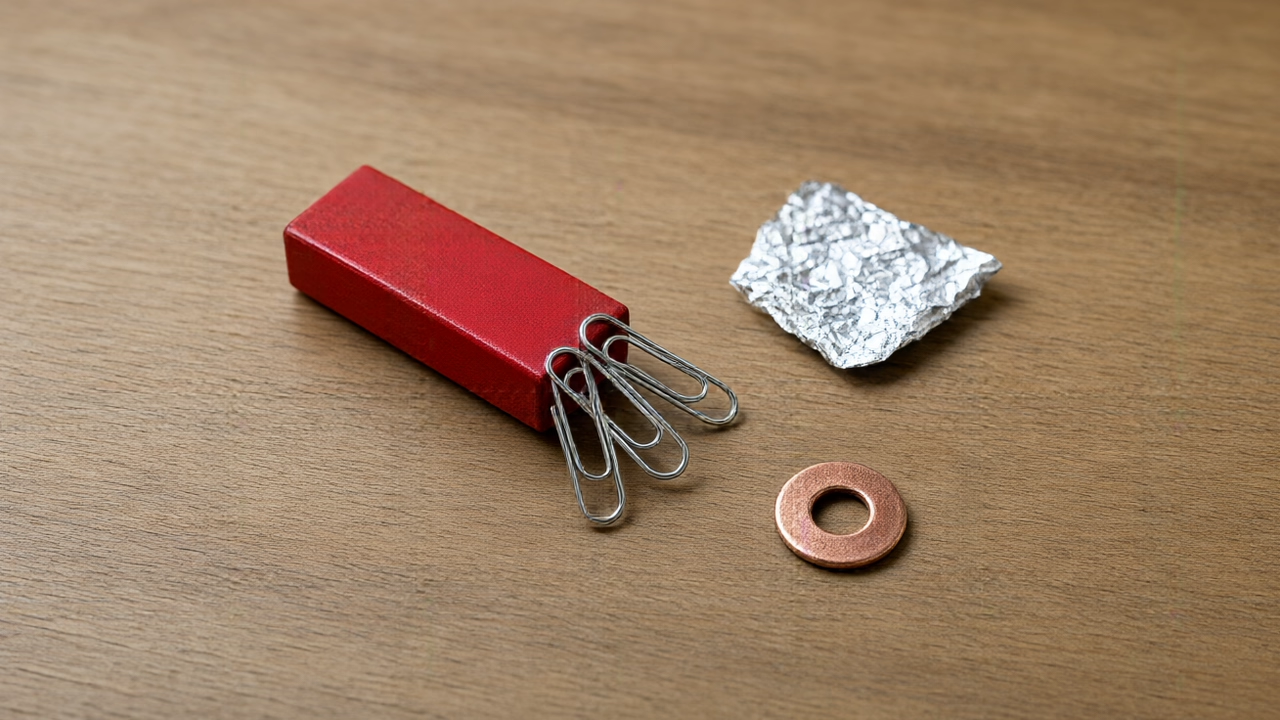
Picture a red bar magnet on a table. Move it close to a steel paper clip, and the clip may slide towards it. Now try a piece of ordinary aluminium foil and a pure copper washer. Neither is likely to show a noticeable pull from the same classroom magnet. All three objects are made of metal, yet they behave differently.
The lesson is not that one object is heavier or shinier. Our first question is simpler: what did we actually observe? A clip moved; the foil and washer did not move noticeably. This description is an observation. We need more reasoning before naming a cause.[1]
Metal does not always mean magnetic
An ordinary permanent magnet can strongly attract certain materials, including iron, nickel and cobalt. Many everyday steel objects are attracted because steel usually contains iron. Ordinary aluminium and copper do not show the same strong attraction in a simple classroom test.
At a deeper level, magnetic behaviour depends on how very small magnetic effects inside a material work together. In iron and certain other materials, they can reinforce one another strongly. You do not need to see those tiny parts to observe the effect: a magnet can pull on a suitable steel clip even before it touches it.
The word 'steel' alone is not a promise. Different alloys, including different kinds of stainless steel, can behave differently. It is more precise to say 'many steel objects' than 'every steel object'.[2]
Make the comparison fair
Test one object at a time with the same ordinary magnet. Start at a similar small gap and watch whether the object moves towards the magnet. Record the material you think each object is made from and what you actually see. Repeat a trial rather than trusting one quick glance.
Keep in mind that changing an object's shape, size, coating or distance can affect the result. A classroom test can compare examples, but it does not identify the chemical ingredients of an unknown object with certainty. Your table should separate the observation ('moved') from the interpretation ('may contain a magnetic material').
Do not use tiny or very powerful loose magnets for this activity. A teacher or trusted adult can choose safe, ordinary classroom materials.[1]
What does the evidence prove?
Imagine someone announces, 'Magnets stick to all metals.' One counterexample is enough to challenge the word 'all': ordinary aluminium foil and copper objects do not show a noticeable pull in this test. The better conclusion is that an ordinary magnet strongly attracts some metal-containing materials, not every metal.
Now imagine a different claim: 'This object did not move, so it must be copper.' That is not justified. Aluminium and many other materials can also show no noticeable movement. The same observation can fit more than one explanation. Strong scientific language says exactly what was tested and what remains uncertain.[2]
Explore the magnetic-materials diagram
Word Lab
Use the meaning, hear the word, then try it in your own sentence.
attract
verbTo pull an object towards something.
The magnet can attract an ordinary steel paper clip.
magnetic
adjectiveShowing a response to a magnetic field; often used for materials noticeably attracted to an ordinary magnet.
The steel clip behaves as a magnetic material in this test.
alloy
nounA material made by combining a metal with one or more other elements.
Different steel alloys do not always respond to a magnet in the same way.
observation
nounSomething noticed or recorded during a test.
The clip moved closer to the magnet is an observation.
inference
nounA possible conclusion drawn from observations and prior knowledge.
The clip may contain iron is an inference based on how many steels behave.
counterexample
nounOne example that shows a claim using 'all' or 'always' cannot be correct.
Copper that does not stick is a counterexample to 'every metal sticks'.
Check your understanding
Choose an answer, explain your choice, and then check. Hints and retries are welcome.
Try the questions here. Public practice does not save a learning record.
Put it in your own words
This draft is not saved when you leave or refresh the page.
Check your own explanation
This is self-review, not automatic marking.
Compare with a model response
The clip moved towards the magnet. However, ordinary aluminium foil did not move noticeably in the same kind of test. This challenges the claim that all metals are attracted. A better conclusion is that an ordinary magnet strongly attracts some materials, including many steels, but not every metal.
Sources and revision notes
Source check: 2026-10-13. Grade guidance is an editorial suggestion, not a standardised reading score.
- National High Magnetic Field Laboratory — Magnet Exploration
- National High Magnetic Field Laboratory — Diamagnetism and Paramagnetism
What changed in this edition?
Initial publication. The tabletop example and diagram are educational illustrations, not records of a new measured experiment. Results and magnetic behaviour may vary with alloy, object and magnet.