Daily Read / Short Story
Short Story · Make an inference by joining clues in the story with what you already know, support it with evidence, and check it when new information arrives
Short Story: Grandpa's Missing Glasses
Original fiction. Grandpa keeps 'forgetting' his glasses, but Theo spots them in his pocket. Join the clues to infer what Grandpa isn't saying.
Device/browser voice. Pronunciation and availability vary.
Grandpa comes to stay
This is an original short story. The characters, the diner and the hardware store are invented.
Grandpa Walt came to stay with us for two weeks in November. He arrived with one suitcase, a red toolbox and a tin of peppermints. By the end of the first day, he had fixed the squeaky back door, tightened the wobbly leg on the kitchen table and put a new chain on my bike. Grandpa could fix anything.
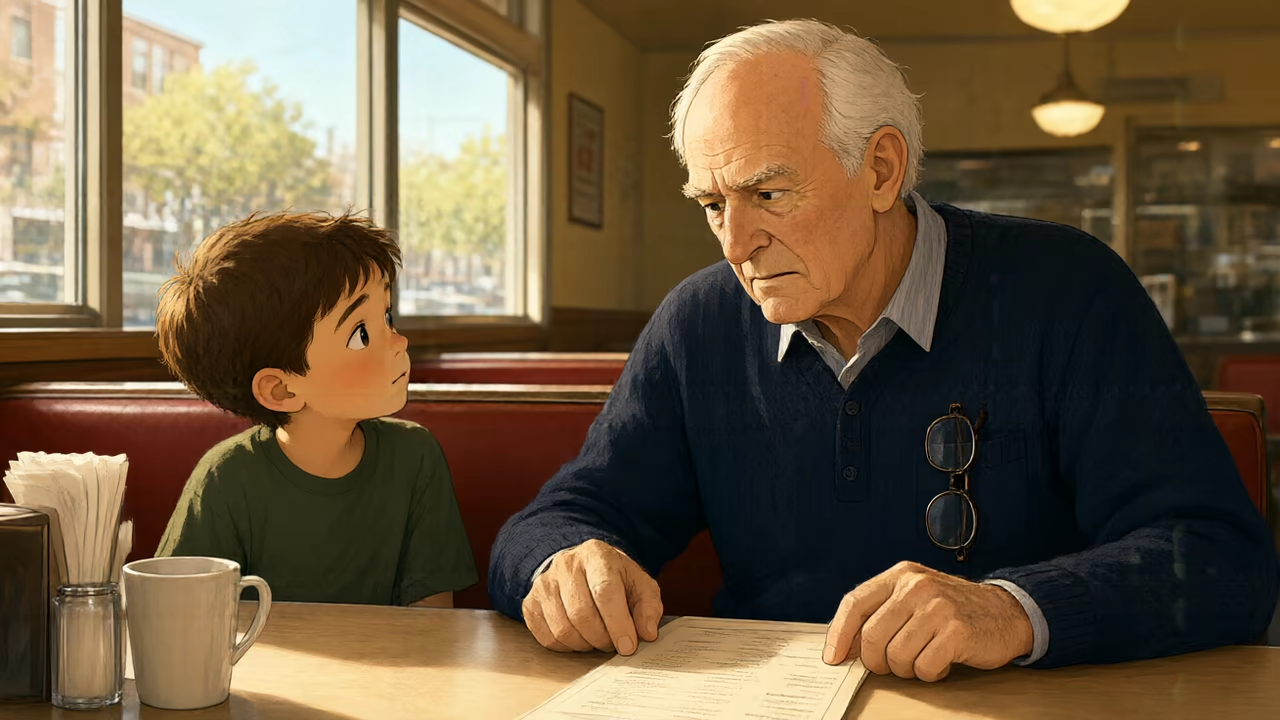
On Saturday we went to the Corner Diner for breakfast. The waiter pointed to a chalkboard on the wall. "Today's specials are up there," she said. Grandpa patted the front of his shirt and shook his head. "Would you look at that. I left my glasses at home," he said. "Theo, read me the specials, will you?" So I did. He ordered the second one, pancakes with blueberries, and winked at me.[1]
Glasses, again
On Monday, Grandpa and I went to the hardware store to buy paint for the fence. He picked up a can, turned it around and handed it to me. "My glasses are at home," he said. "What does the label say about drying time?" I read it out loud: dry to the touch in one hour, second coat after four.
That afternoon, a letter came for him. Mom had forwarded it from his apartment. Grandpa held the envelope for a long time. Then he slid it across the table. "My eyes are tired today, Theo. Read me the important part."
That was when I noticed something. Poking out of his shirt pocket was a brown glasses case. I could see the gold edge of the glasses inside. They had been there the whole time.[1]
Adding up the clues
That night I lay in bed and thought about it. Ms. Rivera, my teacher, says that authors and people do not always tell you everything. Sometimes you have to read between the lines. She taught us a trick: It says, I say, and so. First you write what you notice. Then you add what you already know. Then you decide what it probably means.
It says: Grandpa had his glasses with him, but he still asked me to read. I say: people who need glasses put them on when they want to read. And so: maybe the problem was not the glasses at all.
I thought about other things I had seen. Grandpa built a whole bookshelf in our garage, but he looked only at the pictures in the instructions and never at the words. He could read every number on a tape measure. He never touched the crossword in the newspaper, even though Mom always left it out for him. My idea was getting stronger. I thought reading might be hard for Grandpa, and he did not want anyone to know.[1]
Checking my idea
I did not say anything at breakfast. Mom was there, and I had a feeling Grandpa would not want to talk about it in front of anybody. Instead, after school on Wednesday, I asked him to walk with me to the library to return my books.
At the library door, Grandpa stopped. "I'll wait out here," he said, looking at the bench. I sat down beside him. "Grandpa," I said quietly, "your glasses are in your pocket."
He was quiet for a long moment. Then he took out the brown case and turned it over in his hands. "When I was twelve, my father got sick," he said. "I left school to work on our farm. I never went back. I can read numbers fine, and short words, but long sentences just jumble up on me. Forgetting my glasses is an old trick. I've been using it for sixty years."
So I was right. But being right did not feel like winning a game. It felt like Grandpa had handed me something important to carry carefully.[1]
Page one
"I could help you," I said. "If you want." Grandpa looked at me the way he looks at a broken hinge, like he was figuring out whether it could be fixed. Then he nodded. "Pick a book about engines," he said. "No bunny stories."
Every night after that, we sat at the kitchen table with a book about how engines work. I pointed to each word, and Grandpa sounded it out, slowly. Some nights he got frustrated and pushed the book away. The next night he always pulled it back.
On Grandpa's last morning, we went back to the Corner Diner. The waiter pointed at the chalkboard. Grandpa squinted at it for a long time. "Pancakes," he read, "with … blue … berries." Then he grinned at me and tapped his shirt pocket, where the brown case sat, closed. "Turns out I didn't need these after all," he said.[1]
Fast lesson
Use these checks before you answer the practice questions.
Before reading, do one aloud from daily life: It says the driveway is wet; I say rain makes things wet; and so it probably rained. Then use the same three boxes for Grandpa's glasses.
Stop after 'Adding up the clues' and ask your child for their inference and their evidence. Read on and check it together. If it changes, that is good reading, not a mistake.
Ask why Theo waited until they were alone. Many adults find reading hard for many reasons, and learning is possible at any age; keep the focus on respect, not on the reading difficulty itself.
Common mistakes
Why this fails: Grandpa says he forgot his glasses, but the glasses case in his pocket shows there is more to it.
Why this fails: Every inference needs a clue from the text. 'Grandpa is lazy' has no support in the story.
Why this fails: Theo collects several clues before he is fairly sure, and he still checks his idea by talking to Grandpa.
Word Lab
Use the meaning, hear the word, then try it in your own sentence.
inference
nounan idea you work out from clues and what you already know, when the text does not say it directly
My inference was that reading was hard for Grandpa.
clue
nouna small piece of information that helps you work something out
The glasses case in his pocket was a clue.
evidence
nounfacts or details that show something is true
Theo used evidence from what he saw to support his idea.
specials
noundishes a restaurant offers only on a certain day
The specials were written on a chalkboard.
label
nouna piece of paper or printing on a product that gives information about it
The paint can label gave the drying time.
forward
verbto send mail or a message on to a new address
Mom forwarded Grandpa's letter from his apartment.
read between the lines
idiomto understand something that is meant but not said directly
Ms. Rivera taught us to read between the lines.
jumble
verbto mix up so things are hard to sort out
Long sentences jumble up for Grandpa.
sound out
phrasal verbto say the sounds of a word's letters one by one to read it
Grandpa sounded out each word slowly.
frustrated
adjectiveupset because something is hard or not working
Some nights Grandpa got frustrated and pushed the book away.
squint
verbto look with your eyes partly closed to see better
Grandpa squinted at the chalkboard.
trick
nouna clever way of doing something, sometimes to hide the truth
Forgetting his glasses was an old trick.
Check your understanding
Choose an answer, explain your choice, and then check. Hints and retries are welcome.
Try the questions here. Public practice does not save a learning record.
Support · Find it in the text
Support · Find it in the text practice
Each answer is stated in the story. Point to the sentence.
1. What three things did Grandpa bring when he arrived?
2. What did Theo read for Grandpa at the hardware store?
3. What were the three parts of Ms. Rivera's trick?
4. How old was Grandpa when he left school?
5. What kind of book did Grandpa ask for?
6. What did Grandpa read by himself on his last morning?
Apply · Clue + what I know
Apply · Clue + what I know practice
Name the clue from the story and the idea it supports.
7. Why did the glasses case in Grandpa's pocket surprise Theo?
8. Grandpa held the letter 'for a long time' before passing it to Theo. What might he have been feeling?
9. Why do you think Grandpa never touched the crossword?
10. Why did Theo say being right 'did not feel like winning a game'?
11. Grandpa looks at Theo 'the way he looks at a broken hinge'. What is he thinking about?
12. How do you know Grandpa did not give up, even when reading was hard?
Reason · Build and check inferences
Reason · Build and check inferences practice
Use It says, I say, and so, then test your idea.
13. Complete: It says Grandpa waited on the bench outside the library. I say people avoid places that make them uncomfortable. And so …
14. Someone infers that Grandpa cannot see well. Which clue argues against this?
15. Put in order: Theo sees the glasses case; Grandpa reads the specials; Theo reads the paint label; Grandpa explains about the farm.
16. How is the diner scene at the end different from the diner scene at the start?
17. Write the story's message in one sentence of your own.
Practice answer key
- 1. One suitcase, a red toolbox and a tin of peppermints.
This is in 'Grandpa comes to stay'. - 2. The label on a paint can, about drying time.
See 'Glasses, again'. - 3. It says, I say, and so.
See 'Adding up the clues'. - 4. Twelve.
Grandpa says this in 'Checking my idea'. - 5. A book about engines (no bunny stories).
See 'Page one'. - 6. The pancakes special on the diner chalkboard: pancakes with blueberries.
This is at the end of 'Page one'. - 7. Because Grandpa kept saying his glasses were at home, but they had been with him the whole time.
The clue contradicts what Grandpa said. - 8. He may have been worried or embarrassed, or trying to read it and finding it hard.
A long pause is a clue to feelings; answers can vary if supported. - 9. Crosswords need a lot of reading and spelling, which is hard for him.
Join the clue with what you know about crosswords. - 10. Because the answer was a private, serious thing about Grandpa, so Theo felt responsible for being careful, not proud.
See the end of 'Checking my idea'. - 11. Whether his reading problem could be fixed, and whether to accept Theo's help.
The author compares the moment to fixing something. - 12. Some nights he pushed the book away, but the next night he always pulled it back.
See the middle of 'Page one'. - 13. And so the library may make Grandpa uncomfortable because it is full of reading.
This clue supports Theo's growing inference. - 14. He reads every number on a tape measure and builds a bookshelf from pictures, so his eyesight seems fine.
A good inference fits all the clues, not just one. - 15. Theo reads the paint label → Theo sees the glasses case → Grandpa explains about the farm → Grandpa reads the specials.
Follow the days: Monday, then Wednesday, then the last morning. - 16. At the start, Grandpa asks Theo to read the specials. At the end, he reads them himself, slowly.
The repeated setting shows how Grandpa has changed. - 17. Answers will vary, such as: It is never too late to learn, and good helpers are kind and patient.
A theme is a lesson about life, not a summary of events.
Related skills
Put it in your own words
This draft is not saved when you leave or refresh the page.
Check your own explanation
This is self-review, not automatic marking.
Compare with a model response
Theo inferred that reading was hard for Grandpa and that he was using his glasses as an excuse. It says Grandpa asked Theo to read the specials, a paint label and a letter, but his glasses case was in his shirt pocket the whole time. I say that people who need glasses put them on when they want to read, and so the problem was probably not the glasses. Other clues made the inference stronger: Grandpa used only the pictures in the bookshelf instructions and never touched the crossword. Theo checked his idea privately by mentioning the glasses outside the library, and Grandpa explained that he left school at twelve and that long sentences jumble up on him. After that, they read a book about engines every night. On the last morning, Grandpa squinted at the chalkboard and read the special by himself, with his glasses still in his pocket.
Sources and revision notes
Source check: 2026-10-30. Grade guidance is an editorial suggestion, not a standardised reading score.
What changed in this edition?
Original fiction. All characters, the diner, the hardware store and the library visit are invented. The source supports the inference strategy (joining text clues with background knowledge, supporting inferences with evidence and checking or revising them, and the 'It says, I say, and so' organizer credited to Kylene Beers), not the story's events. The story is not about any real person.