Daily Read / Short Story
Short Story · Compare two characters' points of view, identify a conflict between characters, and explain how a compromise solves the problem
Short Story: Two Ideas, One Poster
An original story: Mateo wants big drawings, Grace wants facts. Their recycling poster splits down the middle until a Grade 1 reader shows them what is missing.
Device/browser voice. Pronunciation and availability vary.
Partners
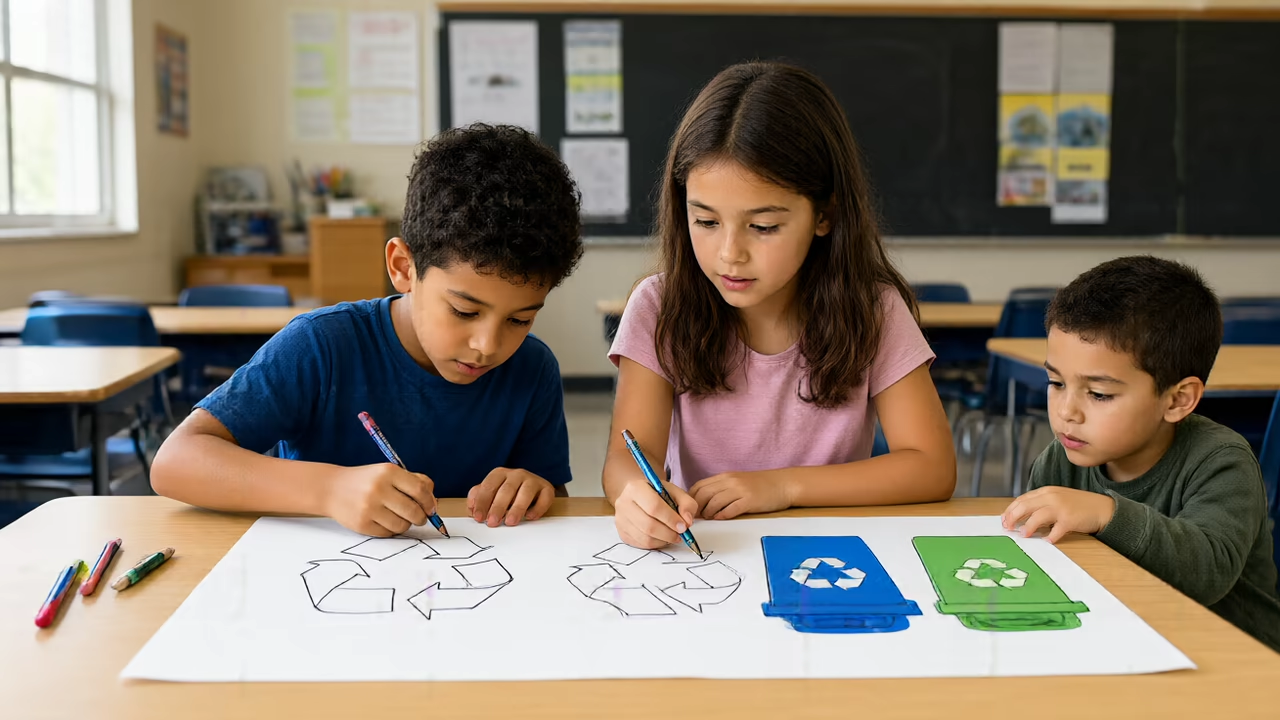
This is an original short story. The characters and events are invented. When Ms. Lavoie read out the poster partners, Mateo and Grace looked at each other across the classroom and did not smile. Their job was to make a poster for the hallway outside the kindergarten and Grade 1 rooms. It had to teach younger students which bin to use: blue for recycling, green for food scraps, black for garbage.
Mateo already had a plan. "Giant drawings," he said, before Grace had even sat down. "A banana peel as big as my head. Little kids love pictures." Grace already had a plan too. She opened her notebook to a page of numbers she had copied from the school's waste report. "We need facts," she said. "A chart. Then people will understand why it matters."[1]
The pencil line
They argued for most of Monday. Mateo said a chart was boring. Grace said a poster with only drawings was just colouring. By Tuesday, neither of them would give in, so Grace took a ruler and drew a pencil line straight down the middle of the chart paper. "Your half," she said, pointing left. "My half."
Mateo drew a banana peel, an apple core and a pizza box, each one huge and bright. Grace drew a neat bar chart with three bars and a title in careful printing, and under it she wrote a paragraph about how much garbage the school made in a week. When they stepped back, it looked like two posters that had been glued together by mistake.[1]
The test
Ms. Lavoie did not say the poster was good or bad. She asked one question: "Who is it for?" Then she suggested they try it on a real reader. At lunch, Grace's little brother Theo, who was in Grade 1, came to look. He went straight to the banana peel. "Cool!" he said. He did not even glance at the chart.
"So where does a banana peel go?" Grace asked him. Theo looked at the picture again. He looked at the three coloured bars. He shrugged. "In the garbage?" Mateo opened his mouth to say no, then closed it. The drawing had caught Theo's eye, but it had not told him anything. And the chart had told him a lot, but he had never looked at it.[1]
Erasing the line
Back in the classroom, Mateo was quiet for a while. Then he said, "My pictures get them to look." Grace nodded slowly. "And my facts tell them what to do. But only if they're short." She crossed out most of her paragraph. Little kids, she realized, would not read it, and they did not need to know the weekly total. They needed to know which bin.
They erased the pencil line. Mateo drew a coloured bin under each of his big pictures: green under the banana peel and the apple core, blue under the clean pizza box. Grace wrote one short line beside each one, in letters big enough to read from the doorway: "Peels go in GREEN." "Clean boxes go in BLUE." She kept her chart, smaller now, in the bottom corner for the older students who walked by.[1]
Theo again
On Friday, they hung the poster outside the Grade 1 room and waited for Theo at lunch. He stopped in front of it with an apple core in his hand. He looked at the apple, looked at the green bin, and dropped the core into the green bin by the door without saying a word.
Grace and Mateo looked at each other. This time, they both smiled. When Ms. Lavoie asked them to sign the poster, they did not each sign their own half. There were no halves anymore. They wrote their names side by side, right in the middle.[1]
Fast lesson
Use these checks before you answer the practice questions.
Make a T-chart: Mateo | Grace. Under each, write what they want, why, and what they give up. The chart shows the compromise clearly.
Compare with 'The Cracked Birdfeeder', where the conflict is inside one character. Here the conflict is between two characters. Ask your child which kind of conflict is harder to solve alone.
Connect the story to your child's own work: before finishing a poster or a piece of writing, who could be the 'Theo' who tries it out?
Common mistakes
Why this fails: Both characters keep part of their idea and give up part. The poster works because of the combination.
Why this fails: It ends the arguing, but the test shows the poster still does not teach younger students.
Why this fails: A theme is a general lesson. If the answer needs the characters' names, it is probably a summary.
Word Lab
Use the meaning, hear the word, then try it in your own sentence.
partner
nouna person you work with on a task
Mateo and Grace were poster partners.
argue
verbto disagree with someone and give reasons, sometimes angrily
They argued for most of Monday.
give in
phrasal verbto stop arguing and let the other person have their way
Neither of them would give in.
glance
verbto look at something quickly
Theo did not even glance at the chart.
shrug
verbto lift your shoulders to show you do not know or do not care
Theo shrugged when Grace asked him.
realize
verbto suddenly understand something
Grace realized that little kids would not read her paragraph.
point of view
noun phrasewhat a character thinks and wants, and the way they see a situation
From Mateo's point of view, pictures matter most.
conflict
nounthe problem or struggle in a story
The conflict is between Mateo and Grace.
compromise
nouna solution where each person gives up part of what they wanted so they can agree
Pictures with short labels were a good compromise.
turning point
noun phrasethe moment in a story when things begin to change
Theo's shrug is the turning point.
audience
nounthe people who will read, watch or listen to something
The poster's audience is young children.
Check your understanding
Choose an answer, explain your choice, and then check. Hints and retries are welcome.
Try the questions here. Public practice does not save a learning record.
Support · Find it in the story
Support · Find it in the story practice
Point to the sentence that gives the answer.
1. Who was the poster for?
2. Which bin colour was for food scraps?
3. What three things did Mateo draw?
4. What question did Ms. Lavoie ask?
5. What did Theo guess when asked where a banana peel goes?
6. Where did Grace and Mateo sign the poster?
Apply · Read the clues
Apply · Read the clues practice
Use clues from the story to explain what the characters think and feel.
7. At the start, Mateo and Grace 'did not smile'. What does this clue suggest?
8. Why does Grace think the poster needs facts?
9. Mateo 'opened his mouth to say no, then closed it.' What did he realize?
10. Why is it important that Ms. Lavoie does not tell them whether the poster is good or bad?
11. What does each partner give up in the compromise?
12. Why does the story say 'There were no halves anymore'?
Reason · Map the story
Reason · Map the story practice
Use a story map: characters, setting, problem, attempts and solution.
13. Fill in a story map: characters, setting, problem and solution.
14. Put in order: Theo uses the green bin; the pencil line is drawn; Theo shrugs; the line is erased; Ms. Lavoie asks who the poster is for.
15. Compare Mateo's and Grace's points of view at the start. How were they each partly right?
16. Was splitting the poster in half a real solution? Explain.
17. State the theme in one sentence without using the names Mateo, Grace or Theo.
Practice answer key
- 1. Younger students in kindergarten and Grade 1.
The first section says it would hang outside their rooms. - 2. Green.
The first paragraph lists blue, green and black bins. - 3. A banana peel, an apple core and a pizza box.
They are in 'The pencil line'. - 4. "Who is it for?"
It opens 'The test'. - 5. In the garbage.
His wrong guess shows the poster was not teaching him. - 6. Side by side, right in the middle.
It is the last sentence of the story. - 7. They were not happy to be partners, maybe because they expected to disagree.
The author shows feelings through actions instead of naming them. - 8. She thinks people will understand why sorting matters if they see the numbers.
She says, 'Then people will understand why it matters.' - 9. That his drawing had caught Theo's eye but had not taught him which bin to use.
The next sentence explains what both partners noticed. - 10. They discover the problem themselves by testing it on a real reader, so they understand it and want to fix it.
Her question points them to the audience instead of giving the answer. - 11. Grace gives up most of her paragraph and makes her chart smaller; Mateo gives up having pictures with no words.
In a compromise, each side gives up part of what they wanted. - 12. Because the poster, and the partners, now work as one team instead of two separate sides.
The line has a literal meaning (no pencil line) and a bigger meaning (they are working together). - 13. Characters: Mateo, Grace, Ms. Lavoie, Theo. Setting: a school classroom and hallway over one week. Problem: the partners disagree about pictures or facts. Solution: big pictures, each with a coloured bin and a short instruction.
A story map shows how the parts of a story connect. - 14. The pencil line is drawn → Ms. Lavoie asks who the poster is for → Theo shrugs → the line is erased → Theo uses the green bin.
The question leads to the test, and the test leads to the change. - 15. Mateo was right that pictures get young children to look. Grace was right that the poster needed words that teach. Each idea alone failed.
Strong answers name what each character got right, not just who won. - 16. No. It stopped the argument but did not solve the problem, because the poster still did not teach Theo which bin to use.
Ending an argument is not the same as solving the problem. - 17. Example: Two different ideas can work better together, especially when you test them with the people they are for.
A theme without names can apply to anyone.
Related skills
Put it in your own words
This draft is not saved when you leave or refresh the page.
Check your own explanation
This is self-review, not automatic marking.
Compare with a model response
At the start, Mateo thinks the poster needs giant drawings because little kids love pictures, while Grace thinks it needs facts and a chart so people understand why sorting matters. Neither will give in, so they split the poster with a pencil line. The turning point comes when Grace's little brother Theo looks only at the banana peel and still guesses it goes in the garbage. Both partners realize that the pictures caught his eye but did not teach him anything, and the chart taught a lot but he never read it. Grace gives up most of her paragraph and shrinks her chart, and Mateo adds coloured bins and short labels to his pictures. The final poster works because Theo puts his apple core in the green bin without help. The theme is that combining different strengths, and testing them with your audience, can create something better than either idea alone.
Sources and revision notes
Source check: 2026-10-26. Grade guidance is an editorial suggestion, not a standardised reading score.
What changed in this edition?
Original fiction. All characters, places, the school waste report and events are invented. The bin colours are an example and differ between municipalities. The source supports the story-map strategy used in the practice, not the story's events.