Daily Read / Chemical reactions
Chemical reactions · Explain a cause-and-effect chain (snap → mix → react → energy → dye → light) and interpret a fair-test comparison of warm and cold glow sticks
How Does a Glow Stick Glow? The Chemistry of Cold Light
Snap, shake, glow! Follow the chemical chain inside a glow stick, then use a fair test to explain why warm sticks shine brighter but cold ones last longer.
Device/browser voice. Pronunciation and availability vary.
Snap, shake, glow
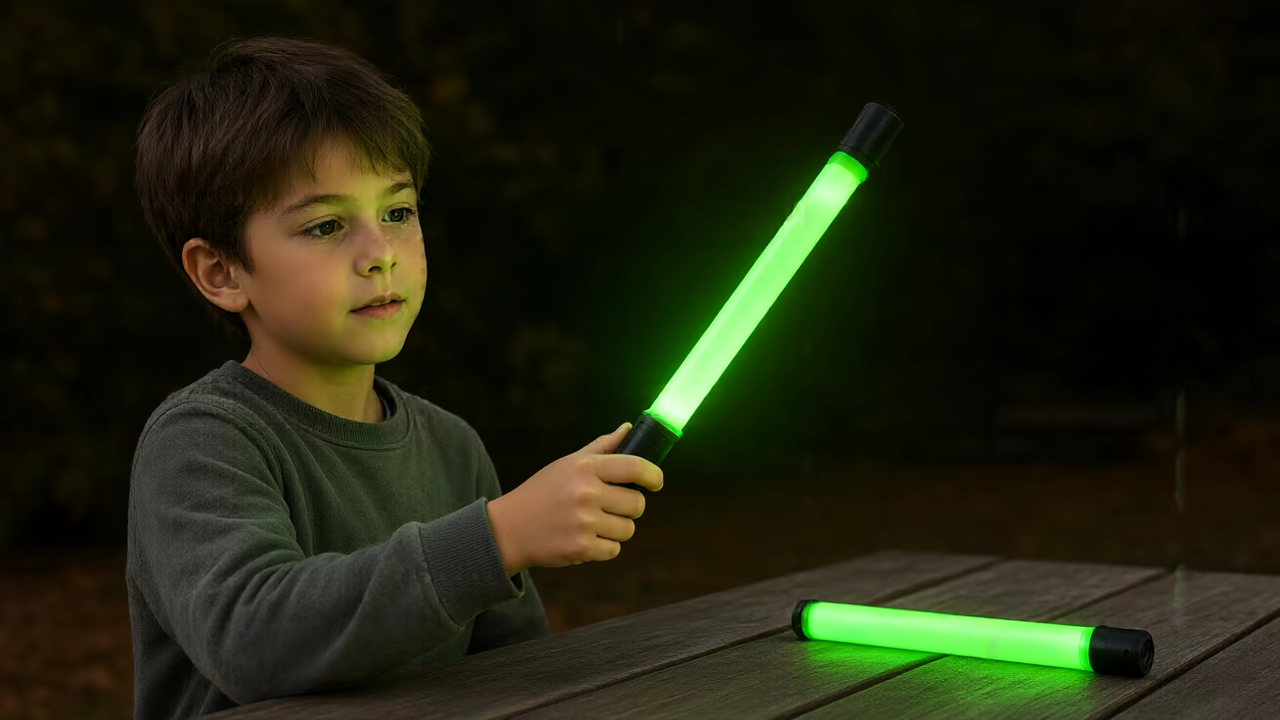
On Halloween night, a glow stick can help you see the sidewalk and help drivers see you. Before you snap it, the stick is dark. After one bend and a shake, it glows green, pink or blue. There is no battery and no wire. So where does the light come from?
The answer is a chain of causes and effects. Andy Brunning, a chemistry writer for the website Compound Interest, explains that a glow stick holds two liquids that are kept apart until you snap it. The light comes from a chemical reaction between them. Light made by a chemical reaction is called chemiluminescence.[1]
What is inside the tube
A glow stick is a tube inside a tube. The outer tube is soft plastic. Floating inside it is a thin glass vial. Classroom notes from MIT OpenCourseWare, a free learning website from the Massachusetts Institute of Technology, say the chemical in the inner glass vial is hydrogen peroxide.
The liquid around the vial is different. The MIT notes say it is a phenyl oxalate ester mixed with a fluorescent dye. An ester is one kind of chemical, and a dye is a substance that gives off or adds colour. As long as the glass is whole, the two liquids cannot touch, so nothing happens.[2]
The chain, one link at a time
Bending the stick breaks the glass vial. Brunning writes that snapping the glow stick breaks the glass cylinder, so the hydrogen peroxide mixes with the other solution. Shaking helps the two liquids mix all through the tube.
Once they mix, the hydrogen peroxide reacts with the oxalate. Brunning explains that the reaction makes a short-lived chemical that quickly breaks apart into carbon dioxide and gives off energy. That energy does not leave as light by itself. It passes to the dye.
The dye is the part you see. The MIT notes say the energy is transferred to the dye molecule, which gets excited and turns that energy into light. Brunning adds that the dye is not used up, and that its structure decides the colour. That is why a green stick and a pink stick use different dyes.[1]
Light without heat
A candle flame makes light, but it also makes a lot of heat. A glow stick is different. The MIT notes say the reaction gives off its energy in the form of light without heat. People sometimes call this kind of glow cold light.
Fireflies glow in a similar way. The Kansas State University Physics Education Research Group, which wrote a classroom activity about light sticks and fireflies, says fireflies do not use fire or heat to make light. They make it by chemiluminescence too, with a chemical reaction inside their bodies. That is why the activity uses a light stick as a model of a firefly.[2]
Why a glow stick goes dark
A glow stick does not glow forever. Brunning explains that the dye stays in the liquid, but the hydrogen peroxide and the oxalate are slowly used up by the reaction. When one of them runs out, the reaction stops, and so does the light.
This gives us one more link in the chain. The faster the chemicals react, the faster they are used up. Keep that idea in mind for the next section.[1]
A fair test: warm, cold or room temperature
How does temperature change a glow stick? A chemistry demonstration sheet from Purdue University's chemistry education website describes putting lightsticks in different temperatures and comparing them. A comparison like this is a fair test when only one thing changes. Here, the one thing that changes is the temperature. Everything else stays the same: the same kind and colour of stick, snapped at the same time, and looked at in the same dark room.
The Purdue sheet reports the results. The heated lightstick is very bright but burns out quickly. The stick in the ice water bath gives the faintest glow, but stays lit the longest. A stick at room temperature falls in between.
Now join the links. Brunning says warmer temperatures speed up the reaction and cooler temperatures slow it down. A faster reaction gives off energy faster, so the warm stick is brighter. But the faster reaction also uses up its chemicals sooner, so the light ends sooner. That is why Brunning suggests putting glow sticks in the freezer to make them last longer.[3]
Using glow sticks safely
Glow sticks are sealed for a reason. Brunning notes that the reaction can make a small amount of a chemical called phenol, that the liquid can bother your skin, and that glow-stick packages often say not to cut them open. The MIT notes warn never to try to open a glow stick with your mouth and say the dyes should not be swallowed.
Our own advice, not from the sources: do glow-stick experiments with an adult, use warm tap water rather than boiling water, and throw away a stick that is cracked or leaking.[1]
Explore the instructional diagram
Fast lesson
Use these checks before you answer the practice questions.
Ask your child to say the chain out loud while pointing to each part of the diagram: snap, mix, react, energy, dye, light. If a link is missing, ask, "What has to happen before that?"
The temperature result is a trade-off: warm gives brighter but shorter, cold gives dimmer but longer. Ask your child to explain both halves with one reason, the speed of the reaction.
Before talking about which stick won, ask what was kept the same. A comparison is only useful when one thing changes.
Do not cut, bite or open glow sticks. Use warm tap water, not boiling water, for any comparison, and throw away a cracked or leaking stick.
Common mistakes
Why this fails: The light comes from a chemical reaction; the MIT notes say the energy comes out as light without heat.
Why this fails: A warm stick is brighter because its reaction is faster, but that also uses up the chemicals sooner, so it goes dark first.
Why this fails: If two things change, you cannot tell which one caused the difference. Change only the temperature.
Word Lab
Use the meaning, hear the word, then try it in your own sentence.
chemiluminescence
nounlight made by a chemical reaction
A glow stick makes light by chemiluminescence.
chemical reaction
noun phrasea change in which substances combine or break apart to make new substances
The chemical reaction starts when the two liquids mix.
vial
nouna small, thin container for a liquid
Bending the stick breaks the glass vial.
hydrogen peroxide
nouna clear liquid chemical; in a glow stick it is kept inside the glass vial
The hydrogen peroxide mixes with the outer liquid.
dye
nouna substance that gives colour; in a glow stick it gives off coloured light
A green stick and a pink stick use different dyes.
fluorescent
adjectiveable to give off light after taking in energy
The fluorescent dye turns the energy into light.
energy
nounthe ability to make something happen, such as making light, heat or movement
The reaction gives off energy, and the dye takes it in.
transfer
verbto move or pass something from one place or thing to another
The energy is transferred to the dye.
faint
adjectiveweak and hard to see or hear
The cold stick gave the faintest glow.
fair test
noun phrasean experiment where only one thing is changed and everything else is kept the same
In our fair test, only the temperature changed.
variable
nounsomething in an experiment that can change or be changed
Temperature is the variable we changed.
firefly
nouna beetle that makes light with a chemical reaction in its body
A firefly glows without fire or heat.
Check your understanding
Choose an answer, explain your choice, and then check. Hints and retries are welcome.
Try the questions here. Public practice does not save a learning record.
Support · Find it in the text
Support · Find it in the text practice
Each answer is stated in the article. Point to the sentence.
1. Which chemical is inside the thin glass vial?
2. What two things are in the liquid around the vial?
3. What gas does the short-lived chemical break apart into?
4. What decides the colour of a glow stick?
5. Where does Brunning suggest keeping glow sticks to make them last longer?
6. What should you never use to try to open a glow stick, according to the MIT notes?
Apply · Cause and effect
Apply · Cause and effect practice
Use 'because' or 'so' and a detail from the article.
7. Why does an unsnapped glow stick stay dark?
8. Why do people shake a glow stick after snapping it?
9. Why can a green stick and a pink stick use the same reaction but glow different colours?
10. Why does a glow stick eventually go dark?
11. Why is a warm glow stick brighter than a cold one?
12. Why should you not cut a glow stick open?
Reason · Chains and fair tests
Reason · Chains and fair tests practice
Finish chains, plan fair tests and test claims against the evidence.
13. Complete the chain: liquids mix → reaction gives off energy → ? → light.
14. In a glow-stick temperature test, name the one thing you change and two things you keep the same.
15. Three sticks were tested: warm water, room temperature and ice water. Put them in order from brightest to faintest.
16. You want a glow stick to last through a long camping night, and you don't need it very bright. Should you keep it warm in your pocket or let it stay cool? Why?
17. How are a glow stick and a firefly alike, and how are they different?
Practice answer key
- 1. Hydrogen peroxide.
See 'What is inside the tube'. - 2. A phenyl oxalate ester and a fluorescent dye.
See the second paragraph of 'What is inside the tube'. - 3. Carbon dioxide.
See 'The chain, one link at a time'. - 4. The structure of the dye.
Brunning says the dye's structure decides the colour. - 5. In the freezer.
See the last paragraph of the fair-test section. - 6. Your mouth.
See 'Using glow sticks safely'. - 7. Because the glass vial keeps the hydrogen peroxide apart from the other liquid, so they cannot react.
No mixing means no reaction and no light. - 8. So the two liquids mix all through the tube and the whole stick can glow.
See 'The chain, one link at a time'. - 9. Because they use different dyes, and the dye's structure decides the colour of the light.
The reaction gives energy; the dye turns it into a colour. - 10. Because the hydrogen peroxide and oxalate are used up, and when one runs out the reaction stops.
See 'Why a glow stick goes dark'. - 11. Because warmth speeds up the reaction, so energy is given off faster and the dye makes more light at once.
This is the first half of the temperature chain. - 12. Because the liquid can bother your skin and the reaction can make a small amount of phenol; the packages often say not to cut them.
See 'Using glow sticks safely'. - 13. The energy passes to the dye.
The dye is the link between the reaction and the light. - 14. Change: the temperature. Keep the same: for example, the kind and colour of stick and the time you snap them (also the room where you look).
Any two controlled conditions are acceptable. - 15. Warm water, room temperature, ice water.
Purdue reports the heated stick is brightest and the ice-water stick faintest. - 16. Let it stay cool, because a cooler reaction is slower and uses up the chemicals more slowly, so it lasts longer.
Trade brightness for time. - 17. Alike: both make light by chemiluminescence, without heat. Different: a firefly's reaction happens inside a living body, while a glow stick's reaction happens in a sealed plastic tube.
Name one likeness and one difference.
Related skills
Put it in your own words
This draft is not saved when you leave or refresh the page.
Check your own explanation
This is self-review, not automatic marking.
Compare with a model response
A glow stick has a thin glass vial of hydrogen peroxide floating in a liquid made of an oxalate ester and a fluorescent dye. When you bend the stick, the vial breaks, so the two liquids mix. As a result, they react and give off energy. The energy passes to the dye, and the dye turns it into light, which is why the stick glows. To test temperature fairly, I would snap two of the same sticks at the same time and put one in warm water and one in ice water. The warm stick would be brighter, because warmth makes the reaction faster. However, the cold stick would last longer, because a slower reaction uses up the chemicals more slowly.
Sources and revision notes
Source check: 2026-10-31. Grade guidance is an editorial suggestion, not a standardised reading score.
- Compound Interest — The Chemistry of Glow Stick Colours (Andy Brunning)
- MIT OpenCourseWare — Chemistry Behind the Magic: Chemiluminescence (What's inside of a light stick anyway?)
- Purdue University chemical education demonstration sheet — 5.8 Chemiluminescence: The Cyalume Lightstick
- Kansas State University Physics Education Research Group — Visual Quantum Mechanics, Activity 8: Using Light Sticks to Predict the Effects of Changing Temperature on the Light Emitted by Fireflies
What changed in this edition?
The two separated solutions, the term chemiluminescence, snapping breaking the glass cylinder so the hydrogen peroxide mixes with the other solution, the reaction producing an unstable compound that breaks down into carbon dioxide and releases energy, the dye not being used up and its structure deciding the colour, the glow ending when the hydrogen peroxide or the oxalate runs out, warmer temperatures speeding the reaction and cooler ones slowing it, the freezer tip, the possible small amount of phenol, skin effects and packaging advice not to cut glow sticks open come from Andy Brunning's Compound Interest article. Hydrogen peroxide in the inner glass vial, a phenyl oxalate ester plus a fluorescent dye in the outer tube, energy transferred to the dye molecule which converts it into light, light without heat, the warning never to open a glow stick with your mouth and the advice that the dyes should not be swallowed come from the MIT OpenCourseWare classroom notes. The heated lightstick being very bright but burning out quickly, and the ice-water stick giving the faintest glow but staying lit the longest, come from the Purdue University demonstration sheet. Fireflies not using fire or heat and making light by chemiluminescence, and the light stick used as a model of a firefly, come from the Kansas State University activity. The Halloween sidewalk opening, the candle comparison, the phrase cold light, the description of the room-temperature stick as in between, the fair-test framing (same stick, same start time, same dark room), the reasoning that a faster reaction uses up its chemicals sooner, the student names Maya and Sam, and the adult-supervision, warm-tap-water and discard-cracked-sticks advice are this lesson's own illustrations and general safety advice, not claims from the sources. The diagram is a simplified schematic, not to scale.