Daily Read / Forces and simple machines
Forces and simple machines · Explain how a fixed pulley changes the direction of a pull, how a movable pulley shares the load between two rope sections, and why less force means pulling more rope
How Does a Pulley Work? Fixed, Movable and the Rope Trade-Off
A flagpole, window blinds and a crane all use pulleys. Compare fixed and movable pulleys, then explain why a smaller pull means pulling more rope.
Device/browser voice. Pronunciation and availability vary.
Why pull down to send a flag up?
On a windy morning at school, someone pulls down on a rope beside the flagpole, and the flag climbs up to the top. Their hands move toward the ground, but the flag moves toward the sky. How can a pull in one direction move something the other way?
The answer is hiding at the top of the pole: a small wheel with the rope looped over it. Science North, a science centre that is an agency of the Government of Ontario, uses a model flagpole in one of its school activities. In the model, thread spools act as the pulleys, and pulling the string raises the paper flag.[4]
What is a pulley?
Britannica describes a pulley as a wheel that carries a flexible rope, cord, cable, chain or belt on its rim. Many pulleys have a groove around the edge so the rope stays in place instead of slipping off.
The pulley is one of the simple machines. Britannica lists it with the lever, the wedge, the wheel and axle, and the screw. Simple machines do not use engines or electricity. They help people by changing the direction of a force, the size of a force, or both. The Daily Read lesson on levers showed how a lever does this with a rigid bar. A pulley does it with a wheel and a rope.[3]
A fixed pulley changes the direction
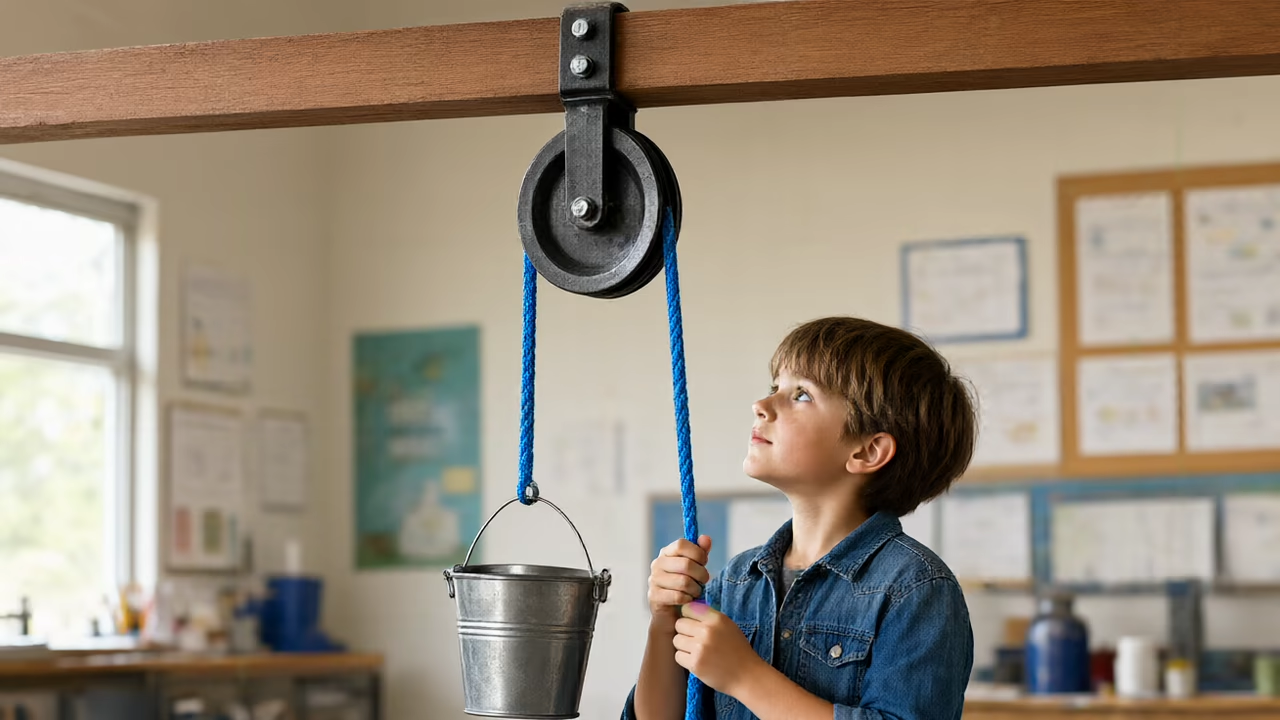
A fixed pulley is attached to one spot and stays there. The pulley at the top of a flagpole is a fixed pulley. So is the wheel above an old-fashioned well, where a bucket hangs on one end of the rope and a person pulls on the other end.
NDSU Extension, part of North Dakota State University, explains that with one fixed pulley the force you need is equal to the weight of the object. The Idaho National Laboratory puts it simply: a fixed pulley changes the direction of the pull, but it doesn't change the amount of force you use.
So why bother? Pulling down is often easier than lifting up. You can use your body weight, stand on the ground and keep the heavy thing away from you. A fixed pulley does not make the load feel lighter, but it lets you pull in a more comfortable direction.[1]
A movable pulley shares the load
A movable pulley is not fixed in place. It is attached to the load and moves up and down with it. One end of the rope is tied to something above, like a hook in a ceiling beam. The rope runs down, under the movable pulley, and back up to your hands.
Now the load is hanging from two sections of rope instead of one. The Idaho National Laboratory explains that because the pulley is supported by two ropes, the amount of force you need is cut in half. Each rope section holds part of the weight, so your hands only have to hold one share. Real pulleys are not perfect, so the pull is about half, not exactly half.[2]
The trade-off: less force, more rope
A movable pulley sounds like a free gift, but there is a cost. NDSU Extension says the trade-off is that the distance the rope must be pulled is increased. You apply a smaller force, but over a longer distance.
Here is why, with invented numbers. Suppose you want to lift a box of books 1 metre with a movable pulley. The box hangs from two rope sections. For the box to rise 1 metre, both rope sections must get 1 metre shorter. That means 2 metres of rope have to pass through your hands. You pull about half as hard, but you pull about twice as far.
This is the same deal you met with a lever: win on force, pay with distance. No simple machine gives you something for nothing.[1]
Many pulleys working together
People can put several pulleys together in one machine. Britannica calls a combination of pulleys, blocks and rope a block and tackle. The more rope sections that hold up the moving pulleys, the more the load is shared, so the pull you need gets smaller. The trade-off grows too: you must pull even more rope.
Pulleys have helped people for a very long time. Britannica says the Greek inventor Archimedes, who lived more than 2,000 years ago, is reported to have used compound pulleys to pull a ship onto dry land. The word reported matters: it is a story written down long ago, not something anyone measured.[3]
Pulleys you might see this week
NDSU Extension names flagpoles, window blinds and cranes as places where pulleys are used. When you tug the cord on some window blinds, a cord running over small pulleys lifts the slats. A construction crane uses steel cables over pulleys to lift heavy loads high above a building site. NDSU also explains that elevators use counterweights, which offset some of the force needed to lift the elevator car.
Science North links pulleys to the Ontario Grade 4 science curriculum, which asks students to describe the purposes of pulley systems. Next time you see a rope running over a wheel, ask two questions: Which way does the pull go, and which way does the load move? Does the pulley stay in one place, or does it move with the load?[1]
Explore the instructional diagram
Fast lesson
Use these checks before you answer the practice questions.
Before naming a pulley fixed or movable, ask: Does the pulley stay in one place or move with the load? Then ask: Which way do my hands pull, and which way does the load move?
Point to each section of rope that holds up the load. One section means the pull is about the load's weight. Two sections means about half. This counting habit will help later with more complex pulley systems.
When you try the home activity, mark the string with tape and measure how far it moves. Children often notice the easier pull but miss the longer pull until they measure it.
The lever lesson showed the same rule: less force, more distance. Ask your child to say the rule in their own words for both machines.
Common mistakes
Why this fails: A single fixed pulley only changes the direction; the pull is about the same as the load's weight.
Why this fails: The load's weight does not change. A movable pulley shares the weight between rope sections, so your hands hold only one share.
Why this fails: Less force always comes with a longer pull. With one movable pulley, you pull about twice as much rope as the distance the load rises.
Word Lab
Use the meaning, hear the word, then try it in your own sentence.
pulley
nouna wheel that carries a rope, cord, cable or chain on its rim to help lift or move a load
A pulley at the top of the flagpole lets us raise the flag.
fixed pulley
noun phrasea pulley attached to one place that does not move
A fixed pulley changes the direction of your pull.
movable pulley
noun phrasea pulley attached to the load that moves with it
With a movable pulley, two rope sections share the weight.
block and tackle
noun phrasea set of pulleys and rope used together to lift heavy loads
The sailors used a block and tackle to raise the heavy sail.
groove
nouna long, narrow cut or channel in a surface
The rope sits in the groove around the pulley wheel.
direction
nounthe way something moves or points
Pulling down on the rope changes the direction of the force, so the flag goes up.
force
nouna push or a pull
A movable pulley lets you lift the box with a smaller force.
load
nounthe object or weight a machine moves or lifts
The bucket of water is the load.
trade-off
noungiving up some of one thing to get more of another
The trade-off with a movable pulley is less force but more rope to pull.
counterweight
nouna weight that balances another weight
An elevator's counterweight offsets some of the force needed to lift the car.
crane
nouna tall machine that lifts and moves heavy things using cables and pulleys
A crane lifted steel beams to the top of the new building.
share
verbto divide something so each part takes some of it
Two rope sections share the weight of the load.
Check your understanding
Choose an answer, explain your choice, and then check. Hints and retries are welcome.
Try the questions here. Public practice does not save a learning record.
Support · Find it in the text
Support · Find it in the text practice
Each answer is stated in the article. Point to the sentence.
1. What can a pulley carry on its rim, according to Britannica?
2. In Science North's model flagpole, what acts as the pulleys?
3. Name two places the article says a fixed pulley is used.
4. How many rope sections hold up the load with a movable pulley?
5. What three places does NDSU Extension name as using pulleys?
6. What does Britannica call a combination of pulleys, blocks and rope?
Apply · Cause and effect
Apply · Cause and effect practice
Use because or so to connect a cause with its effect.
7. Why does the flag go up when you pull the rope down?
8. Why does a movable pulley need only about half the pull?
9. Why is the pull with a movable pulley 'about half' and not 'exactly half'?
10. Why must you pull more rope with a movable pulley?
11. Why might a person choose a fixed pulley even though it does not reduce the force?
12. What happens to the pull you need as more rope sections hold up the moving pulleys in a block and tackle?
Reason · Fixed, movable and trade-offs
Reason · Fixed, movable and trade-offs practice
Use what you learned to reason about new situations.
13. A pulley is screwed into a garage ceiling, and a bike hangs from a rope that runs over it. Fixed or movable?
- Fixed
- Movable
14. A pulley hooks onto a heavy bag and rises with it as the rope is pulled. Fixed or movable?
- Fixed
- Movable
15. Sam lifts a pail 1 metre with a fixed pulley. Kai lifts the same pail 1 metre with a movable pulley. Who pulls harder? Who pulls more rope?
16. How is a movable pulley like a lever with the load close to the fulcrum?
17. A classmate says, "With enough pulleys, you could lift a car with one finger and pull only a little rope." What is wrong with the second part?
Practice answer key
- 1. A flexible rope, cord, cable, chain or belt.
See 'What is a pulley?' - 2. Thread spools.
See 'Why pull down to send a flag up?' - 3. At the top of a flagpole and above an old-fashioned well.
See 'A fixed pulley changes the direction'. - 4. Two.
See 'A movable pulley shares the load'. - 5. Flagpoles, window blinds and cranes.
See 'Pulleys you might see this week'. - 6. A block and tackle.
See 'Many pulleys working together'. - 7. Because the rope goes over a fixed pulley at the top, so the pulley turns the downward pull into an upward pull on the flag.
A fixed pulley changes the direction of the force. - 8. Because the load hangs from two rope sections, so each section holds part of the weight and your hands hold only one share.
See 'A movable pulley shares the load'. - 9. Because real pulleys are not perfect, so a little extra pull is needed.
The article says real pulleys are not perfect. - 10. Because both rope sections holding the load have to get shorter, so the rope passing through your hands is about twice as long as the distance the load rises.
See the invented box-of-books example. - 11. Because pulling down is easier than lifting up, so they can use their body weight and stand away from the load.
See the last paragraph of 'A fixed pulley changes the direction'. - 12. The pull gets smaller because the load is shared by more sections, but you must pull even more rope.
See 'Many pulleys working together'. - 13. Fixed
The pulley stays attached to the ceiling and does not move with the bike. - 14. Movable
It moves with the load, so it is a movable pulley. - 15. Sam pulls harder (about the pail's weight). Kai pulls more rope (about 2 metres).
Fixed changes direction only; movable halves the pull but doubles the rope. - 16. Both let you use less force, but you must move your hands a longer distance.
Both simple machines trade force for distance. - 17. More pulleys mean less force but much more rope to pull, so you could not pull only a little rope.
The trade-off grows as you add pulleys.
Related skills
Put it in your own words
This draft is not saved when you leave or refresh the page.
Check your own explanation
This is self-review, not automatic marking.
Compare with a model response
A pulley is a wheel with a rope running over it. A fixed pulley stays in one place, like the one at the top of a flagpole. When I pull down, the flag goes up, so a fixed pulley changes the direction of my pull. However, it does not make the pull smaller, because the force I need is about the same as the load's weight. A movable pulley moves with the load. Because two rope sections hold the load, I only need about half the pull. As a result, lifting is easier, but I have to pull about twice as much rope. Cranes use many pulleys together to lift heavy steel beams.
Sources and revision notes
Source check: 2026-11-03. Grade guidance is an editorial suggestion, not a standardised reading score.
- NDSU Extension (North Dakota State University) — The Power of Pulleys (4-H STEM activity guide)
- Idaho National Laboratory — Create a Pulley System (STEM activity)
- Britannica — pulley
- Science North — Pushing and Pulling: Fly a Flag (pre-activity)
What changed in this edition?
The definitions of fixed and movable pulleys, the statement that with one fixed pulley the force equals the object's weight, the trade-off that the rope must be pulled a greater distance, the flagpole, window blind and crane examples, and elevator counterweights come from the NDSU Extension guide. The fixed pulley changing the direction but not the amount of force, the movable pulley supported by two ropes cutting the force in half, and the well example come from the Idaho National Laboratory activity. The definition of a pulley as a wheel carrying a rope, cord, cable, chain or belt, grooved pulleys, the list of simple machines, the block and tackle definition, and the report that Archimedes used compound pulleys to pull a ship onto dry land come from Britannica. The model flagpole with thread spools, Science North's status as an Ontario government agency and the Grade 4 expectation to describe the purposes of pulley systems come from the Science North activity. The school-flagpole scene, the box-of-books and pail examples with their distances, the 'about half' note on real pulleys, the invented newton test, the spool home activity and the window-blind description are original illustrations or reasoning. Report errors through Sources and corrections.