Daily Read / History and community
History and community · Explain a chain of causes and effects (why the canal was built) and follow a process in order (how a lock raises or lowers a boat)
Why Was the Rideau Canal Built? How Locks Lift Boats
Find out why Britain built the Rideau Canal after the War of 1812, then follow the steps a lock uses to lift a boat with water and gravity.
Device/browser voice. Pronunciation and availability vary.
A water road from Ottawa to Kingston
You can paddle a canoe from Ottawa all the way to Kingston on Lake Ontario. Parks Canada says this route, the Rideau Canal, is 202 kilometres long. It joins the Ottawa River, the Rideau River, a chain of small lakes and the Cataraqui River.
A canal is a waterway that people build or change so boats can travel through it. Why build one through forests and swamps nearly 200 years ago? The answer is a chain of causes and effects.[1]
Why build it? A chain of causes
Parks Canada explains the chain like this. After the American Revolution, Britain saw the United States as a threat to its colonies in Canada. The most important route to the Great Lakes was the St. Lawrence River. But much of the river's southern shore belonged to the United States, so boats carrying soldiers and supplies along it could be attacked.
In 1812, Britain and the United States went to war. The war lasted two years. It showed that the St. Lawrence route was a weak spot. The Canadian Encyclopedia puts it this way: the war proved how vulnerable the St. Lawrence lifeline was to attack from the south.
So Britain wanted a second, safer route from Montréal to the Great Lakes, away from the border. Parks Canada's heritage listing describes the canal as a military supply route between Montréal and Lake Ontario, built as an alternative to the St. Lawrence. UNESCO says it was built primarily for strategic military purposes.[1]
Colonel By and the builders
Lieutenant-Colonel John By of the Royal Engineers was put in charge. He arrived in 1826. His headquarters grew into a settlement called Bytown, named after him. Today we call it Ottawa, Canada's capital. Parks Canada says By pushed for larger locks than first planned, at least 134 feet long and 33 feet wide, so that new steamboats could fit.
The Canadian Encyclopedia says the work was done almost entirely by hand. Workers drilled holes in rock with hand chisels and filled them with gunpowder to blast it apart. Parks Canada says that each year as many as 5,000 to 6,000 workers gathered at more than two dozen worksites. Most labourers were Irish and French Canadian, working with skilled craftsmen such as Scottish stonemasons.
The work was dangerous. Many workers caught malaria, which the men called swamp fever, in the swamps along the route. Parks Canada says workers endured injury and disease and that hundreds died. The Canadian Encyclopedia says the exact number who died is not known. Both sources describe disease as one of the greatest dangers.
Parks Canada also notes that Indigenous peoples helped the construction by harvesting and supplying goods and food to the British military and to workers.[4]
Dams make lakes, locks make steps
Boats cannot travel up rapids and waterfalls. The Canadian Encyclopedia says Colonel By built dams to create calm, deep lakes above them that boats could use. This kind of canal is called a slackwater canal, because the water behind each dam is slow, or slack. When the canal opened, it had 47 masonry locks and 52 dams.
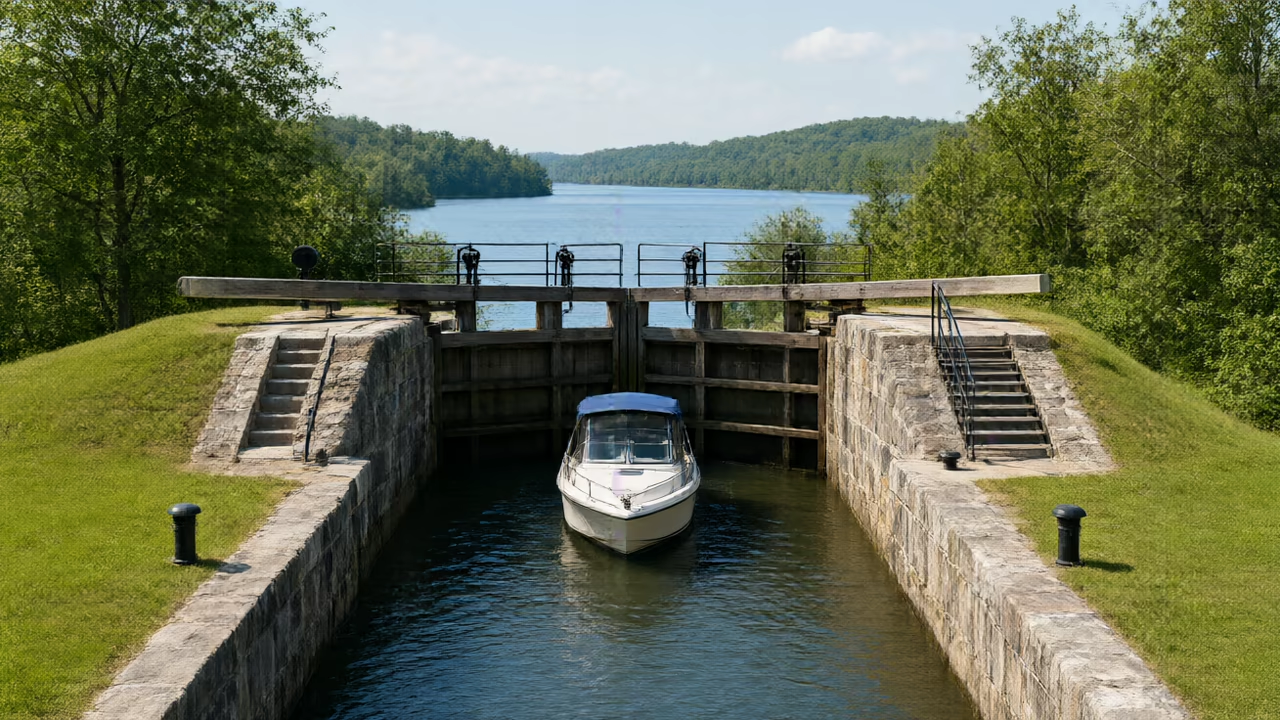
But a dam leaves the water above it much higher than the water below. That is where a lock comes in. A lock is like a staircase made of water. Going from Ottawa up to Upper Rideau Lake, boats climb 83.2 metres through 31 locks, one step at a time.[4]
How a lock lifts a boat, step by step
Parks Canada describes how a boat goes up, or locks up, through one lock. Step 1: the water inside the lock chamber is at the same level as the lower channel, so staff open the lower gates and the boat moves in. Step 2: staff close the lower gates and their valves, so the chamber is watertight.
Step 3: staff slowly open the valves at the upper end. Water from the higher level flows into the chamber through tunnels, pulled down by gravity, and the boat floats up with it. Step 4: when the water in the chamber reaches the upper level, staff crank open the upper gates. Step 5: the boat leaves at the higher level.
To go down, the steps run the other way. The chamber starts full, the boat enters through the upper gates, the gates close, and staff open valves in the lower gates so water drains out. When the water matches the lower level, the lower gates open and the boat floats out.
Parks Canada says the gates are opened and closed with cranks called crabs, and that the system runs on water, gravity, levers and gears, and human muscle power. UNESCO says most of the lock gates are still worked by hand-powered winches.[2]
Lands and peoples along the canal
Long before the canal, these lakes and rivers were important travelling and trading routes for Indigenous peoples. Parks Canada's management plan says archaeological information shows that Algonquin peoples have lived in the Ottawa Valley for many generations.
The plan says the canal passed mainly through lands traditionally used by the Algonquin, Mohawk and Mississauga peoples, and that this military project had an impact on their relationship to the land. Today, Parks Canada says it engages with the Algonquins of Ontario, the Mississauga of Alderville and the Mohawks of Akwesasne and Tyendinaga in planning for the canal.[6]
After 1832 and today
The canal opened in the summer of 1832. Parks Canada says it cost £800,000. Parliament criticized the spending and held an inquiry, which found no mismanagement. By died in 1836.
The canal became a busy trade route. Then, by 1849, locks were built around the rapids on the St. Lawrence, and shippers switched to that route. Commercial traffic on the Rideau fell, and from the 1880s on, recreation and tourism took over. Parks Canada says the canal is open to boats from May to October.
In winter, the National Capital Commission turns part of the canal in Ottawa into the Rideau Canal Skateway. It first opened in the 1970–1971 season and now winds over 7.8 kilometres.
The Rideau Canal was named a national historic site in 1925 and was added to UNESCO's World Heritage List in 2007. UNESCO calls it the best-preserved example of a slackwater canal in North America, and says it has worked as a waterway without interruption since it was built.[1]
Fast lesson
Use these checks before you answer the practice questions.
Write four boxes linked by arrows: southern shore is American → St. Lawrence is easy to attack → War of 1812 shows the problem → Britain builds a safer route. Ask your child to say 'so' between each box.
Use two containers at different heights and a small floating toy. Show that the toy rises only when water is added, and that it can move across only when the water levels match. Keep it simple; this is a model, not a real lock.
The builders faced disease and danger, and the canal crossed lands traditionally used by Algonquin, Mohawk and Mississauga peoples. Stick to what the sources say and let your child ask questions.
Point out 'hundreds died' and 'the exact number is not known'. Talk about the difference between a rough amount and an exact count.
Common mistakes
Why this fails: It was built mainly for military reasons; recreation came later, from the 1880s on.
Why this fails: In this lock system, water flows in from the higher level by gravity, and the boat floats up with it.
Why this fails: The gates behind the boat must close, and the water must reach the new level, before the gates ahead open.
Word Lab
Use the meaning, hear the word, then try it in your own sentence.
canal
nouna waterway that people build or change so that boats can travel through it
The Rideau Canal joins Ottawa and Kingston.
lock
nouna section of a canal with gates at each end, where the water level is raised or lowered to move boats up or down
Boats climb 83.2 metres through 31 locks.
chamber
nounthe enclosed space inside a lock where the boat waits while the water level changes
Water flows into the chamber and the boat rises.
valve
nouna part that opens or closes to let water flow or stop it
Staff open the valves slowly.
dam
nouna wall built across a river to hold back water and make it deeper
The canal had 52 dams when it opened.
slackwater
adjectivedescribing calm, slow water held back by a dam
The Rideau is a slackwater canal.
vulnerable
adjectiveeasy to attack or harm
The St. Lawrence route was vulnerable to attack from the south.
supply route
noun phrasea path used to move soldiers, food and equipment
Britain wanted a safer military supply route.
labourer
nouna worker who does hard physical work
Most labourers were Irish and French Canadian.
malaria
nouna serious disease spread by mosquitoes that causes fever
Workers called malaria swamp fever.
inquiry
nounan official investigation to find out the facts
The inquiry found no mismanagement.
World Heritage Site
noun phrasea place UNESCO lists as important to all people, worth protecting
The Rideau Canal became a World Heritage Site in 2007.
Check your understanding
Choose an answer, explain your choice, and then check. Hints and retries are welcome.
Try the questions here. Public practice does not save a learning record.
Support · Find it in the text
Support · Find it in the text practice
Each answer is stated in the article. Point to the sentence.
1. Which two cities does the Rideau Canal join, and how long is it?
2. Who was put in charge of building the canal?
3. What was Bytown, and what is it called today?
4. How many locks and dams did the canal have when it opened?
5. What did workers call malaria?
6. In what year was the canal added to UNESCO's World Heritage List?
Apply · Causes, effects and steps
Apply · Causes, effects and steps practice
Use 'because', 'so' or 'next' and a fact from the article.
7. Complete the chain: The St. Lawrence's southern shore was American, so … so …
8. Why did Colonel By want larger locks?
9. What job does a dam do in a slackwater canal?
10. List the five steps for locking a boat up, in order.
11. What pushes the water into the chamber when a boat locks up?
12. What are the cranks that open and close the lock gates called?
Reason · Chains, steps and sources
Reason · Chains, steps and sources practice
Order events, reverse a process and weigh what sources say.
13. Put in order: UNESCO World Heritage listing; War of 1812 begins; the Skateway first opens; the canal opens.
14. A boat is going DOWN. Which gates does it enter by, and where does the water go?
15. The canal was built for the military, but today it is used for boating and skating. What caused this change?
16. Name two facts that two different sources in this article agree on.
17. Sort: (a) The canal opened in 1832. (b) Skating on the canal is the best winter activity. (c) The canal had 47 locks and 52 dams when it opened.
Practice answer key
- 1. Ottawa and Kingston; 202 kilometres.
See 'A water road from Ottawa to Kingston'. - 2. Lieutenant-Colonel John By of the Royal Engineers.
See 'Colonel By and the builders'. - 3. The settlement around Colonel By's headquarters, named after him; today it is Ottawa.
See 'Colonel By and the builders'. - 4. 47 masonry locks and 52 dams.
See 'Dams make lakes, locks make steps'. - 5. Swamp fever.
See 'Colonel By and the builders'. - 6. 2007.
See 'After 1832 and today'. - 7. …boats on it could be attacked, so Britain wanted a second, safer route away from the border.
Each 'so' links a cause to its effect. - 8. So that new steamboats could fit through them.
See 'Colonel By and the builders'. - 9. It holds back the river to make a calm, deep lake that boats can travel on.
See 'Dams make lakes, locks make steps'. - 10. Boat enters through open lower gates → lower gates and valves close → upper valves open and water flows in → upper gates open at the upper level → boat leaves.
See 'How a lock lifts a boat, step by step'. - 11. Gravity: water flows down from the higher level into the chamber.
The article says the system runs on water, gravity, levers and gears, and muscle power. - 12. Crabs.
See the last paragraph of 'How a lock lifts a boat, step by step'. - 13. War of 1812 begins (1812) → the canal opens (1832) → the Skateway first opens (1970–1971 season) → UNESCO listing (2007).
Use the dates in the article. - 14. It enters through the upper gates; water drains out through valves in the lower gates until it matches the lower level.
Locking down is locking up in reverse. - 15. After the St. Lawrence got locks by 1849, trade moved away, and from the 1880s recreation and tourism took over.
A later cause can change how a place is used. - 16. For example: Parks Canada and the Canadian Encyclopedia both say the St. Lawrence route was vulnerable, and both say many workers died; Parks Canada and UNESCO both say it was built for military reasons.
When sources agree, you can be more confident. - 17. Facts: (a) and (c). Opinion: (b).
Facts can be checked in a source; 'best' is an opinion.
Related skills
Put it in your own words
This draft is not saved when you leave or refresh the page.
Check your own explanation
This is self-review, not automatic marking.
Compare with a model response
Britain built the Rideau Canal because the St. Lawrence River ran along a shore that was largely American, so boats on it could be attacked. The War of 1812 showed this weak spot, and as a result Britain wanted a safer supply route from Montréal to Lake Ontario. Lieutenant-Colonel John By led the work, and thousands of Irish and French-Canadian labourers built it almost entirely by hand, while many caught malaria. To lift a boat, first the boat enters the lock chamber through the lower gates. Next, the lower gates close so the chamber is watertight. Then staff open the upper valves, and water flows in by gravity until the boat floats up to the higher level. Finally, the upper gates open and the boat moves on. Today the canal is a World Heritage Site, and in winter part of it becomes the Rideau Canal Skateway.
Sources and revision notes
Source check: 2026-10-31. Grade guidance is an editorial suggestion, not a standardised reading score.
- Parks Canada — Rideau Canal National Historic Site: Culture and history
- Parks Canada — The Evolution of the Lock (Rideau Canal, PDF)
- Parks Canada — Directory of Federal Heritage Designations: Rideau Canal National Historic Site
- The Canadian Encyclopedia — Colonel By and the Construction of the Rideau Canal
- UNESCO World Heritage Centre — Rideau Canal
- Parks Canada — Rideau Canal and Merrickville Blockhouse National Historic Sites Management Plan, 2022
- National Capital Commission — History of the Rideau Canal Skateway
- Parks Canada — Rideau Canal: Lockage and navigation
What changed in this edition?
The 202 km route, the rivers and lakes it joins, the threat after the American Revolution, the vulnerable St. Lawrence with a largely American southern shore, the two-year War of 1812, the need for a second, safer route from Montreal to the Great Lakes, John By's arrival in 1826, Bytown, the minimum 134-by-33-foot locks for steamboats, the summer 1832 opening, the £800,000 cost, the inquiry finding no mismanagement, By's death in 1836, the shift of shipping to the St. Lawrence by 1849 and recreation from the 1880s come from Parks Canada's Culture and history page. The lock steps, crabs, energy sources, the 83.2 m lift through 31 locks and the 7.9 m Smiths Falls lift come from Parks Canada's Evolution of the Lock document. The military supply route between Montréal and Lake Ontario, 1826–1832 construction, 5,000–6,000 workers a year at over two dozen worksites, Irish and French Canadian labourers and Scottish stonemasons, 'hundreds died', designation in 1925 and the 2007 World Heritage inscription come from Parks Canada's heritage designation page. Work done almost entirely by hand, hand chisels and gunpowder, 'swamp fever', the vulnerable St. Lawrence 'lifeline', dams creating slack-water lakes, 47 masonry locks and 52 dams, and 'how many died is not known' come from The Canadian Encyclopedia. 'Built primarily for strategic military purposes', best-preserved slackwater canal in North America, operation without interruption and hand-powered winches come from UNESCO. Indigenous travelling and trading routes, Algonquin presence in the Ottawa Valley, lands traditionally used by the Algonquin, Mohawk and Mississauga, the project's impact on that relationship, Indigenous supply of goods and provisions during construction and Parks Canada's engagement with named communities come from the 2022 management plan. The Skateway's first season and 7.8 km length come from the National Capital Commission. The May to October season comes from Parks Canada's navigation page. The description of gravity moving the water and the 'staircase made of water' comparison are this lesson's simplified explanation. This lesson explains history and how locks work and does not take a position on current policy or land negotiations.