Daily Read / Forces and simple machines
Forces and simple machines · Explain how a ramp (inclined plane) lets you raise a load with a smaller push, why a gentler ramp needs less force but a longer trip, and how friction changes the ideal result
How Does a Ramp Work? The Inclined Plane and the Longer Path
Wheelchair ramps, loading ramps and even stairs are inclined planes. Compare steep and gentle ramps, then explain why a smaller push means a longer trip.
Device/browser voice. Pronunciation and availability vary.
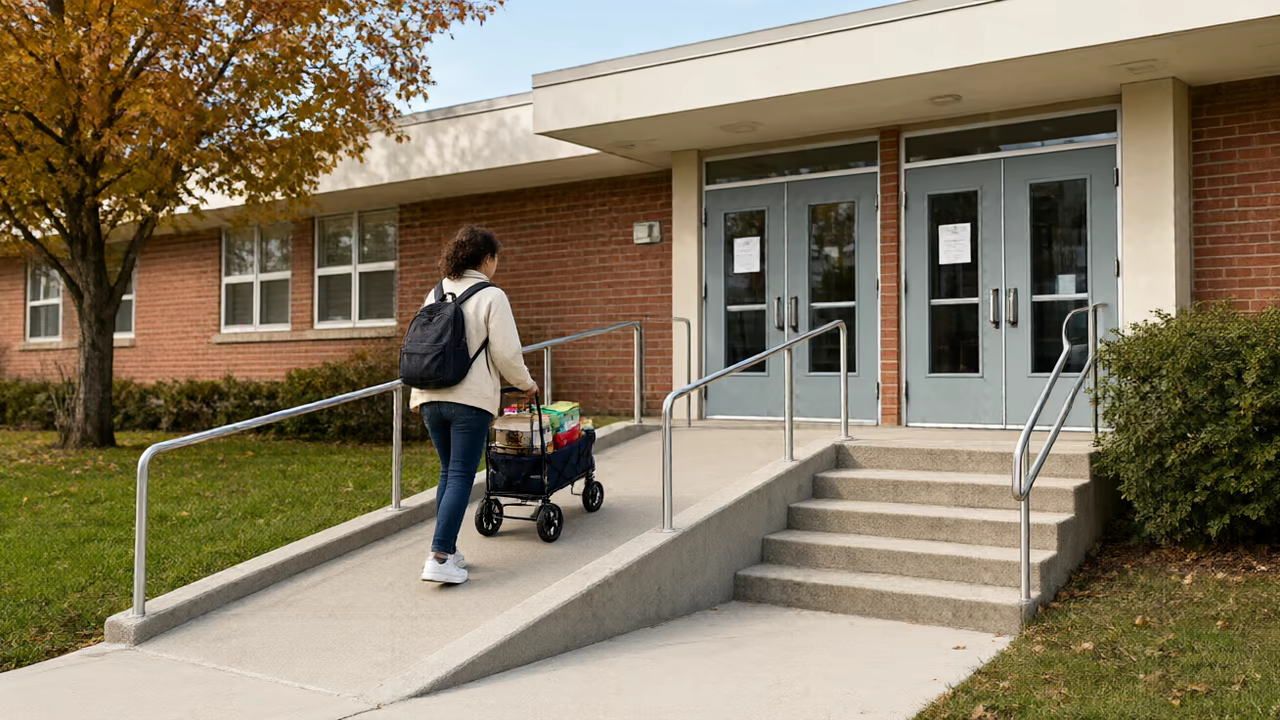
A ramp beside the stairs
Look at the front entrance of many schools, libraries and community centres. Beside the stairs, there is often a long ramp that zigzags back and forth or stretches along the wall. Both paths reach the same door. So why is the ramp so much longer?
An inclined-plane activity sheet published on the RAFT website points out the same thing: a wheelchair ramp is much longer than a staircase that is needed to reach the same height. That extra length is not a mistake. It is how the ramp does its job.[3]
What is an inclined plane?
Britannica describes an inclined plane as a simple machine consisting of a sloping surface, used for raising heavy bodies. The word plane means a flat surface, and inclined means tilted. Put them together and you get a tilted flat surface: a ramp.
The RAFT sheet calls the inclined plane the simplest simple machine. It has no moving parts at all. In the Daily Read lessons on levers and pulleys, you met machines with a bar or a wheel. A ramp just sits there, yet it can still make a hard job easier.[1]
Push up the slope instead of lifting straight up
Imagine a heavy box of library books on the floor and a stage 1 metre high. You could lift the box straight up. To do that, your arms must hold up the whole weight of the box.
Now lay a ramp from the floor to the stage and slide or roll the box up it. Britannica explains that, without friction, moving an object up an incline takes less force than lifting it straight up. The ramp holds up part of the weight while you push, so your arms only supply the rest.[1]
Steep or gentle: the trade-off
Energy Education, an online science encyclopedia, says that the longer the plane gets, the easier the task will be in terms of force. It also says the distance will always have to change in proportion. A gentler ramp means a smaller push, but you have to push the box farther.
Britannica describes the other end: the steeper the slope, the more nearly the required force approaches the actual weight. A ramp so steep that it stands straight up is no help at all; you are back to lifting.
Here is an invented example with ideal numbers. A ramp 2 metres long up to a 1-metre stage needs a push of about half the box's weight, and the box travels 2 metres. A ramp 4 metres long to the same stage needs about one quarter of the weight, and the box travels 4 metres. Energy Education gives the rule for an ideal ramp as the length divided by the height. It is the same deal you met with levers and pulleys: win on force, pay with distance.[2]
Friction takes its share
Real ramps are not perfect. When a box rubs against a ramp, friction pushes back against the motion. Energy Education says friction is always present, so the true mechanical advantage of a ramp will always be less than the ideal one. In plain words, the real push is a little bigger than the numbers in the invented example.
That is one reason people put wheels on heavy things before pushing them up a ramp. A cart or a dolly rolls instead of scraping, so less of the push is wasted.[2]
Ramps hiding in plain sight
Energy Education describes lifting a boat out of the water onto higher land. Lifting it straight up would be a daunting task, but pulling it up a ramp takes less force over a much longer pull. The same page says stairs are really a form of ramp, broken into steps.
Britannica adds that the inclined plane idea is used widely, including in screws and bolts, where a small turning force along a slope can produce a much larger force. A screw is like a ramp wrapped around a post. Next time you see a ramp, ask two questions: How high does it rise, and how long is it? The longer it is for the same height, the smaller the push.[2]
Explore the instructional diagram
Fast lesson
Use these checks before you answer the practice questions.
Before comparing two ramps, check that they reach the same height. Only then does the longer ramp mean a gentler slope and a smaller push.
In the home activity, children usually feel the easier push first. Ask them to also measure how far the object travelled, so they notice the cost as well as the benefit.
The ½ and ¼ values are ideal estimates. Friction always adds a little. Encourage your child to say "about" when using these numbers.
Ask your child to state the force-for-distance rule for the lever, the pulley and the ramp in their own words.
Common mistakes
Why this fails: The weight stays the same. The ramp supports part of it, so the push is smaller.
Why this fails: For the same height, a shorter ramp is steeper, so the push is closer to the whole weight.
Why this fails: Real pushes are a little bigger than ideal estimates because friction acts against the motion.
Word Lab
Use the meaning, hear the word, then try it in your own sentence.
inclined plane
noun phrasea simple machine made of a sloping surface, used to raise heavy things
An inclined plane lets you push a heavy box up instead of lifting it.
ramp
nouna sloping path or surface that joins a lower place and a higher place
The ramp beside the library stairs is much longer than the steps.
slope
nouna surface that goes up or down at an angle
The slope of the ramp is gentle, so the push is easy.
steep
adjectiverising or falling sharply
A steep ramp needs a push close to the whole weight.
gentle
adjectiverising or falling slowly, not sharply
The gentle ramp is long, but the push is small.
height
nounhow high something is from bottom to top
The stage has a height of 1 metre.
force
nouna push or a pull
Pushing up the ramp takes less force than lifting.
friction
nouna force that acts against motion when two surfaces rub together
Friction makes the real push a little bigger.
trade-off
noungiving up some of one thing to get more of another
The trade-off with a long ramp is a smaller push but a longer trip.
simple machine
noun phrasea basic tool, such as a lever, pulley or ramp, that changes the size or direction of a force
A ramp is the simplest simple machine because it has no moving parts.
dolly
nouna small platform or frame on wheels for moving heavy things
The movers rolled the boxes up the ramp on a dolly.
screw
nouna metal fastener with a spiral ridge, like a ramp wrapped around a post
A screw uses the idea of an inclined plane.
Check your understanding
Choose an answer, explain your choice, and then check. Hints and retries are welcome.
Try the questions here. Public practice does not save a learning record.
Support · Find it in the text
Support · Find it in the text practice
Each answer is stated in the article. Point to the sentence.
1. What does the word inclined mean, according to the article?
2. What does the RAFT sheet call the inclined plane?
3. How does a wheelchair ramp compare with a staircase that reaches the same height?
4. What force always acts against the box on a real ramp?
5. What does Energy Education say stairs really are?
6. What rule does Energy Education give for an ideal ramp?
Apply · Cause and effect
Apply · Cause and effect practice
Use because or so to connect a cause with its effect.
7. Finish the sentence: Pushing a box up a ramp is easier than lifting it, because …
8. Finish the sentence: The gentle ramp is long, so …
9. Why does a very steep ramp help less than a gentle one?
10. Why do movers often put heavy boxes on a dolly before going up a ramp?
11. Why is the real push on a ramp bigger than the ideal number?
12. Use the rule length ÷ height. About what fraction of the weight is the ideal push for a 3-metre ramp up to a 1-metre stage?
Reason · Steep, gentle and trade-offs
Reason · Steep, gentle and trade-offs practice
Use what you learned to reason about new situations.
13. A loading ramp at the back of a store reaches a truck 1 metre high and is 5 metres long. Steep or gentle?
- Steep
- Gentle
14. A playground slide drops 2 metres over a length of about 3 metres. Steep or gentle?
- Steep
- Gentle
15. Two paths go up the same hill: a straight trail and a zigzag road. Which needs less push for a bike, and what is the cost?
16. How is a ramp like a lever and a pulley?
17. Kai says, "A ramp makes the box lighter." Is he right? Explain.
Practice answer key
- 1. Tilted.
See 'What is an inclined plane?' - 2. The simplest simple machine.
See 'What is an inclined plane?' - 3. The ramp is much longer.
See 'A ramp beside the stairs'. - 4. Friction.
See 'Friction takes its share'. - 5. A form of ramp.
See 'Ramps hiding in plain sight'. - 6. The length divided by the height.
See 'Steep or gentle: the trade-off'. - 7. … the ramp holds up part of the weight, so my push only supplies the rest.
This is the main reason a ramp helps. - 8. … the push is small, but the box has to travel farther.
Less force comes with more distance. - 9. Because the steeper the slope, the closer the push gets to the whole weight.
Britannica describes this pattern. - 10. Because wheels roll instead of scraping, so less push is lost to friction.
See the friction section. - 11. Because friction acts against the motion and uses up some of the push.
Ideal numbers ignore friction. - 12. About one third of the weight (3 ÷ 1 = 3).
This is an ideal estimate; friction makes the real push a little bigger. - 13. Gentle
It is long compared with its height, so the slope is gentle. - 14. Steep
It is not much longer than it is high, so it is steep. - 15. The zigzag road needs less push, but it is a longer ride.
Zigzags make the slope gentler by making the path longer. - 16. All three trade force for distance: less force means more distance.
This is the shared rule across the simple-machines lessons. - 17. No. The box weighs the same; the ramp holds up part of the weight, so the push is smaller.
A machine changes the push, not the weight.
Related skills
Put it in your own words
This draft is not saved when you leave or refresh the page.
Check your own explanation
This is self-review, not automatic marking.
Compare with a model response
An inclined plane is a sloping surface, like a ramp. When I push a box up a ramp, the ramp holds up part of the weight, so I need less force than if I lifted it straight up. A steep ramp is short, but the push is close to the whole weight. A gentle ramp is longer, so the push is smaller. However, I have to push the box farther, because less force always comes with more distance. Friction also works against me, so the real push is a little bigger than the ideal one. That is why the wheelchair ramp at our library is much longer than the stairs.
Sources and revision notes
Source check: 2026-11-04. Grade guidance is an editorial suggestion, not a standardised reading score.
What changed in this edition?
The definition of an inclined plane as a simple machine made of a sloping surface used for raising heavy bodies, the statement that without friction moving an object up an incline takes less force than lifting it, the statement that the steeper the slope the more nearly the required force approaches the actual weight, and the use of the principle in screws and bolts come from Britannica. The statements that the longer the plane the easier the task in terms of force while the distance changes in proportion, the ideal mechanical advantage of length divided by height, that friction makes true mechanical advantage less than ideal, the boat example and stairs as a form of ramp come from Energy Education. The description of the inclined plane as the simplest simple machine and the comparison of a wheelchair ramp with a staircase come from the RAFT activity sheet. The school-entrance scene, the box of library books, the 2-metre and 4-metre ramp numbers, the dolly note, the comparison of a screw to a ramp wrapped around a post, the zigzag road, the invented newton test and the home activity are original illustrations or reasoning. Report errors through Sources and corrections.