Daily Read / Weather
Weather · Put the steps of a natural process in order, and explain how temperature and humidity cause different snow crystal shapes
How Does a Snowflake Form? From a Speck of Dust to Six Arms
A snowflake is not a frozen raindrop. Follow its growth step by step, from a speck of dust to six arms, and see why cold and damp air change its shape.
Device/browser voice. Pronunciation and availability vary.
Not a frozen raindrop
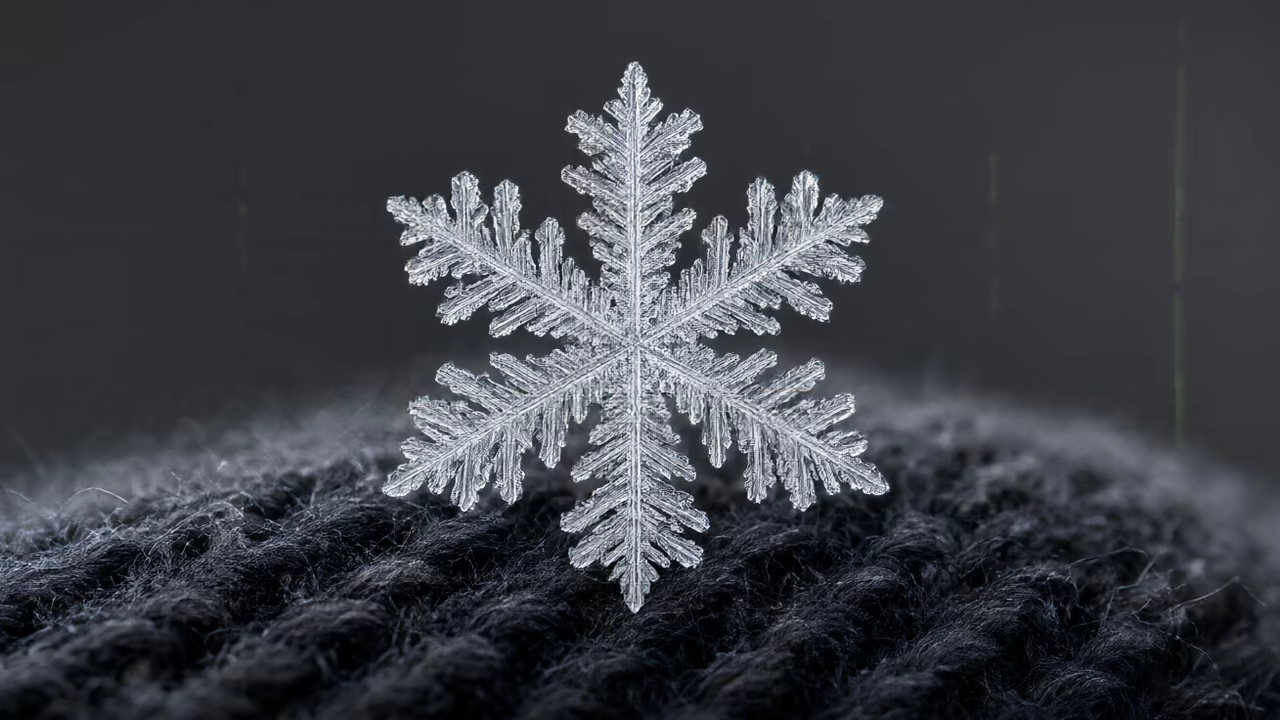
Catch a snowflake on a dark mitten and look closely before it melts. You may see six arms, each one lined with tiny branches, all fitting around the centre like the spokes of a wheel. Where did such a careful shape come from?
Many people think a snowflake is a raindrop that froze on the way down. NOAA, the American weather and ocean agency, says snow is not simply a frozen droplet of water. A frozen raindrop would be a little lump of ice, like sleet. A snowflake forms slowly and grows inside a cloud, one tiny layer at a time. To understand it, we need to follow the steps in order.[1]
Step 1: A speck to start on
Clouds hold water vapour, which is water in the form of an invisible gas. On its own, the vapour does not easily turn into ice. It needs something to start on. EarthDate, a science program about the Earth, explains that a snowflake begins when water vapour freezes around a nucleus, such as a speck of dust.
Here is the surprising part. The vapour does not turn into liquid water first. It skips the liquid stage and changes straight from a gas into solid ice. NOAA calls the result a slowly growing ice crystal.[2]
Step 2: Six sides from the start
Ice is a crystal. A crystal is a solid whose tiny parts line up in a repeating pattern. In ice, that pattern has six sides. So, NOAA explains, the new crystal starts as a tiny six-sided prism, shaped a bit like a short pencil with flat faces. Those flat faces are called facets.
This is why snowflakes have six arms and not five or eight. NOAA says a snowflake has six-fold symmetry: a pattern on one of its six arms is repeated on the other five.[1]
Step 3: Corners grow into arms
Next, the crystal keeps catching water vapour from the air around it. The six corners of the prism poke out a little farther than the flat faces, so they reach the vapour first. NOAA describes what happens next: a small bump catches vapour first, so it grows larger, and because it is larger, it catches even more. The bump becomes a branch.
As this repeats, each corner grows into an arm, and each arm can sprout side branches. The crystal can also keep adding smooth, flat facets. NOAA says growth can switch between facets and branches, and both can even happen at once.[1]
Step 4: Cold and damp air pick the shape
The air around the crystal decides what kind of shape grows. Scientists have tested this by growing snow crystals in laboratories. SnowCrystals.com, a snowflake science website, says thin, flat plates grow near −2 °C, slender columns grow near −6 °C, and large, thin plates grow near −15 °C. EarthDate adds that the biggest star-shaped crystals grow at about −15 °C, and that needles and columns grow at about −6 °C.
Humidity matters too. Humidity is the amount of water in the air. When the air holds only a little extra water, a crystal grows slowly and stays simple, like a plain six-sided prism. When the air is very damp, the crystal grows quickly and becomes complicated, with lots of fern-like branches.[3]
Step 5: One trip, one shape
A growing snowflake does not stay in one place. It drifts up and down inside the cloud, passing through air that is a little colder or warmer, drier or damper. Each change can switch the way it grows. A crystal might start as a plate, then sprout branches, then add flat tips. EarthDate explains that all six arms grow alike because they travel together on the same path through the cloud.
That trip is also why two snowflakes are almost never the same. NOAA says a snowflake's shape depends on the exact order of conditions it meets and how long each one lasts. For two flakes to match, they would need the same trip down to the tiniest detail, which NOAA calls astronomically unlikely. When the crystal finally becomes heavy enough, it falls out of the cloud as snow.[2]
The people who looked closely
Wilson Bentley, an American weather watcher and photographer, became known as "Snowflake" Bentley. EarthDate says he was the first to take detailed photographs of snowflakes and published his work in the early 1900s. In the 1930s, the Japanese physicist Ukichiro Nakaya grew the first snow crystals made in a laboratory and showed how temperature and humidity shape them. He called snow crystals "hieroglyphs sent from the sky", because each one holds a record of the weather it grew in.[2]
Explore the instructional diagram
Fast lesson
Use these checks before you answer the practice questions.
Ask your child to point to each numbered stage and say what changed from the stage before. Then cover the labels and have them retell the steps using First, Next, Then and Finally.
Many children picture raindrops freezing. Pause after Step 1 and ask: what does the vapour skip? Linking this to frost on a window can help, but keep it as a comparison, not a fact from the article.
Make a two-column chart: the condition (temperature or humidity) and the shape it causes. Each row is one cause-and-effect sentence.
Common mistakes
Why this fails: Frozen raindrops are lumps like sleet. Snowflakes grow from water vapour that turns directly into ice.
Why this fails: Shape depends on the exact temperature and the humidity. Columns grow near −6 °C, between the plate temperatures.
Why this fails: NOAA calls identical flakes astronomically unlikely. That is a very strong 'almost never', not a proof.
Word Lab
Use the meaning, hear the word, then try it in your own sentence.
water vapour
noun phrasewater in the form of an invisible gas
Clouds hold water vapour as well as droplets.
nucleus
nounthe tiny centre that something forms or grows around
A speck of dust can be the nucleus of a snowflake.
crystal
nouna solid whose tiny parts line up in a repeating pattern
Ice is a crystal with a six-sided pattern.
hexagonal
adjectivehaving six sides
Every snow crystal starts with a hexagonal shape.
prism
nouna solid shape with two matching ends and flat sides
The new crystal is a tiny six-sided prism.
facet
nounone of the flat faces on a crystal
Light shone on each smooth facet.
symmetry
nounthe quality of having matching parts that repeat or mirror each other
A snowflake has six-fold symmetry.
humidity
nounthe amount of water vapour in the air
High humidity makes branched snowflakes.
branch
nouna part that grows out from a main arm
Each arm had tiny side branches.
slender
adjectivelong and thin
Slender columns grow near −6 °C.
sequence
nounthe order in which things happen
The sequence of steps matters in a process.
astronomically
adverbto an extremely large degree
Two identical snowflakes are astronomically unlikely.
Check your understanding
Choose an answer, explain your choice, and then check. Hints and retries are welcome.
Try the questions here. Public practice does not save a learning record.
Support · Find it in the text
Support · Find it in the text practice
Each answer is stated in the article. Point to the sentence.
1. What is water vapour?
2. What does EarthDate give as an example of a nucleus for a snowflake?
3. What are the flat faces of a crystal called?
4. Near what temperature do large, thin plates grow?
5. What is humidity?
6. Who was the first to take detailed photographs of snowflakes?
Apply · Sequence and cause
Apply · Sequence and cause practice
Use a time-order word or 'because' and a detail from the article.
7. Why is a snowflake different from a frozen raindrop?
8. What happens just after water vapour freezes onto a speck?
9. What happens just before the flake falls out of the cloud?
10. Why do all six arms of one snowflake look alike?
11. Why does a crystal that grows in dry air stay simple?
12. Why did Nakaya call snow crystals 'hieroglyphs sent from the sky'?
Reason · Sequence a process
Reason · Sequence a process practice
Order the steps, link conditions to shapes and test claims.
13. Put these in order: corners become arms; vapour freezes on dust; flake falls; six-sided prism forms.
14. Complete the chain: a corner reaches vapour first → ? → it catches even more vapour.
15. A snow crystal is a long, thin column. Using SnowCrystals.com, about what temperature did it probably grow at?
16. Someone says snowflakes are frozen rain. What would you tell them, using the article?
17. How are a column and a large star-shaped crystal alike, and how are they different?
Practice answer key
- 1. Water in the form of an invisible gas.
This is in 'Step 1: A speck to start on'. - 2. A speck of dust.
See 'Step 1'. - 3. Facets.
This is in 'Step 2: Six sides from the start'. - 4. Near −15 °C.
See 'Step 4: Cold and damp air pick the shape'. - 5. The amount of water in the air.
See the second paragraph of 'Step 4'. - 6. Wilson Bentley, known as "Snowflake" Bentley.
This is in 'The people who looked closely'. - 7. Because a frozen raindrop is a lump of liquid water that froze, but a snowflake grows slowly in a cloud as vapour turns straight into ice.
See 'Not a frozen raindrop' and 'Step 1'. - 8. The ice forms a tiny six-sided prism with flat faces.
Step 1 leads into Step 2. - 9. It drifts through the cloud and grows until it is heavy enough to fall.
This is the end of 'Step 5'. - 10. Because the six arms travel together on the same path through the cloud, so they meet the same conditions.
EarthDate explains this in 'Step 5'. - 11. Because there is only a little water vapour, so it grows slowly and does not form many branches.
See 'Step 4'. - 12. Because each crystal's shape is like writing that records the temperature and humidity it grew in.
Hieroglyphs are picture writing; see the last section. - 13. Vapour freezes on dust → six-sided prism forms → corners become arms → flake falls.
Check each step against the headings. - 14. It grows into a bigger bump.
This loop is how branches form. - 15. Near −6 °C.
Columns grow near −6 °C; plates grow near −2 °C and −15 °C. - 16. Snowflakes are not frozen rain. Frozen raindrops are lumps of ice like sleet; snowflakes grow from water vapour that turns straight into ice.
Use NOAA's point from the first section. - 17. Alike: both are six-sided ice crystals that grow from vapour. Different: columns grow near −6 °C and are long and thin; large star shapes grow near −15 °C and are flat with arms.
Name one likeness and one difference.
Related skills
Put it in your own words
This draft is not saved when you leave or refresh the page.
Check your own explanation
This is self-review, not automatic marking.
Compare with a model response
First, water vapour in a cloud freezes onto a tiny speck of dust, skipping the liquid stage. Next, the ice forms a small six-sided prism, because the parts of ice line up in a hexagonal pattern. Then the six corners catch water vapour before the flat faces do, so they grow into arms, and the arms grow side branches. After that, the air decides the shape: near −6 °C the crystal may grow into a slender column, and near −15 °C it may grow into a large star, especially if the humidity is high. The flake drifts through the cloud, and every change in the air can change how it grows. Finally, it becomes heavy enough to fall as snow. Because each flake takes its own path through the cloud, two flakes would need exactly the same trip to match, which NOAA calls astronomically unlikely.
Sources and revision notes
Source check: 2026-10-29. Grade guidance is an editorial suggestion, not a standardised reading score.
- NOAA NESDIS — How Do Snowflakes Form?
- EarthDate — How Snowflakes Grow
- SnowCrystals.com — Snow Crystal Morphology
What changed in this edition?
Snowflakes forming slowly in a cloud rather than being frozen raindrops, vapour condensing on a particle and changing directly into ice, the slowly growing crystal, the hexagonal prism with facets, six-fold symmetry, the bump that catches more vapour and becomes a branch, switching between facets and branches, and the 'astronomically unlikely' chance of identical flakes come from NOAA NESDIS. The dust nucleus, skipping the liquid stage, arms growing alike because they share one path, the largest stellar crystals at about −15 °C, needles and columns at about −6 °C, Bentley's early photographs and Nakaya's laboratory crystals and quotation come from EarthDate. Thin plates near −2 °C, slender columns near −6 °C, large thin plates near −15 °C, and slow growth in low humidity versus fast branched growth in high humidity come from SnowCrystals.com. The mitten, wheel-spoke and pencil comparisons are illustrations. The comparison of a frozen raindrop with sleet is this lesson's illustration. The diagram is a simplified schematic, not to scale.