Daily Read / Winter & Water
Winter & Water · Inference and degrees of certainty
Why Do Lakes Freeze From the Top?
Follow the unusual density behaviour of freshwater to explain why lake ice forms at the surface, while practising careful inferences and certainty words.
Device/browser voice. Pronunciation and availability vary.
The cold starts at the surface
On a cold Canadian night, the air above a lake can be far below freezing while the water underneath is still liquid. The upper surface is the part directly exposed to the cold air, so that surface water loses heat first. But that alone does not explain why a lake usually builds ice on top instead of freezing into a solid block from the bottom upward.
The next clue is unusual. Freshwater does not keep becoming denser all the way to its freezing point. Environment and Climate Change Canada explains that very cold freshwater near freezing is relatively low in density, so it tends to stay near the surface and can quickly form an ice layer there.[1]
Four degrees is a turning point
Density tells us how much mass is packed into a given volume. For liquid freshwater, density reaches a maximum at about 4°C. Water that cools from a warmer temperature toward 4°C becomes denser and can sink beneath lighter water. This helps a cooling lake mix for a time.
Below about 4°C, the pattern reverses: colder freshwater becomes less dense. Near-freezing water therefore tends to remain above the denser water below it. That is a strong piece of evidence for the surface-first freezing pattern. It does not mean every point in every lake sits at one exact temperature.[2]
Ice floats instead of sinking
When freshwater freezes, its molecules arrange into a more open structure than they have in liquid water. The solid is less dense than liquid water, so ordinary ice floats. The U.S. Geological Survey notes that this is the opposite of what happens with many substances, whose solids are denser than their liquids.
Put the clues together: the coldest freshwater stays near the top, it freezes there, and the ice remains at the surface rather than sinking away. More surface water can then freeze beneath or around the existing ice as winter continues. Liquid water can remain below the ice.[2]
A good inference is careful, not timid
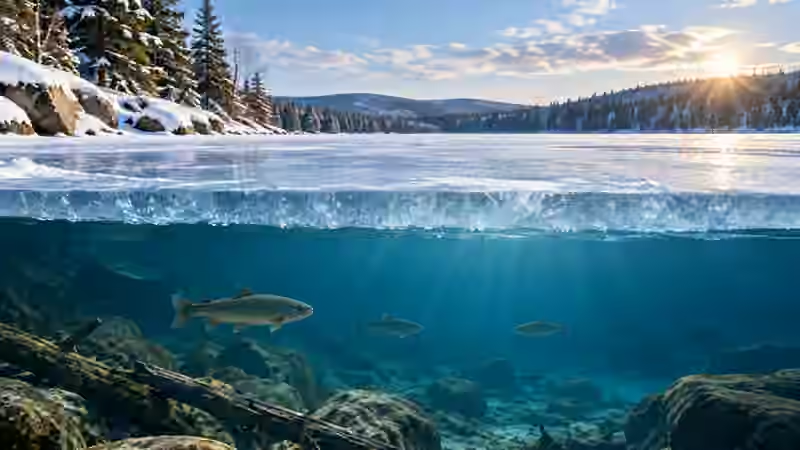
Suppose you see a photograph of a lake covered with ice. You can directly observe surface ice. You can reasonably infer that some liquid water may remain below if the lake is deep enough and conditions allow it. But the photograph alone cannot tell you the exact temperature at the bottom, the exact ice thickness, or whether every part of the lake has the same conditions.
That difference matters in science reading. “The evidence supports this explanation” is stronger than “this might happen for no reason,” but weaker than “one photograph proves every detail.” Good readers match words such as shows, supports, suggests, may and must to how much evidence is actually available.[2]
Do not transfer a freshwater rule to every kind of water
Salt changes the freezing and density behaviour of water. NOAA explains that seawater freezes at a lower temperature than freshwater and that seawater continues becoming denser as it cools toward its freezing point. That is different from the freshwater pattern near 4°C.
This gives us a final reading lesson: an explanation can be well supported and still have a scope. The freshwater lake explanation is useful because it follows evidence about freshwater density and floating ice. It should not be stretched into the claim that every body of water behaves exactly the same way.[3]
Explore the freeze-up diagram
Fast lesson
Use these checks before you answer the practice questions.
A direct fact is stated or measured. An inference connects facts to reach a conclusion that the text supports but may not state word for word.
Must, proves and always make strong claims. Can, may, suggests and supports leave room for conditions or missing measurements.
The strongest inference here uses several links: density near 4°C, near-freezing water staying higher, and ice floating.
A freshwater mechanism should not automatically be transferred to seawater, where dissolved salt changes freezing and density behaviour.
Common mistakes
Why this fails: Seeing surface ice does not directly show the exact temperature of water several metres below.
Why this fails: Real lakes differ in depth, wind, dissolved material and other conditions, so exact local claims need local evidence.
Why this fails: A cold-weather fact does not by itself explain why ice floats. Density evidence is more directly connected to that claim.
Why this fails: Salt changes both freezing temperature and density behaviour, so the scope of the explanation matters.
Word Lab
Use the meaning, hear the word, then try it in your own sentence.
density
nounHow much mass is packed into a given volume.
Water changes density as its temperature changes.
dense
adjectiveHaving more mass packed into the same amount of space.
Water near 4°C is denser than near-freezing freshwater.
surface
nounThe top or outside layer of something.
Ice first appears at the lake surface.
infer
verbTo reach a reasonable conclusion from evidence rather than from a direct statement.
We can infer that the writer expects us to connect density with floating ice.
evidence
nounInformation or observations used to support or test a claim.
The density measurements are evidence for the explanation.
certainty
nounHow sure we can reasonably be that a statement is true.
The word may shows less certainty than must.
Check your understanding
Choose an answer, explain your choice, and then check. Hints and retries are welcome.
Try the questions here. Public practice does not save a learning record.
Foundation
Foundation practice
Find the stated facts and the cause-and-effect order before making an inference.
1. Which part of a lake loses heat to cold winter air first?
2. Freshwater is most dense at about which temperature?
- 0°C
- 4°C
- 20°C
- 100°C
3. What happens to near-freezing freshwater compared with denser water near 4°C?
4. What does infer mean in this lesson?
5. Put these in order: ice floats; surface water cools below about 4°C; surface ice forms; colder freshwater stays above denser water.
6. True or false: The passage says every part of every frozen lake is exactly 4°C below the ice.
Inference
Inference practice
Choose conclusions that follow from the evidence without sneaking in extra assumptions.
7. A lake has a solid-looking ice surface. What can you reasonably infer?
8. Which inference is best supported by the fact that ice is less dense than liquid water?
- Ice tends to float.
- Ice must be warmer than air.
- All ice has the same thickness.
- Lake bottoms contain no water.
9. Which evidence is stronger for the 4°C density claim: a table of measured water density at different temperatures or a photo of snow beside a lake?
10. Why can you not infer exact bottom temperature from surface ice alone?
11. Which is stronger: “liquid water may remain below the ice” or “the bottom is exactly 4°C everywhere”? Why?
12. What two density facts work together to explain surface ice?
Certainty
Certainty practice
Match the strength of your words to the strength and scope of the evidence.
13. “Ice is less dense than liquid water.” Is this a direct source-backed fact, a local inference, or an unsupported guess?
14. “A particular lake has 18 cm of ice today.” What would this claim require?
15. Rewrite “A frozen lake is always 4°C underneath” to match the evidence more carefully.
16. Which word best fits limited but reasonable evidence?
- proves
- guarantees
- suggests
- must
17. Why is “Canada is cold” weak evidence for the claim that ice floats?
18. Why should a reader be cautious about applying the freshwater density rule directly to the ocean?
Synthesis
Synthesis practice
Use several sections together and decide what evidence would strengthen a real-world claim.
19. Summarize why lakes freeze from the top and include one caution about certainty.
20. You want to know whether water below a local frozen pond is still liquid. What observation would be more useful than a surface photo?
21. Connect this reading to the road-salt article: why might dissolved salt matter when thinking about water density?
22. Which is stronger evidence for a general freshwater-density rule: repeated laboratory measurements or one winter photograph? Explain.
23. Why does the passage include the seawater comparison near the end?
24. Write one sentence that uses “supports” or “suggests” accurately to connect evidence with a claim.
Practice answer key
- 1. The surface water.
The surface is directly exposed to the cold air. - 2. B
The passage and USGS source identify about 4°C as the maximum-density point for freshwater. - 3. The near-freezing water is less dense and tends to stay above the denser water.
This is a key reason the coldest water remains near the surface. - 4. Reach a reasonable conclusion from evidence rather than from a direct statement.
An inference connects evidence to a conclusion. - 5. Surface water cools below about 4°C → colder freshwater stays above denser water → surface ice forms → ice floats.
That order follows the physical cause-and-effect chain in the passage. - 6. False.
The passage uses 4°C to explain a density pattern, not as a measurement of every location in every lake. - 7. The surface has frozen, but liquid water may still remain below.
The freshwater density and floating-ice mechanism supports that inference without proving the entire lake is liquid underneath. - 8. A
Lower density directly explains why ordinary ice floats. - 9. The density measurements.
They measure the exact property named in the claim. - 10. Surface ice shows freezing at the top but does not measure the deeper water.
A local temperature claim needs temperature measurements at depth. - 11. The exact-4°C statement is stronger and needs more local evidence.
May remain is a cautious inference from the mechanism; an exact temperature everywhere is a measurement claim. - 12. Near-freezing freshwater is less dense than water around 4°C, and ice is less dense than liquid water.
The first keeps the coldest liquid near the top; the second keeps the frozen solid at the top. - 13. A direct source-backed fact.
The cited USGS source states this physical relationship. - 14. A local ice-thickness measurement.
The general density mechanism cannot supply a current local thickness. - 15. In freshwater lakes, denser water near 4°C can lie below colder surface water, but exact temperatures vary and require measurement.
The rewrite keeps the mechanism while dropping an unsupported absolute claim. - 16. C
Suggests signals support without claiming complete certainty. - 17. It describes climate, not the density relationship that causes floating.
Evidence must be relevant to the exact mechanism in the claim. - 18. Dissolved salt changes seawater freezing temperature and density behaviour.
The NOAA source describes a different pattern as seawater cools. - 19. Freshwater near freezing is less dense than water around 4°C, so the coldest water stays near the surface, freezes there, and the less-dense ice floats. The mechanism does not provide exact temperatures or ice thickness for a specific lake without measurements.
The summary keeps both the physical chain and the evidence limit. - 20. A safe, appropriate measurement or observation below the ice showing water state and temperature, collected by qualified monitoring methods.
The question is about conditions below the surface, so evidence must reach below the surface. - 21. Dissolved material can change water density, so natural lake water is more complicated than perfectly pure freshwater.
USGS notes that dissolved material changes density; the road-salt reading provides a real example of dissolved chloride entering freshwater systems. - 22. Repeated measurements are stronger.
They directly test density across temperatures, while a photograph mainly shows appearance at one place and time. - 23. To show that a well-supported explanation has a scope and should not be stretched to every kind of water.
The comparison reinforces the reading skill of matching claims to their evidence and conditions. - 24. The fact that near-freezing freshwater is less dense than water near 4°C supports the explanation that the coldest water can remain near the surface before freezing.
The sentence names evidence, a careful certainty word and the conclusion it supports.
Related skills
Put it in your own words
This draft is not saved when you leave or refresh the page.
Check your own explanation
This is self-review, not automatic marking.
Compare with a model response
Freshwater is densest near 4°C, so water that becomes colder than that can remain above denser water. Near the freezing point, this cold surface water can turn to ice. Because ordinary ice is less dense than liquid water, it floats and stays at the surface while liquid water can remain below. These facts support the surface-freezing explanation, but they do not tell us the exact ice thickness or bottom temperature of a particular lake without measurements.
Sources and revision notes
Source check: 2026-09-21. Grade guidance is an editorial suggestion, not a standardised reading score.
- Environment and Climate Change Canada — Freshwater ice formation
- U.S. Geological Survey — Water Density
- NOAA Ocean Service — Can the ocean freeze?
What changed in this edition?
Initial release. Freshwater density, surface ice formation, floating-ice and seawater-comparison claims checked against Environment and Climate Change Canada, USGS and NOAA sources on 2026-09-21. Passage, questions and examples are original Study Commons material.