Daily Read / Scary Science
Scary Science · Text structure: suspense to explanation
The House That Knocked Back
A creepy midnight house story turns into a science investigation of moving building materials, plumbing bangs, attic wildlife and the quiet danger of carbon monoxide.
Device/browser voice. Pronunciation and availability vary.
12:43 a.m.
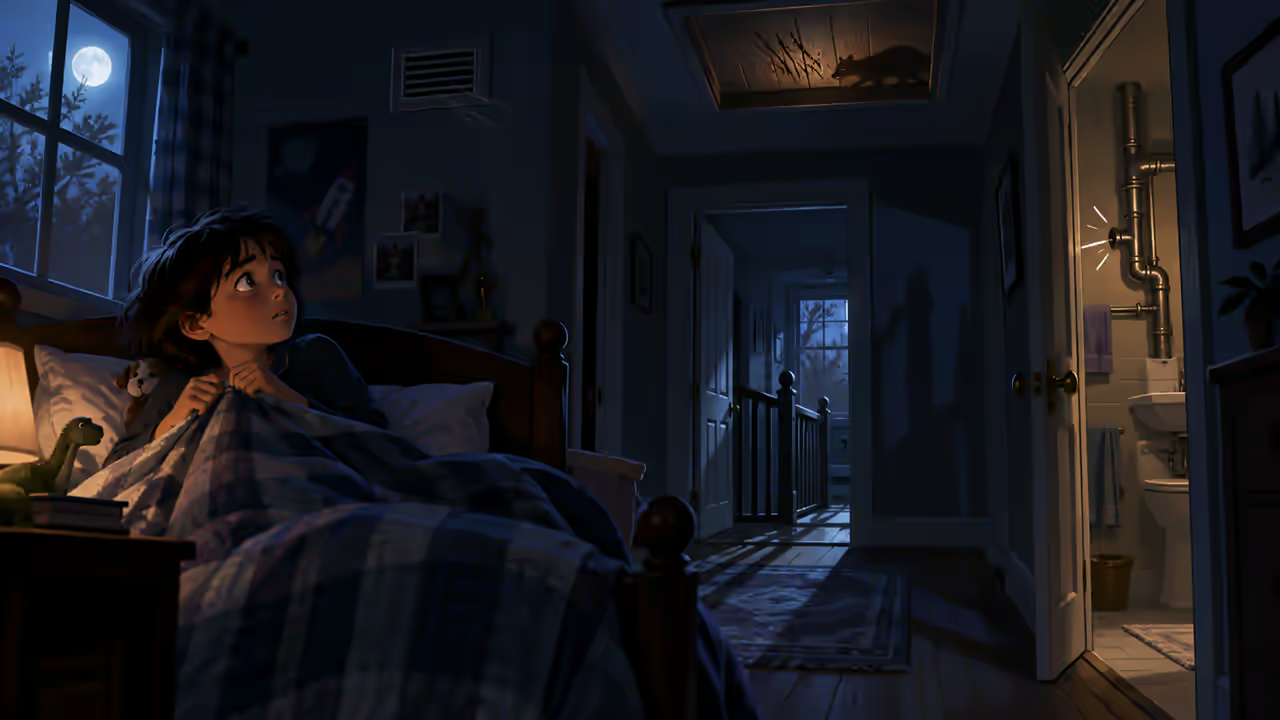
At 12:43 a.m., a boy named Eli woke to three knocks from inside the wall. Knock. Knock. Knock. He held his breath. The hallway was empty. A few seconds later came a long creak above the ceiling, then a scratch-scratch-scratch from the attic. Eli pulled the blanket to his nose. The house sounded as if it were answering him.
Then came one hard BANG from somewhere near the bathroom. Eli's imagination supplied the missing creature immediately: footsteps, claws, perhaps something that knew he was awake. But a good mystery starts by separating what happened from what we think happened. Buildings really do move. Canada's National Research Council notes that building materials need room for expansion and contraction caused by thermal changes, moisture and other forces. The sound is real; the monster is only one hypothesis.[1]
Clue 1: the house is not perfectly still
Wood, metal and other building materials can change size slightly as conditions change. Temperature can make materials expand or contract. Wood also responds strongly to moisture: Penn State Extension explains that wood can shrink as it loses moisture and swell as it gains moisture. In a real house, many pieces are fastened tightly together, so tiny movements can shift joints, rub surfaces or release stored stress.
That does not mean every nighttime creak has one guaranteed cause. A roof, wall, floor or duct can make different sounds for different reasons. The useful scientific habit is to ask whether the timing fits. Did outdoor temperature fall quickly? Did the heating system just turn on? Is the sound repeated from the same area? Those observations help turn a spooky guess into a testable explanation.[2]
Clue 2: water can make a surprisingly hard bang
The bathroom bang has another possible suspect: moving water. When flowing water changes speed very quickly, the change in momentum can create a pressure surge often called water hammer. The National Wildfire Coordinating Group defines water hammer as a force created by rapid acceleration or deceleration of water, commonly when a valve opens or closes too quickly.
In household plumbing, a sudden stop in flow can make pipes knock or bang against supports. Hearing one bang does not prove water hammer, but the hypothesis becomes stronger if the noise follows a toilet filling, a washing machine valve closing or another abrupt change in water flow. Again, sequence matters: event first, sound second.[3]
Clue 3: sometimes the scratching really is an animal
Not every strange sound comes from wood or pipes. Toronto's wildlife guidance notes that raccoons can enter through loose shingles and openings in attics, roofs and eaves. An animal moving above a ceiling can produce scratching, rustling or heavier thumps that sound much larger at night when the rest of the house is quiet.
This is where evidence beats imagination. A sound alone cannot tell you exactly which animal is present. Location, timing, footprints, an entry opening or a professional inspection would be stronger evidence. Eli's original thought—something is in the attic—might therefore be possible even though the ghost story is not needed to explain it.[4]
The quiet clue that deserves more respect
Now for the twist: one of the most important household dangers may make no spooky noise at all. Carbon monoxide, or CO, is produced when fuels burn. Health Canada says you cannot see, smell or taste it, and breathing it reduces the body's ability to carry oxygen in the blood. That is why a carbon-monoxide alarm matters more than whether a wall creaks at midnight.
If a CO alarm sounds, Health Canada's instruction is not to hunt through the house for the source. Leave the home immediately, move to fresh air, call 9-1-1 or emergency services from outside, and return only after the problem has been fixed by a professional. In a good science mystery, curiosity is important—but safety rules outrank curiosity.[5]
Why the story felt scarier before the explanation
The opening withheld causes and gave you sounds first: three knocks, a creak, scratching and a bang. That structure creates suspense because your brain has to fill gaps before enough evidence arrives. The explanatory sections reorganize the same mystery by possible mechanism: moving materials, moving water, wildlife and a separate safety hazard.
That change in structure is the reading lesson. A narrative asks, “What happens next?” An explanation asks, “What caused this, and what evidence supports it?” The same event can feel supernatural in a story and ordinary in a science investigation. The goal is not to stop enjoying scary stories. It is to know when you are enjoying suspense—and when a real alarm means it is time to act.[5]
Explore the instructional diagram
Fast lesson
Use these checks before you answer the practice questions.
Write down what was actually heard or seen before deciding what caused it. 'Three knocks' is data; 'ghost' and 'contracting wood' are competing explanations.
A scary opening often gives effects before causes. Explanatory nonfiction does the opposite: it names mechanisms and tests them against evidence.
If a bang consistently follows a fast valve closure, the timing supports a plumbing explanation more than an unrelated one.
A CO alarm is not a clue to investigate inside the house. Follow the official emergency response: leave and call from outside.
Common mistakes
Why this fails: Fear can generate a hypothesis quickly, but an explanation needs evidence.
Why this fails: Houses contain many moving systems and materials; one sound rarely identifies one cause by itself.
Why this fails: A single sound is weak evidence. Location, tracks, openings or inspection can narrow the explanation.
Why this fails: Health Canada says to leave immediately and call emergency services from outside.
Word Lab
Use the meaning, hear the word, then try it in your own sentence.
creak
noun / verbA long, small cracking or squeaking sound, often made when material moves under pressure.
A slow creak came from the ceiling after the room cooled.
expansion
nounAn increase in size or volume.
Heating can cause thermal expansion in some building materials.
contraction
nounA decrease in size or shortening.
Cooling can cause contraction.
moisture
nounA small amount of water held in air or material.
Wood can change size as its moisture content changes.
water hammer
nounA pressure surge caused when moving water changes speed very quickly.
A sudden valve closure can contribute to water hammer.
hypothesis
nounA possible explanation that can be tested with evidence.
The pipe-noise hypothesis became stronger after the washing machine valve closed.
evidence
nounInformation or observations that support, weaken or test an explanation.
Footprints would be stronger evidence of an attic animal than one unexplained scratch.
carbon monoxide
nounA colourless, odourless gas produced when fuels burn that can be dangerous to breathe.
A certified carbon-monoxide alarm can warn people about dangerous CO levels.
Check your understanding
Choose an answer, explain your choice, and then check. Hints and retries are welcome.
Try the questions here. Public practice does not save a learning record.
Foundation
Foundation practice
Separate the story's direct observations from the explanations that come later.
1. What four kinds of sounds appear in the opening?
2. Classify: 'Something scratched above the ceiling.'
3. Classify: 'A raccoon was in the attic.'
4. Why can building materials move even when nobody is walking through the house?
5. What does hypothesis mean in this article?
6. Which comes first in scientific reasoning: observation or conclusion?
Story Structure
Story Structure practice
Notice how suspense and explanation use the same clues differently.
7. Why does the opening repeat 'Knock. Knock. Knock.' instead of immediately explaining the sound?
8. What organizing pattern is used in the middle science sections?
9. What question drives the narrative part, and what question drives the science part?
10. How does the tone change after the first section?
11. Why include a fictional scary opening in a science reading?
12. Which heading most clearly signals the change from story to investigation?
Science Evidence
Science Evidence practice
Match each possible cause with the kind of evidence that would actually help.
13. What observation would support a temperature-related movement explanation?
14. How can changing moisture affect wood?
15. What is water hammer?
16. Which is stronger evidence of an attic raccoon: one scratch or footprints near an attic opening? Why?
17. Does a midnight bang prove there is a plumbing problem?
18. Why is carbon monoxide different from the spooky noises discussed earlier?
Synthesis
Synthesis practice
Use both reading structure and scientific reasoning to resolve the mystery carefully.
19. Summarize the article in two sentences.
20. Why is 'I cannot explain the sound, therefore it is supernatural' weak reasoning?
21. A bang happens every time the washing machine stops filling. Which hypothesis becomes more plausible: attic animal or water hammer?
22. You hear scratching above the ceiling. Name two pieces of evidence that could help test the animal hypothesis.
23. What is the purpose of the final carbon-monoxide section?
24. Give the three-column method this article recommends for another mystery.
Practice answer key
- 1. Knocks, a creak, scratching and a bang.
These concrete sounds create the mystery before causes are introduced. - 2. Observation.
It reports what was heard without naming a cause. - 3. Hypothesis.
It proposes a cause that needs additional evidence. - 4. Temperature, moisture and other forces can make materials expand, contract or shift slightly.
The NRC source describes movement from thermal changes, moisture and other forces. - 5. A possible explanation that can be tested with evidence.
A hypothesis is not simply a guess that must be accepted. - 6. Observation.
Starting with what actually happened helps prevent the explanation from outrunning the evidence. - 7. The repetition slows the moment and increases suspense before the cause is known.
The author controls information to make the reader experience uncertainty. - 8. Possible cause/mechanism followed by evidence and limits.
Each clue gets a scientific candidate explanation rather than continuing as pure narrative. - 9. Narrative: what happens next / what is making the sound? Science: what mechanism could cause it, and what evidence would support that mechanism?
The shift in questions marks the change in text structure. - 10. From fearful and uncertain to investigative and explanatory.
The content becomes calmer as mechanisms and evidence replace imagination. - 11. It creates curiosity and gives concrete clues that can later be re-examined scientifically.
The story is a hook and also supplies evidence for the later investigation. - 12. Any of the 'Clue' headings, especially 'Clue 1: the house is not perfectly still.'
The word clue reframes the noises as evidence to analyse. - 13. The sound repeatedly occurs as the house cools or the heating system changes temperature.
Timing tied to temperature change is relevant to expansion/contraction. - 14. Wood can shrink as it loses moisture and swell as it gains moisture.
Penn State Extension describes this dimensional response to moisture. - 15. A pressure surge/force created when moving water changes speed very quickly.
Rapid acceleration or deceleration can create the surge. - 16. Footprints near an opening.
They are more directly linked to an animal and a plausible entry route. - 17. No.
A bang is an observation; water hammer is only one possible explanation until timing and other evidence support it. - 18. It may have no smell, taste or colour and requires an alarm for detection; if the alarm sounds, the response is evacuation rather than investigation.
The danger may be silent, which is why the official safety rule is different. - 19. A frightening set of nighttime house sounds can have ordinary physical or biological causes such as material movement, plumbing pressure changes or wildlife. The article uses the mystery to teach observation, hypothesis and evidence, while separating harmless eerie sounds from the serious warning of a CO alarm.
A strong summary keeps both the story-to-science structure and the safety contrast. - 20. Not knowing the cause is missing information, not evidence for one particular extraordinary explanation.
A scientific conclusion needs positive evidence, not just an unexplained gap. - 21. Water hammer/plumbing pressure change.
The repeated timing links the bang to a rapid change in water flow. - 22. Examples: footprints, a visible entry opening, droppings, camera evidence or professional inspection.
These observations are more specific than sound alone. - 23. To show that what feels scary and what is actually dangerous can be different, and to give a clear safety response for a real hidden hazard.
The ending reverses the reader's expectations and turns the theme into a safety lesson. - 24. Observation → Hypothesis → Evidence needed.
The method slows down premature conclusions and makes explanations testable.
Related skills
Put it in your own words
This draft is not saved when you leave or refresh the page.
Check your own explanation
This is self-review, not automatic marking.
Compare with a model response
At 1:08 a.m., Maya heard a sharp bang from the wall behind the laundry room. The observation was simply a bang; it did not prove that anything was hiding there. One hypothesis was a plumbing pressure surge, because the washing machine had just stopped filling. Repeated timing between the valve closing and the bang would be useful evidence. That kind of noise can be eerie without being supernatural. A carbon-monoxide alarm would be different: everyone should leave immediately and call emergency services from outside.
Sources and revision notes
Source check: 2026-09-22. Grade guidance is an editorial suggestion, not a standardised reading score.
- National Research Council Canada — movement joints and building-material movement
- Penn State Extension — Why Does Lumber Need to be Dried?
- National Wildfire Coordinating Group — Water hammer definition
- City of Toronto — Raccoons: protecting your home
- Health Canada — Carbon monoxide: preventing exposure
What changed in this edition?
Initial release. Building-material movement, wood-moisture response, water-hammer mechanism, raccoon attic entry and carbon-monoxide safety guidance were checked against National Research Council Canada, Penn State Extension, NWCG, City of Toronto and Health Canada sources on 2026-09-22. The opening scene is original fiction; the scientific explanations and practice are original Study Commons material.