Daily Read / Short Story
Short Story · Track a character's feelings and choices, map problem and solution, and state a theme in your own words
Short Story: The Cracked Birdfeeder
An original story: Sam's soccer ball cracks a neighbour's birdfeeder. Follow his choices, read his feelings from clues, and work out the story's message.
Device/browser voice. Pronunciation and availability vary.
One bad kick
This is an original short story. The characters and events are invented. Sam had been practising the same kick against the fence for a week. On Saturday morning, he leaned back too far, and the ball sailed over the fence into Mr. Okafor's yard. There was a sharp crack, then silence.
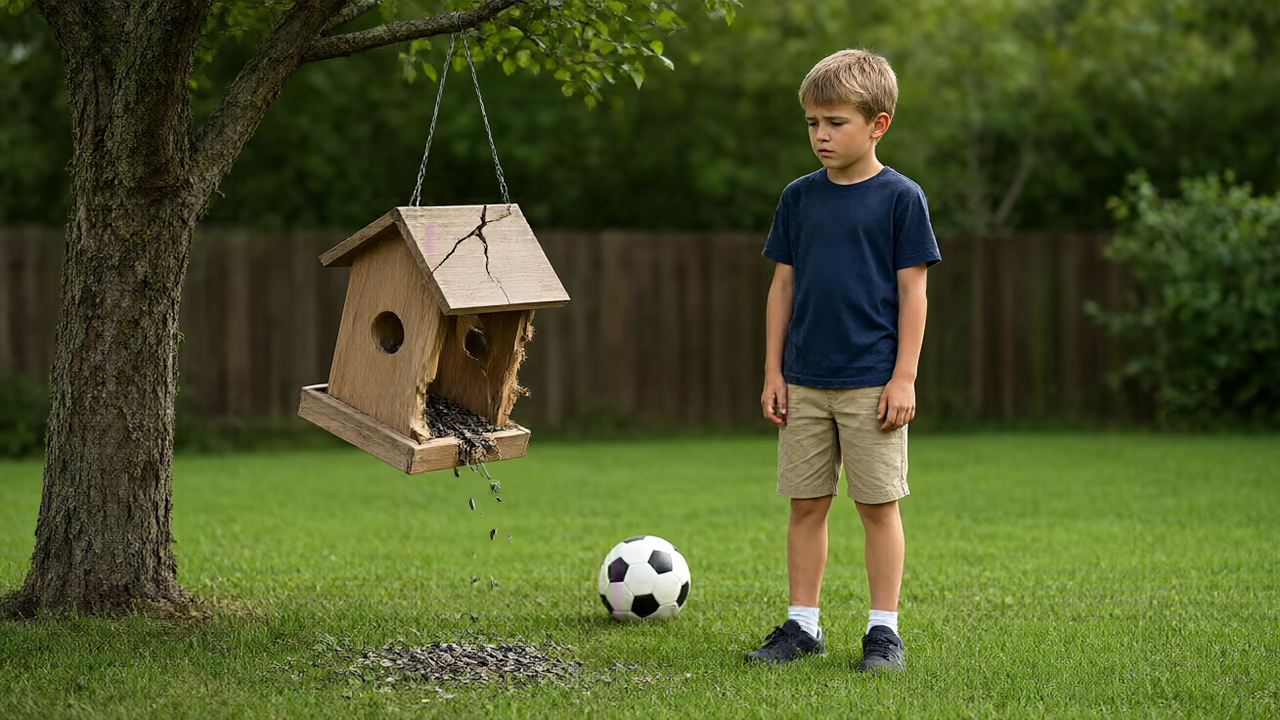
Sam climbed onto the recycling bin and looked over. Mr. Okafor's wooden birdfeeder hung crooked from its branch. A long split ran down one side, and sunflower seeds were spilling onto the grass. No one was in the yard. The kitchen curtains were closed.[1]
Three ideas
Sam's stomach dropped. He climbed down and sat on the back step with his knees pulled up. Nobody saw, he thought. I could just leave the ball there. Then he had a second idea: squirrels were always climbing on that feeder. Mr. Okafor might think a squirrel had knocked it.
The third idea was the one he liked least. He could knock on the door and tell the truth. Just thinking about it made his face feel hot. Mr. Okafor had built that feeder himself. Sam had watched him paint the little roof green last spring.[1]
The tape does not hold
Sam decided to fix it before anyone noticed. He found a roll of clear tape in the kitchen drawer and slipped through the gap in the fence. He wrapped the tape around the crack again and again until the feeder looked almost whole. Then he scooped up his ball and hurried home.
After lunch, Sam checked from his bedroom window. Two chickadees landed on the feeder. As soon as they started to eat, the tape peeled loose and the side swung open. Seeds poured out, and the birds flew off. Sam watched the empty feeder sway in the wind for a long time.[1]
Knocking
At three o'clock, Sam stood on Mr. Okafor's front step. He knocked so softly that he had to knock again. When the door opened, the words came out all at once. "I kicked my ball over the fence and it cracked your birdfeeder and I tried to tape it but the tape didn't work and I'm sorry."
Mr. Okafor looked at him for a moment. Then he walked to the backyard, and Sam followed. He turned the feeder over in his hands. "Tape doesn't like wet wood," he said. "Screws and a little glue will do better." He looked at Sam. "You could have let me blame the squirrels." Sam stared at his shoes. "I thought about it," he admitted.[1]
A new side
Mr. Okafor brought out a toolbox and a piece of leftover board. He measured, and Sam held the board steady while it was cut. Sam drove in the last two screws himself, slowly, the way Mr. Okafor showed him. When they hung the feeder back on its branch, the new side was a lighter colour than the rest.
"It looks a bit patched," Sam said. "It is patched," said Mr. Okafor. "That's how you can tell somebody fixed it properly." The next morning, Sam counted four chickadees at the feeder. He practised his kick facing the other way.[1]
Fast lesson
Use these checks before you answer the practice questions.
The story never names Sam's feelings. Underline every body clue (stomach dropped, face hot, soft knock, staring at shoes) and name the feeling together.
If the child's theme includes 'Sam' or 'birdfeeder', ask them to say it again so it could be true for anyone.
Mr. Okafor does not punish Sam. Ask why the author might have made him patient, and how the story would change if he had shouted.
Common mistakes
Why this fails: The ball starts the trouble, but the conflict is Sam's decision about honesty.
Why this fails: A theme is a lesson that could apply to other people, not a list of events.
Why this fails: He only considered it. He told Mr. Okafor the truth, including that he had thought about it.
Word Lab
Use the meaning, hear the word, then try it in your own sentence.
crooked
adjectivenot straight; bent or tilted to one side
The birdfeeder hung crooked from its branch.
split
nouna long, narrow crack or break
A long split ran down one side of the feeder.
admit
verbto say that something is true, often something you did wrong
"I thought about it," Sam admitted.
blame
verbto say that someone or something caused a problem
Sam thought about letting Mr. Okafor blame the squirrels.
patched
adjectiverepaired by adding a new piece
The feeder looked a bit patched.
sway
verbto move slowly from side to side
The empty feeder swayed in the wind.
character trait
noun phrasea word that describes what a person is like, such as honest or careful
Honest is one of Sam's character traits by the end.
conflict
nounthe problem a character must face in a story
Sam's conflict is whether to tell the truth.
resolution
nounthe part of a story where the problem is solved
In the resolution, Sam and Mr. Okafor fix the feeder together.
theme
nounthe big idea or lesson a story shows
The theme is about owning a mistake.
infer
verbto work out something the author does not say directly, using clues
We can infer that Sam feels guilty.
Check your understanding
Choose an answer, explain your choice, and then check. Hints and retries are welcome.
Try the questions here. Public practice does not save a learning record.
Support · Find it in the story
Support · Find it in the story practice
Point to the sentence that gives the answer.
1. What did Mr. Okafor paint green last spring?
2. What were Sam's three ideas?
3. What did Sam use for his first repair?
4. According to Mr. Okafor, what works better than tape?
5. How many chickadees did Sam count the next morning?
6. What did Sam change about his soccer practice?
Apply · Read the clues
Apply · Read the clues practice
The author shows feelings instead of naming them. Explain what the clue shows.
7. What does 'Just thinking about it made his face feel hot' show about Sam?
8. Why does Sam knock 'so softly that he had to knock again'?
9. Why do the words come out 'all at once'?
10. Why does Sam 'stare at his shoes' when he admits he thought about blaming the squirrels?
11. Why does the author show the tape failing instead of letting it work?
12. Name one character trait of Mr. Okafor and give a clue.
Reason · Story map and theme
Reason · Story map and theme practice
Organise the whole story and explain its message.
13. Fill in the story map: setting, main characters, problem, attempts, resolution.
14. Which moment is the turning point, where Sam's choice changes?
15. State the theme in your own words, without using the names Sam or Mr. Okafor.
16. Give two pieces of evidence that support your theme.
17. If the ball goes over the fence again next week, what do you think Sam will do? Explain using the story.
Practice answer key
- 1. The little roof of the birdfeeder.
Sam remembers watching him paint it, which is one reason telling feels hard. - 2. Leave the ball and say nothing, let Mr. Okafor think a squirrel did it, or knock and tell the truth.
They appear in 'Three ideas'. - 3. Clear tape from the kitchen drawer.
He wrapped it around the crack again and again. - 4. Screws and a little glue.
He says tape does not like wet wood. - 5. Four.
Earlier only two came, and they flew away when the tape failed. - 6. He practised facing the other way.
It is the last sentence of the story. - 7. He feels embarrassed or nervous about telling the truth.
A hot face is a body clue for embarrassment. - 8. He is nervous and part of him hopes no one will answer.
The soft knock shows he is unsure, even though he has decided to go. - 9. He wants to get the hard part over before he loses his courage.
One long sentence with no pauses matches how nervous he is. - 10. He feels ashamed of that idea, but he still tells the truth about it.
Looking down is a common sign of shame; admitting it anyway shows his honesty growing. - 11. It shows that hiding the problem does not really fix it and pushes Sam toward the honest choice.
The failed tape is the turning point of the plot. - 12. Patient or kind: he teaches Sam to fix the feeder instead of getting angry.
Any trait backed by a specific action from the story is a good answer. - 13. Setting: Sam's and Mr. Okafor's backyards on a Saturday. Characters: Sam, Mr. Okafor. Problem: Sam cracks the feeder and must decide whether to tell. Attempts: secret tape repair (fails). Resolution: Sam tells the truth and they fix it with screws and glue.
A story map shows how the events connect. - 14. When he watches the taped feeder break and the chickadees fly away.
Before it, he is hiding; after it, he goes to the door. - 15. Example: Admitting a mistake is uncomfortable, but it lets you fix things properly.
Leaving out the names checks that it is a general lesson, not a summary. - 16. Example: the secret tape fix fails; after Sam tells, they make a strong repair together and four chickadees return.
Good evidence comes from different parts of the story. - 17. Probably knock and tell right away, because he learned that telling led to a better result. This is a prediction.
A prediction should use the character's change as evidence.
Related skills
Put it in your own words
This draft is not saved when you leave or refresh the page.
Check your own explanation
This is self-review, not automatic marking.
Compare with a model response
At the start of the story, Sam is tempted to hide his mistake. He thinks about leaving his ball or letting Mr. Okafor blame the squirrels, and his stomach drops when he sees the cracked feeder. He tries to fix it secretly with tape. The turning point comes when he watches the tape fail and the chickadees fly away, and he keeps staring at the empty feeder. After that, he knocks on Mr. Okafor's door, even though he knocks very softly because he is nervous. He tells the whole truth, and they fix the feeder properly together. By the end, Sam is willing to own and repair his mistakes. The theme is that admitting a mistake is hard, but it is the only way to fix it properly.
Sources and revision notes
Source check: 2026-10-25. Grade guidance is an editorial suggestion, not a standardised reading score.
What changed in this edition?
Original fiction. All characters, places and events are invented. The source supports the story-map strategy used in the practice, not the story's events.