Daily Read / Living Things and Soil
Living Things and Soil · Put the steps of a cycle in order, explain each decomposer's job, and use cause and effect to explain why some leaves break down faster
Where Do Fallen Leaves Go? How Decomposers Recycle the Forest Floor
Trees drop new leaves every fall, yet forests are not buried. Meet the shredders, fungi and bacteria that break leaves down and return nutrients to the soil.
Device/browser voice. Pronunciation and availability vary.
A puzzle on the forest floor
Every fall, the trees in an Ontario forest drop a fresh layer of leaves. The next fall, they drop another layer, and the year after that, another. If the old leaves simply stayed, the forest floor would get deeper and deeper. But when you walk through a forest, you find only a soft layer of leaves on top of dark soil. So where did all the old leaves go?
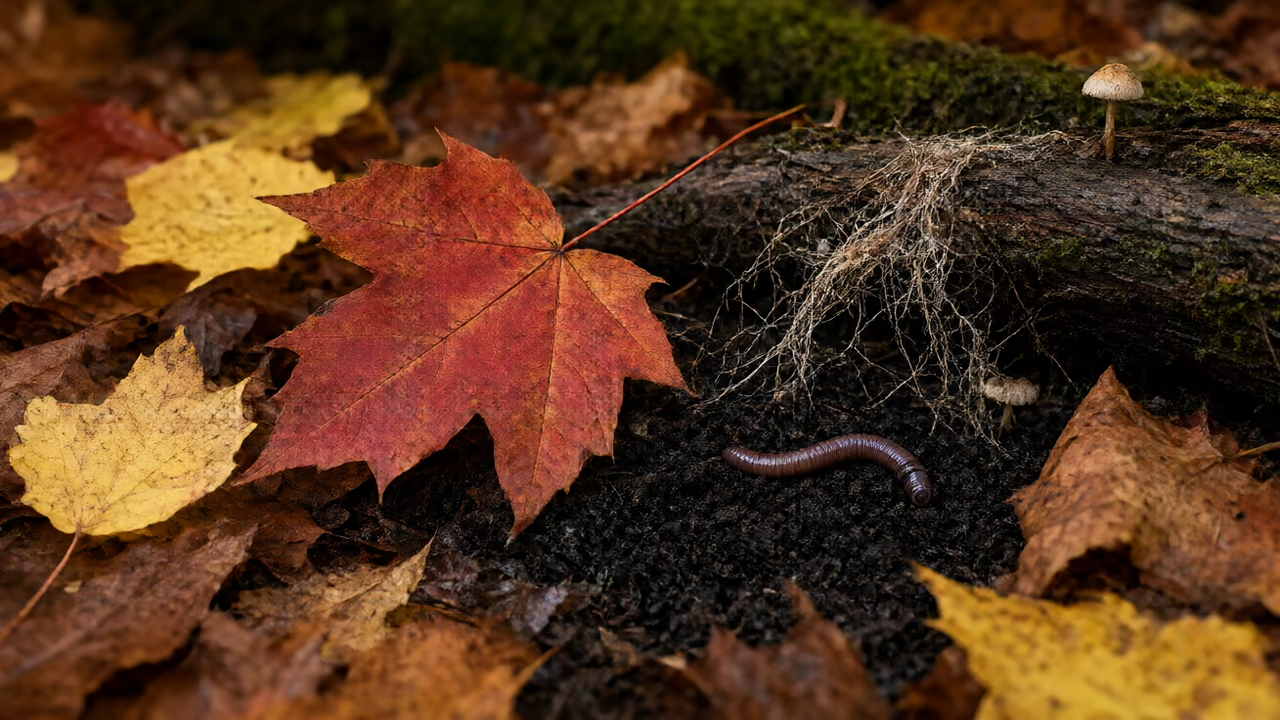
The layer of fallen leaves, twigs and other dead plant parts is called leaf litter. It may look like garbage, but it is full of life. Leaf litter is a home for many tiny creatures and a source of food and nutrients for them. Dead leaves feed the living.[1]
The FBI of the forest floor
The living things that break down dead plants and animals are called decomposers. Credit Valley Conservation, an Ontario conservation authority, gives them a nickname: the FBI. In this case, FBI stands for fungi, bacteria and invertebrates. Invertebrates are small animals without backbones.
Each member of the FBI has a different job. The invertebrates break leaves into smaller pieces. The fungi and bacteria do the chemistry: they break the leaf material down so far that its nutrients go back into the soil.[1]
Step 1: The shredders
Earthworms, millipedes, woodlice and snails all feed on dead leaves. As they chew, nest and dig, they tear the leaves into smaller and smaller pieces. Small pieces have more surface for the tiny decomposers to work on.
These animals digest only a small part of what they eat. Most of it comes back out as droppings. In one laboratory study, scientists compared the droppings with the dead leaves the animals had eaten. On average, the droppings broke down 38 per cent faster than the leaves. So the shredders do not finish the job, but they help speed it up.[2]
Step 2: The tiny digesters
Most of the work is done by living things far too small to see one at a time: fungi and bacteria. Fungi grow thin threads called hyphae through the leaves. The hyphae release enzymes, chemicals that break down the tough walls of the leaf's cells. Then the fungus can take in the nutrients that were locked inside.
Bacteria work on an even smaller scale. They help break down the leaf one cell at a time. Together, fungi and bacteria slowly turn a stiff leaf into soft, dark crumbs that you can no longer recognize as a leaf.[3]
Where it all goes
A leaf contains carbon, along with nutrients such as nitrogen. When decomposers break it down, the nutrients return to the soil. Tree roots can take them up again and use them to grow new leaves. The microbes also release carbon back into the air as carbon dioxide, a gas.
That is why scientists describe decomposition as recycling. Nothing is thrown away. The same nutrients can move from soil to tree to leaf to soil again, year after year.[2]
Fast leaves and slow leaves
Not every leaf breaks down at the same speed. Temperature, moisture, how acidic the soil is and the type of plant all make a difference. Decomposition is much slower in soil that is very dry or very wet. Broad, thin aspen leaves break down faster than the needles of fir, spruce and pine trees. Leaves that are thick, tough and low in nutrients, such as pine or beech leaves, break down more slowly than soft leaves with more nutrients.
The whole process can take many years. So the leaf litter you walk on is a mix of this year's leaves on top and older, more broken-down leaves underneath. Credit Valley Conservation even suggests that people leave some fallen leaves where they land, because leaf litter is part of a healthy ecosystem.[3]
Explore the instructional diagram
Fast lesson
Use these checks before you answer the practice questions.
Before the questions, ask your child to draw the cycle from the diagram from memory: leaf, shredders, fungi and bacteria, soil, roots, new leaf. Most questions can be answered from that drawing.
The key comparison is that shredders make pieces smaller, while fungi and bacteria change what the pieces are made of. Ask: which one could you see happening with your eyes?
Use the 38 per cent result to practise asking: who measured it, where, and what were they comparing? The answer is one lab study, on average, droppings versus leaves.
Common mistakes
Why this fails: Shredders help, but the article says fungi and bacteria do most of the work of breaking leaves down.
Why this fails: Roots take up nutrients from the soil after decomposers have released them, not leaf pieces.
Why this fails: The material goes somewhere: nutrients go into the soil and carbon goes into the air as carbon dioxide.
Word Lab
Use the meaning, hear the word, then try it in your own sentence.
decomposer
nouna living thing that breaks down dead plants and animals
Fungi are important decomposers on the forest floor.
decompose
verbto break down slowly into smaller parts after dying
Thin leaves decompose faster than pine needles.
leaf litter
noun phrasethe layer of fallen leaves and dead plant parts on the ground
Millipedes live in the leaf litter.
invertebrate
nounan animal without a backbone
An earthworm is an invertebrate.
fungi
noun (plural)living things such as moulds and mushrooms that feed on dead material; one is a fungus
Fungi grow threads through the dead leaves.
bacteria
noun (plural)living things made of a single tiny cell
Bacteria break down a leaf one cell at a time.
hyphae
noun (plural)the thin threads that make up most of a fungus
Hyphae spread through the leaf like tiny roots.
enzyme
nouna chemical made by a living thing that helps break something down or build something up
Fungi release enzymes that break down cell walls.
nutrient
nouna substance that living things need to grow and stay healthy
Nitrogen is a nutrient that trees need.
carbon dioxide
noun phrasea gas in the air that living things give off
Microbes release carbon dioxide as they break down leaves.
cycle
nouna set of events that happen again and again in the same order
Nutrients move in a cycle from soil to tree and back.
ecosystem
nounall the living and non-living things in an area and how they affect each other
Leaf litter is part of a healthy forest ecosystem.
Check your understanding
Choose an answer, explain your choice, and then check. Hints and retries are welcome.
Try the questions here. Public practice does not save a learning record.
Support · Find it in the text
Support · Find it in the text practice
Each answer is stated in the article. Point to the sentence.
1. What is leaf litter?
2. Name four animals that feed on dead leaves.
3. What is an invertebrate?
4. What are the thin threads that fungi grow through leaves called?
5. Which gas do microbes release as they break down leaves?
6. Which break down faster: aspen leaves or pine needles?
Apply · Explain the reason
Apply · Explain the reason practice
Use 'because' and a detail from the article.
7. Why is the forest floor not buried metres deep in old leaves?
8. Why does the article say 'Dead leaves feed the living'?
9. The shredders do not finish breaking down leaves. Why are they still important?
10. Why do fungi need enzymes?
11. How can a nutrient from last year's leaf end up in this year's leaf?
12. Why is the bottom of the leaf litter darker and more crumbly than the top?
Reason · Order and compare
Reason · Order and compare practice
Put the cycle in order, compare decomposers and judge evidence.
13. Put these in order: roots take up nutrients; leaf falls; fungi release enzymes; millipede chews the leaf; nutrients enter the soil.
14. Compare the job of a millipede with the job of a fungus.
15. A classmate says, 'The study proves that every forest breaks down leaves 38 per cent faster because of worms.' What is wrong with this?
16. Give two conditions that slow decomposition, according to the article.
17. If you put leaves in a sealed, dry container with no soil, what would you predict, and why?
Practice answer key
- 1. The layer of fallen leaves, twigs and other dead plant parts on the forest floor.
It is defined in the first section. - 2. Earthworms, millipedes, woodlice and snails.
They are listed at the start of 'Step 1: The shredders'. - 3. A small animal without a backbone.
The definition is in 'The FBI of the forest floor'. - 4. Hyphae.
'Step 2' names them. - 5. Carbon dioxide.
It is in 'Where it all goes'. - 6. Aspen leaves.
The last section compares broad aspen leaves with fir, spruce and pine needles. - 7. Because decomposers keep breaking old leaves down and returning their nutrients to the soil.
This answers the puzzle in the first section. - 8. Because leaf litter is food and a home for many small creatures, and its nutrients later feed plants.
Leaf litter is a source of food and nutrients. - 9. They tear leaves into small pieces with more surface, and their droppings break down faster than whole leaves.
Both reasons appear in 'Step 1'. - 10. Because the nutrients are locked inside tough cell walls, and enzymes break those walls down.
'Step 2' describes the enzymes breaking the cell walls. - 11. Decomposers return it to the soil, tree roots take it up, and the tree uses it to grow new leaves.
This is the cycle in 'Where it all goes'. - 12. Because the bottom leaves are older and have been breaking down for longer.
The last section says the process takes years, so older leaves lie underneath. - 13. Leaf falls → millipede chews the leaf → fungi release enzymes → nutrients enter the soil → roots take up nutrients.
Shredding comes first, the tiny digesters release the nutrients, and only then can roots use them. - 14. The millipede breaks leaves into smaller pieces; the fungus uses enzymes to break the leaf material down chemically and release nutrients.
One works on the size of the pieces, the other on what the pieces are made of. - 15. The 38 per cent was an average from one laboratory study comparing droppings with leaves. It does not measure every forest, and it was not only about worms.
Check where a number came from and what it compared before stretching it. - 16. Any two of: very dry soil, very wet soil, tough thick leaves or needles, leaves that are low in nutrients.
The last section lists these causes. - 17. They would break down very slowly, because there is little moisture and no soil animals, fungi or bacteria from the soil to work on them.
This is a prediction. You would need to test it to be sure.
Related skills
Put it in your own words
This draft is not saved when you leave or refresh the page.
Check your own explanation
This is self-review, not automatic marking.
Compare with a model response
When a leaf falls in the forest, it becomes part of the leaf litter. First, invertebrates such as millipedes and earthworms chew and tear it into smaller pieces, and most of what they eat comes out as droppings. Next, fungi grow hyphae through the pieces and release enzymes that break down the leaf's cell walls, while bacteria break it down one cell at a time. As the leaf decomposes, its nutrients go back into the soil, and the microbes release carbon into the air as carbon dioxide. Tree roots take up the nutrients and use them to grow new leaves, so the cycle starts again. Not all leaves break down at the same speed. Thick, tough pine needles and leaves in very dry soil decompose more slowly than thin aspen leaves.
Sources and revision notes
Source check: 2026-10-26. Grade guidance is an editorial suggestion, not a standardised reading score.
- Credit Valley Conservation — What Lurks Beneath the Leaves (Countryside Stewardship Mail, November 4, 2024)
- Frontiers for Young Minds — Joly, F.-X. and Subke, J.-A. (2022), The Bizarre Role of Soil Animals in the Decomposition of Dead Leaves
- Walking Mountains Science Center — Where Do the Leaves Go? (Lara Carlson; posted September 21, 2020)
What changed in this edition?
The FBI nickname, the habitat role of leaf litter and the suggestion to leave some leaves come from Credit Valley Conservation. The list of shredders, the droppings result (38 per cent faster on average in one laboratory study), the carbon dioxide release and the leaf-toughness comparison come from Frontiers for Young Minds. Hyphae, enzymes, the role of bacteria, the factors that change decomposition speed, the aspen-versus-needles comparison and the many-years timescale come from Walking Mountains. The cycle diagram is a simplified schematic, not to scale.