Daily Read / Living Things in Winter
Living Things in Winter · Compare three survival strategies and put the steps of a process in order
Where Do Frogs Go in Winter? Three Ways to Survive the Cold
Ontario frogs can't fly south or make their own heat. Read how some rest under the ice, some dig deep, and some freeze, then compare the three plans.
Device/browser voice. Pronunciation and availability vary.
The silent pond
Walk past an Ontario pond on a warm evening in May and you may hear frogs calling from every direction. Walk past the same pond in January and it is silent, covered with ice and snow. The frogs have not gone anywhere. They cannot fly south like geese, and they cannot make their own body heat the way you can. A frog's body warms and cools with its surroundings.
So when winter comes, every frog needs a safe place to wait. Different kinds of frogs have found very different answers. Most use one of three plans: rest underwater, dig underground, or spend the winter partly frozen on land.[1]
Plan 1: Under the ice
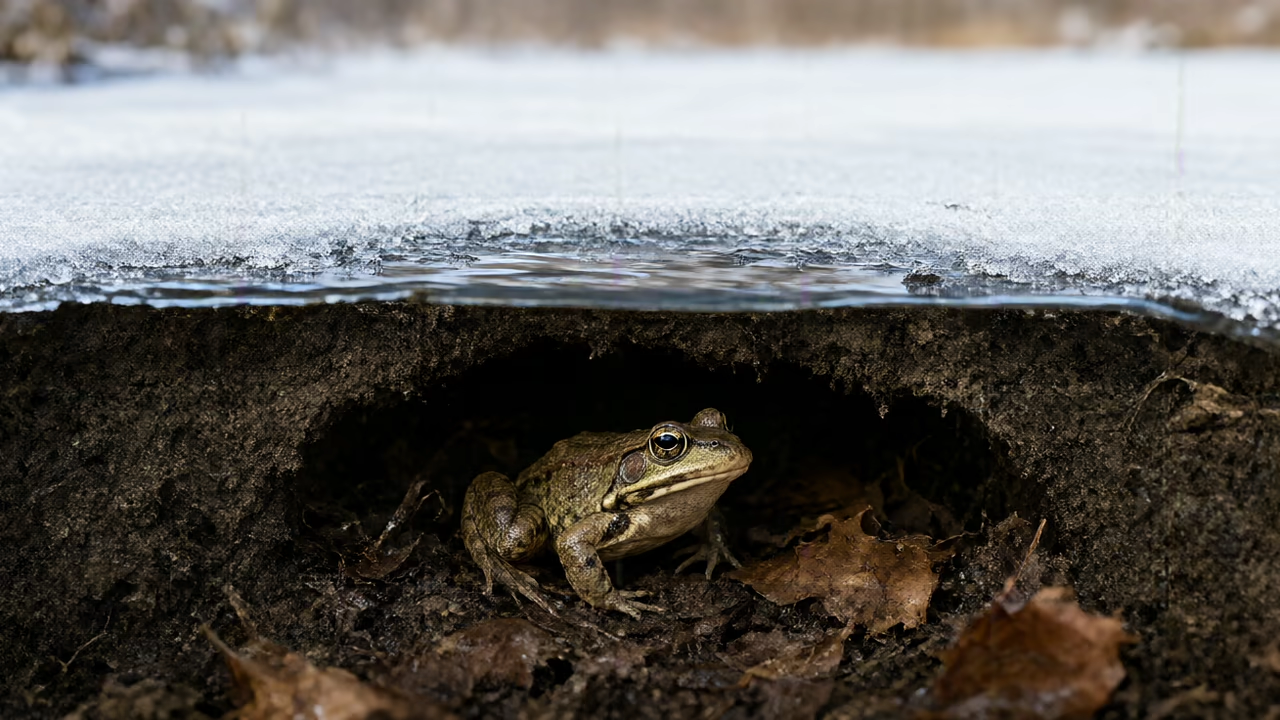
Bullfrogs, green frogs and mink frogs spend the winter in water. They settle on the bottom of a pond or stream, among rocks, logs or roots. Ice forms on the surface, but the water underneath stays liquid, just a little above freezing.
A frog under the ice does not swim up to breathe air. Instead, it takes in oxygen through its skin. Cold water can hold more oxygen than warm water, and moving water brings a fresh supply. That is why these frogs rest on top of the mud instead of burying themselves deep inside it, where there would not be enough oxygen.[1]
Plan 2: Below the frost line
The American toad chooses a different hiding place: underground. The edges of a toad's back feet have hard, knobby bumps that work like small shovels. In the fall, the toad uses them to dig into loose soil, often more than 50 centimetres down.
Why so deep? Near the surface, the ground can freeze solid in winter. Farther down, below a level called the frost line, the soil does not freeze. The toad waits there, cold but not frozen, until the soil warms up in spring.[1]
Plan 3: Freeze, and survive
The wood frog, spring peeper, gray treefrog and chorus frog are poor diggers. They tuck themselves under fallen leaves or loose bark, where the winter cold can reach them. These frogs do something that sounds impossible: they let part of their bodies freeze.
When the temperature around a wood frog drops to about −5°C, ice crystals begin to form in its body. Roughly 40 per cent of the water in its body can turn to ice. The frog stops breathing. Its blood stops flowing. Its heart stops beating. If you found it under the leaves, it would feel hard and cold, and you might think it was dead.[1]
The sugar that protects the cells
For most living things, freezing is deadly. As ice forms in the body, it pulls water out of nearby cells. The cells shrink and are damaged. A wood frog protects its cells with sugar. Its body builds up glucose, a kind of sugar, to as much as ten times the usual amount. The glucose lowers the temperature at which the frog's tissues freeze and helps its cells resist shrinking.
Scientists who studied wood frogs in Alaska reported that up to 60 per cent of a frog's body can freeze there, and that some frogs stay frozen for as long as seven months. That number is larger than the Ontario figure. The two reports describe frogs in different places, and one counts the water in the body while the other describes the whole body. It makes sense to treat the numbers as a range rather than one exact fact.[3]
Spring wakes the pond
In spring, the frozen frog thaws, sometimes in as little as a day. Its heart starts beating again, it begins to breathe, and soon it can hop away.
So the silent pond in January is not empty. Some frogs are resting on the bottom under the ice. A toad may be buried in the ground nearby. Other frogs lie frozen under the leaves at the edge of the woods. Each one is waiting for spring in its own way.[1]
Explore the instructional diagram
Fast lesson
Use these checks before you answer the practice questions.
Columns: Under the ice, Below the frost line, Frozen on land. Rows: which animals, where, what keeps it alive. Most questions can be answered from this chart.
The big comparison is that two plans avoid freezing and one survives freezing. Ask the learner to sort the plans this way before reading the glucose section.
Use the 40 and 60 per cent figures to practise checking where a number comes from and what it measures before deciding a source is wrong.
Common mistakes
Why this fails: Only freeze-tolerant frogs on land freeze. Aquatic frogs and toads survive by staying somewhere that does not freeze.
Why this fails: They take in oxygen through their skin; that is why they stay where oxygen-rich water reaches them.
Why this fails: The heart stops. Glucose protects the cells from freezing damage until the frog thaws.
Word Lab
Use the meaning, hear the word, then try it in your own sentence.
hibernate
verbto rest through winter with the body working very slowly
Green frogs hibernate on the bottom of ponds.
surroundings
nounthe place and conditions around something
A frog's body warms and cools with its surroundings.
oxygen
nouna gas that animals need to stay alive
Frogs under the ice take in oxygen through their skin.
frost line
noun phrasethe depth below which the ground does not freeze
The toad dug below the frost line.
freeze-tolerant
adjectiveable to survive having part of the body frozen
The wood frog is freeze-tolerant.
ice crystal
noun phrasea tiny piece of ice with a regular shape
Ice crystals formed in the frog's body at about −5°C.
glucose
nouna kind of sugar that living things make and use
The frog's body built up glucose.
tissue
nouna group of similar cells that work together in a body
Glucose helps the frog's tissues resist freezing.
thaw
verbto warm up so that ice melts
The frog can thaw in as little as a day.
leaf litter
noun phrasea layer of fallen leaves on the ground
Spring peepers hide in leaf litter.
strategy
nouna plan for reaching a goal
Digging deep is the toad's winter strategy.
range
nounthe span between a lower and a higher number
The reports give a range from 40 to 60 per cent.
Check your understanding
Choose an answer, explain your choice, and then check. Hints and retries are welcome.
Try the questions here. Public practice does not save a learning record.
Support · Find it in the text
Support · Find it in the text practice
Each answer is stated directly. Point to the sentence.
1. Name the three frogs that spend the winter on the bottom of ponds or streams.
2. How deep does an American toad often dig?
3. What part of the toad's body works like a small shovel?
4. At about what temperature do ice crystals begin to form in a wood frog?
5. Where do freeze-tolerant frogs spend the winter?
6. How quickly can a thawed frog in Ontario be ready to hop away?
Apply · Explain the reason
Apply · Explain the reason practice
Use 'because' and a detail from the article.
7. Why can't a frog keep itself warm through the winter the way you can?
8. Why is cold, moving water good for a frog under the ice?
9. Why does the toad dig below the frost line instead of staying near the surface?
10. Why is freezing usually deadly for living things?
11. The spring peeper is a poor digger. How does that help explain where it spends the winter?
12. Which two plans avoid freezing, and which plan survives freezing?
Reason · Order and compare
Reason · Order and compare practice
Put steps in order, compare plans and judge evidence.
13. Put the wood frog's year in order: thaws, freezes, hides under leaves, heart starts again.
14. Give one way a wood frog's winter is harder than a bullfrog's.
15. A friend says, 'The Alaska study proves that Ontario wood frogs freeze 60 per cent.' What is wrong with that claim?
16. Why do you think the author starts and ends with the silent pond?
17. Ice covers a pond much longer than usual one spring. Which group of frogs would wait longest to become active, and why?
Practice answer key
- 1. Bullfrogs, green frogs and mink frogs.
They are listed at the start of 'Plan 1: Under the ice'. - 2. More than 50 centimetres.
'Plan 2' says it often digs more than 50 centimetres down. - 3. The hard, knobby edges of its back feet.
The text compares the knobby bumps on its back feet to shovels. - 4. About −5°C.
'Plan 3' gives this temperature. - 5. Under fallen leaves or loose bark.
They are poor diggers, so they use leaf litter or bark. - 6. In as little as a day.
The last section gives this timing. - 7. Because a frog cannot make its own body heat; its body warms and cools with its surroundings.
This is stated in the first section and is the reason every frog needs a winter plan. - 8. Cold water holds more oxygen, and moving water brings a fresh supply.
The frog takes in that oxygen through its skin. - 9. Because the ground near the surface can freeze solid, but the soil below the frost line does not.
The toad avoids freezing by going deep. - 10. Ice pulls water out of nearby cells, so the cells shrink and are damaged.
This explains why the wood frog's glucose matters. - 11. Because it cannot dig deep, it hides under leaves or bark where it may freeze, so it must survive freezing.
Its hiding place and its freeze tolerance go together. - 12. Underwater and underground avoid freezing; the leaf-litter plan survives freezing.
Sorting the plans this way is the key comparison in the article. - 13. Hides under leaves → freezes → thaws → heart starts again.
The frog must be in its hiding place before the cold arrives, and the heart restarts as the body thaws. - 14. The cold reaches the wood frog under the leaves, so part of its body freezes; the bullfrog's water stays liquid.
Any answer that names the exposure to freezing is supported. - 15. The Alaska study describes frogs in Alaska, not Ontario, and it measures the whole body rather than body water.
A result from one place and one measure should not be stretched to another without evidence. - 16. It sets up the puzzle (where did the frogs go?) and then answers it once all three plans are explained.
Opening and closing with the same scene is a common way to frame a comparison text. - 17. Probably the frogs under the ice, because they cannot leave the water until it opens up. This is a prediction, not something the article states.
A good prediction uses the text and says clearly that it goes beyond it.
Related skills
Put it in your own words
This draft is not saved when you leave or refresh the page.
Check your own explanation
This is self-review, not automatic marking.
Compare with a model response
Ontario frogs and toads survive winter in three different ways. Bullfrogs and green frogs rest on the bottom of ponds, where the water stays just above freezing and they take in oxygen through their skin. The American toad digs more than 50 centimetres down, below the frost line, where the soil does not freeze. Unlike these two, the wood frog hides under leaves and lets part of its body freeze at about −5°C. Its heart and breathing stop, but glucose helps protect its cells. In spring it thaws and its heart starts again. In my opinion, the wood frog's plan is the most surprising, because the article says a frozen frog could look dead and still recover.
Sources and revision notes
Source check: 2026-10-25. Grade guidance is an editorial suggestion, not a standardised reading score.
- Ontario Parks blog (David LeGros, Algonquin Provincial Park) — Underground, underwater or frozen solid: how do frogs & toads spend the winter?
- Scientific American — How do frogs survive winter? Why don't they freeze to death? (answer by Rick Emmer, Cleveland Metroparks Zoo)
- Audubon — Frogs Freeze to Survive the Alaskan Winter (2014, reporting work by Brian Barnes and Don Larson)
What changed in this edition?
Species lists, the 50-centimetre digging depth, the −5°C freezing temperature, the 40 per cent body-water figure and the one-day thaw come from the Ontario Parks article. The 60 per cent, seven-month and ten-times-glucose figures come from the Audubon report on Alaskan wood frogs and are not presented as Ontario measurements. The diagram is a schematic, not to scale. The Scientific American answer independently supports the points that aquatic frogs avoid burying deep in mud and that glucose helps protect a freezing frog's organs.