Daily Read / Canada and Community
Canada and Community · Build a timeline from dates in a text, explain cause and effect, and compare how different sources report the same details
Why Do Canadians Wear Poppies? The Story Behind Remembrance Day
Each November, millions of Canadians pin on a small red poppy. Trace the symbol from a 1915 poem to today's ceremonies, and learn why everything pauses at 11 o'clock.
Device/browser voice. Pronunciation and availability vary.
A small red pin
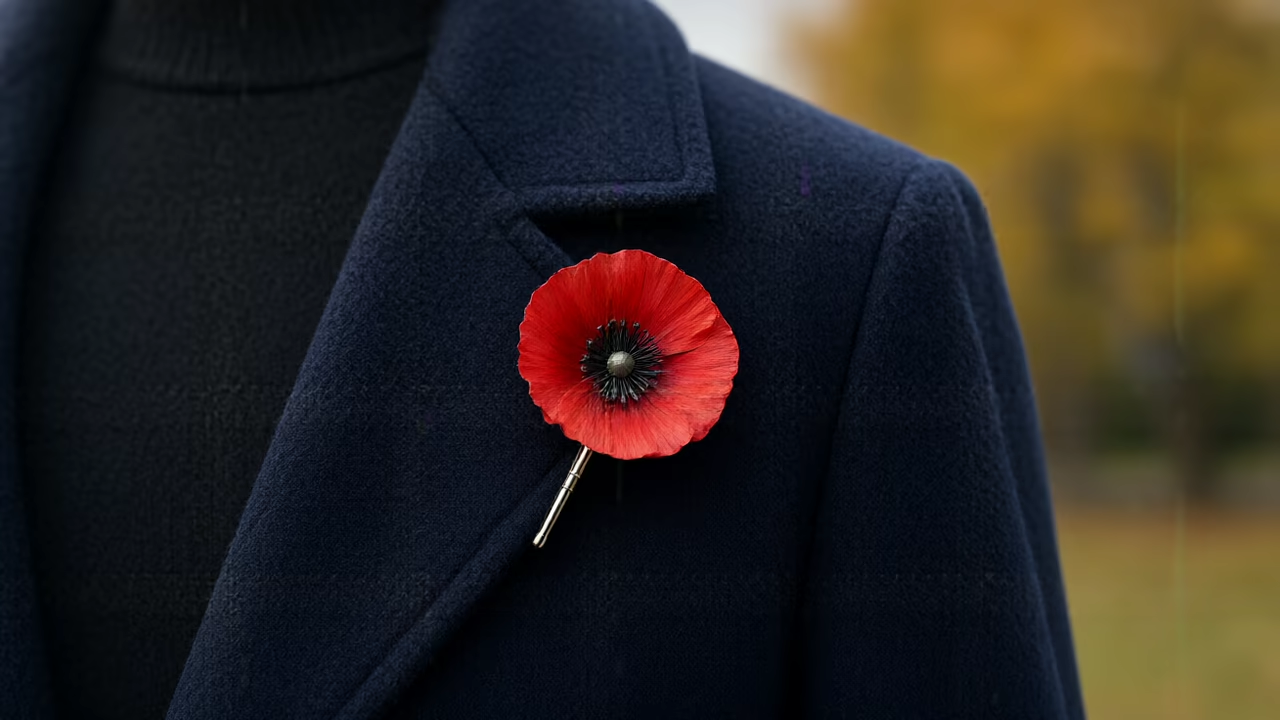
Starting on the last Friday in October, you may notice small red flowers pinned to coats all over Canada: on your teacher, on a bus driver, on people on the news. The flower is a poppy, and it is one of Canada's most common symbols of remembrance. People wear it to remember those who died in war and those who served.
The pins are part of the Royal Canadian Legion's Poppy Campaign, which runs until November 11 and raises money. The money helps Veterans, people who served in the military, with things such as financial help, medical equipment, home services and long-term care.[1]
A poem from a battlefield
The idea began during the First World War. In 1915, John McCrae, a Canadian doctor serving with the army, wrote a poem called "In Flanders Fields" at a Canadian dressing station, a place where wounded soldiers were treated, north of Ypres in Belgium. Flanders is a region of Belgium where many soldiers were buried.
McCrae's poem drew attention to the red poppies growing among the soldiers' graves. According to Canada's Department of National Defence, poppies had been rare in those fields before the war. Rubble from the fighting added lime to the soil, and seeds that had been waiting in the ground sprouted and covered the fields in red.[2]
From one flower to millions
The poem was read far beyond the battlefield. On November 9, 1918, an American woman named Moina Michael read it and decided to wear a poppy to remember the war dead. A French woman named Anna Guérin then had a new idea: make artificial poppies and sell them to raise money for people who had been harmed by the war.
In 1921, Madame Guérin visited Canada. She persuaded the Great War Veterans Association, a group that later became part of the Royal Canadian Legion, to adopt the poppy as its symbol of remembrance. That same year, Canada officially adopted the poppy. The Royal Canadian Legion was formed in 1925 and has run the poppy campaign ever since.[1]
Why 11 o'clock on November 11?
The First World War ended with an agreement called an armistice, an agreement to stop fighting. It took effect at 11 a.m. on November 11, 1918, which people describe as the eleventh hour of the eleventh day of the eleventh month. The next year, in 1919, the first Armistice Day was observed.
For several years, Armistice Day was held on a Monday, so its date changed from year to year. In 1931, the House of Commons passed a bill that fixed the day on November 11 and changed its name to Remembrance Day. So when you pause at 11:00 a.m. on November 11, you are marking the exact hour when the fighting of the First World War stopped.[3]
How Canadians remember
Across Canada, many people stop for two minutes of silence at 11 a.m. on Remembrance Day. The custom goes back to the first Armistice Day, when King George V asked people to pause for two minutes. In 1919, businesses and schools across Canada paused, and even traffic stopped.
Today, Remembrance Day honours Canadians who died in the two world wars and in the Korean War, as well as those who served in later conflicts and missions, including Cyprus, Bosnia and Afghanistan. The national ceremony takes place at the National War Memorial in Ottawa. Many towns hold their own ceremony at a local cenotaph, a monument to people who died in war. Veterans Affairs Canada suggests wearing the poppy on the left lapel of a coat; if there is no lapel, wear it as close to your heart as possible. At the end of the ceremony, many people take it off and leave it at the base of the cenotaph as a sign of respect.[4]
Fast lesson
Use these checks before you answer the practice questions.
Write 1915, 1918, 1919, 1921, 1925 and 1931 on a strip of paper and add one event to each. Most questions become easier once the timeline is in front of the child.
This reading explains a symbol and a ceremony. It does not judge any war or country. If your child asks harder questions about war, answer simply and honestly, and focus on why people remember.
Use the Guérin and Michael spellings to practise source checking: what do the sources agree on, what is different, and how could we check further?
Common mistakes
Why this fails: It is a day to remember people who died and those who served, and it is marked with silence, not celebration.
Why this fails: It became a symbol after the First World War. Canada adopted it in 1921.
Why this fails: It began as Armistice Day in 1919 and was renamed in 1931.
Word Lab
Use the meaning, hear the word, then try it in your own sentence.
remembrance
nounthe act of remembering people or events, especially in an honouring way
The poppy is a symbol of remembrance.
symbol
nounan object or picture that stands for an idea
A red poppy is a symbol of remembrance.
Veteran
nouna person who has served in the armed forces
The poppy campaign helps Veterans and their families.
donation
nounmoney or goods given to help others
Many people give a donation to a cause they care about.
armistice
nounan agreement to stop fighting
The armistice took effect at 11 a.m. on November 11, 1918.
cenotaph
nouna monument that honours people who died in war, often in a town centre
The ceremony was held at the cenotaph.
ceremony
nouna formal event held to mark something important
The national ceremony takes place in Ottawa.
artificial
adjectivemade by people rather than grown in nature
Anna Guérin suggested selling artificial poppies.
adopt
verbto choose and start using something as your own
Canada adopted the poppy in 1921.
persuade
verbto make someone agree to do something by giving reasons
She persuaded the veterans' group to use the poppy.
rubble
nounbroken pieces of stone, brick and other material
Rubble from the fighting added lime to the soil.
timeline
nouna line that shows events in the order they happened
Put 1915, 1918, 1921 and 1931 on a timeline.
Check your understanding
Choose an answer, explain your choice, and then check. Hints and retries are welcome.
Try the questions here. Public practice does not save a learning record.
Support · Find it in the text
Support · Find it in the text practice
Each answer is in the article. Point to the sentence.
1. When does the Royal Canadian Legion's Poppy Campaign start and end?
2. What was John McCrae's job?
3. In what year did Canada officially adopt the poppy?
4. What year was the first Armistice Day observed?
5. Where is the national Remembrance Day ceremony held?
6. On which side should you wear a poppy, according to Veterans Affairs Canada?
Apply · Explain the history
Apply · Explain the history practice
Use the article to explain how and why.
7. How did a poem lead to the poppy becoming a symbol?
8. What new idea did Anna Guérin add?
9. Why is November 11 at 11 a.m. sometimes called 'the eleventh hour of the eleventh day of the eleventh month'?
10. What changed in 1931?
11. Where did the two minutes of silence come from?
12. Why do some people leave their poppy at the cenotaph after a ceremony?
Reason · Build a timeline
Reason · Build a timeline practice
Order events, compare sources and apply what you learned.
13. Put these years in order with one event each: 1931, 1915, 1921, 1918, 1919, 1925.
14. Explain how the war itself helped the poppies grow.
15. Veterans Affairs Canada and The Canadian Encyclopedia both name Moina Michael. Another government page says 'Moira Michaels, a young New Yorker'. What should a careful reader do?
16. Is 'The poppy campaign runs until November 11' a fact or an opinion?
17. Your class will attend a ceremony at a cenotaph. Name two things you have learned that would help you take part respectfully.
Practice answer key
- 1. From the last Friday in October to November 11.
This is in 'A small red pin'. - 2. He was a doctor serving with the army.
'A poem from a battlefield' says he was a Canadian doctor. - 3. 1921.
It is in 'From one flower to millions'. - 4. 1919.
This is in 'Why 11 o'clock on November 11?' - 5. At the National War Memorial in Ottawa.
It is in 'How Canadians remember'. - 6. On the left lapel, or as close to your heart as possible if there is no lapel.
The last section gives this advice. - 7. McCrae's poem drew attention to poppies on soldiers' graves; Moina Michael read it and started wearing a poppy, and the idea spread.
Follow the chain of people in the second and third sections. - 8. Making and selling artificial poppies to raise money for people harmed by the war.
Moina Michael wore a poppy; Guérin turned it into fundraising. - 9. Because it is 11 o'clock on the 11th day of November, the 11th month.
November is the eleventh month of the year. - 10. the House of Commons passed a bill that fixed the day on November 11 and changed its name from Armistice Day to Remembrance Day.
Before 1931, the date had moved around. - 11. From the first Armistice Day, when King George V asked people to pause for two minutes.
This is in 'How Canadians remember'. - 12. As a sign of respect for those being remembered.
Veterans Affairs Canada describes this custom. - 13. 1915 poem written; 1918 armistice (and Moina Michael's poppy); 1919 first Armistice Day; 1921 Canada adopts the poppy; 1925 Royal Canadian Legion formed; 1931 name changed to Remembrance Day.
A timeline makes cause and effect easier to see. - 14. Rubble from the fighting added lime to the soil, which helped seeds that were already there to sprout.
This is the Department of National Defence's explanation. - 15. Notice the difference, check more sources, and use the spelling most reliable sources agree on, while recognising that all three describe the same role.
Two out of three sources agreeing is a clue, not final proof. - 16. A fact. It can be checked with Veterans Affairs Canada.
Facts can be checked; opinions are beliefs or feelings. - 17. Examples: wear the poppy on the left lapel, stay silent for two minutes at 11 a.m., and leave the poppy at the base of the cenotaph if you wish.
Use details from the article rather than guesses.
Related skills
Put it in your own words
This draft is not saved when you leave or refresh the page.
Check your own explanation
This is self-review, not automatic marking.
Compare with a model response
The poppy became a symbol of remembrance after the First World War. In 1915, a Canadian doctor named John McCrae wrote 'In Flanders Fields', a poem about the poppies growing among soldiers' graves in Belgium. On November 9, 1918, Moina Michael read the poem and began wearing a poppy to remember the war dead. Two days later, at 11 a.m. on November 11, 1918, the armistice took effect and the fighting stopped, which is why Remembrance Day is on that date. In 1921, Anna Guérin persuaded a Canadian veterans' group to adopt the poppy, and Canada officially adopted it that year. In 1931, Armistice Day was fixed on November 11 and renamed Remembrance Day. Today, many Canadians wear a poppy on the left lapel and pause for two minutes of silence at 11 a.m.
Sources and revision notes
Source check: 2026-10-26. Grade guidance is an editorial suggestion, not a standardised reading score.
- Veterans Affairs Canada — The poppy
- The Canadian Encyclopedia — Remembrance Day Poppy
- Veterans Affairs Canada — Quick facts: Remembrance Day
- Department of National Defence — Remembrance Day ceremony: 2. History of Remembrance Day
- Department of National Defence — Remembrance Day ceremony: 3. History of the Poppy
What changed in this edition?
The campaign dates, the uses of donations, Moina Michael's November 9, 1918 date, Anna Guérin's fundraising idea, the 1921 adoption and how to wear a poppy come from Veterans Affairs Canada's poppy page. McCrae's dressing station north of Ypres, the 1921 official adoption and the Legion's founding in 1925 come from The Canadian Encyclopedia, which spells the name 'Anne Guérin'. The armistice time, the 1919 first observance, the 1931 bill and the national ceremony come from Veterans Affairs Canada's Remembrance Day quick facts. The two minutes of silence and King George V's request come from the Department of National Defence history of Remembrance Day. The lime-in-the-soil explanation, the list of conflicts remembered and the 'Moira Michaels' spelling come from the Department of National Defence history of the poppy. The article explains customs and history and does not take a position on any war, policy or group.