Daily Read / Plants
Plants · Compare and contrast needles with broad leaves, and use cause and effect to explain how needle features help a tree through winter
Why Do Evergreen Trees Keep Their Needles in Winter?
Maples are bare by November, but pines stay green. Compare a needle with a broad leaf and explain how its shape, wax and pores help it survive winter.
Device/browser voice. Pronunciation and availability vary.
Bare branches and green ones
Walk through an Ontario park in November. The maples and oaks are bare, and their leaves lie in brown piles on the ground. A few steps away, a pine or a spruce is still covered in green. Both kinds of trees face the same snow and the same freezing nights, so why does one kind drop its leaves while the other keeps them?
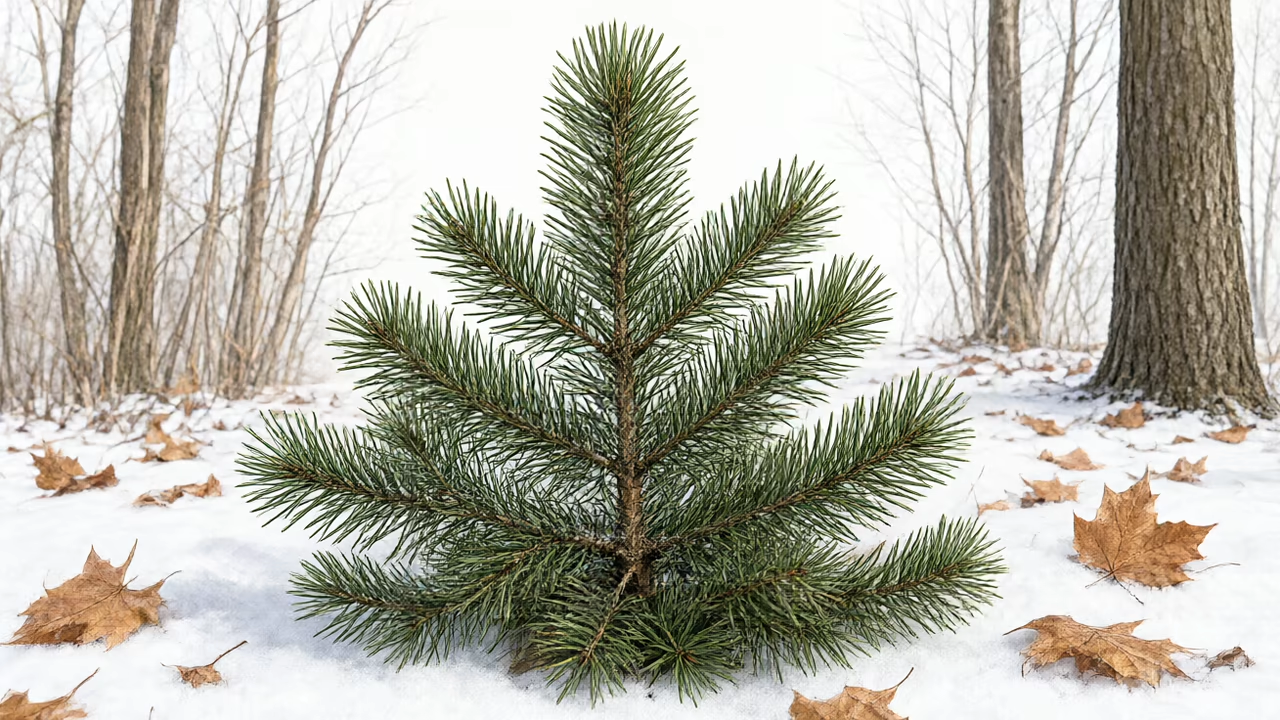
Trees like maples are called deciduous: they drop their broad, flat leaves every fall. Trees like pines and spruces are called evergreen because they keep their leaves all winter. An evergreen's leaves are narrow needles. To see why needles can stay, we need to compare them with broad leaves, feature by feature.[1]
Winter is a dry season for trees
Snow and ice are made of water, so it may seem strange to call winter dry. But the Open University explains that water that has turned into ice is not available to plants. When the ground freezes, roots can take up only a little water, and only very slowly.
Leaves lose water all the time. Water escapes from a leaf's surface and through its pores into the air. In winter the tree cannot easily replace that water, so a leaf that loses a lot of water can dry out and die. A NASA page about spruce trees describes the same problem: in very cold winters, the water in the soil is frozen and the trees cannot use it.[1]
Three features that save water
First, look at the shape. A needle is narrow and thick, so it has a small surface compared with the amount of leaf inside it. A broad leaf is thin and flat, with a large surface. Less surface means less water can escape.
Second, a needle has a thick, waxy outer layer called a cuticle. Wax keeps water in, the way a waxed paper bag keeps a sandwich from drying out. NASA says the waxy coating on spruce needles helps the trees save water in very cold winters.
Third, a needle's pores are tucked away. Leaves have tiny pores called stomata that let gases move in and out. On a needle, the stomata sit in sunken pits. The Open University explains that all three features reduce the water a needle loses.[1]
Antifreeze inside and snow outside
Cold is a second danger. An article in The Conversation explains that if ice forms inside the cells of a needle, it would be lethal. To protect themselves, conifer needles build up substances that lower the temperature at which water freezes and help guard the parts of each cell. You can think of them as a kind of natural antifreeze.
Snow is a third problem. The same article says thin, often drooping needles catch less snow than broad leaves would. Conifer branches spread outward and downward, and they are flexible. When heavy snow piles up, the branch bends until the snow slides off.[2]
Every choice has a cost
If needles are so well protected, why do maples bother with broad leaves? Because the features that help needles survive winter have a cost. The Open University says they make needles less efficient at making food in spring and summer. A broad leaf does not pay that cost, so it works well in summer. But its large, thin surface would lose too much water in winter, so the tree drops it in fall and grows new leaves in spring.
An evergreen does not have to build a whole new set of leaves each spring. The Conversation explains that its needles can keep working for more than one growing season. Needles still do not last forever. White pine needles last about two seasons, so a pine does drop old needles; it just never drops them all at once.[1]
The conifer that turns gold
Not every tree with needles is evergreen. The Canadian Encyclopedia says larches are Canada's only deciduous conifers. A conifer is a tree that makes cones. Larch needles turn golden yellow in fall and then drop, just like maple leaves.
Canada has three kinds of larch. One of them, the tamarack, grows in every province and territory. Its bluish-green needles grow in bundles of 10 to 30. So if you see a tree with bare, bumpy twigs in winter and cones still hanging on, it might be a tamarack, not a dead pine.[4]
Explore the instructional diagram
Fast lesson
Use these checks before you answer the practice questions.
Ask your child to point to each label on the needle side, then find the matching feature on the broad-leaf side and say how they differ. Each pair is one compare-and-contrast sentence.
Many children think evergreens are just 'tougher'. Help them name three separate problems in the article (losing water, ice inside cells and heavy snow) and match one feature to each.
Practise saying chains with a middle link: frozen ground → roots get little water → leaves must save water. Then try a needle feature: waxy cuticle → less water escapes → the needle survives.
Common mistakes
Why this fails: Needles have a lifespan. White pine needles last about two seasons, so old needles fall a few at a time.
Why this fails: Larches such as the tamarack are conifers that drop their needles each fall.
Why this fails: Frozen water is ice, and roots can take up very little of it. That is why saving water matters so much in winter.
Word Lab
Use the meaning, hear the word, then try it in your own sentence.
evergreen
adjectivekeeping green leaves all year
A spruce is an evergreen tree.
deciduous
adjectivedropping all its leaves once a year, usually in fall
Maples are deciduous trees.
conifer
nouna tree or shrub that makes cones, usually with needles or scales for leaves
Pines, spruces and tamaracks are conifers.
needle
nouna long, narrow leaf of a pine, spruce or other conifer
The pine needles stayed green under the snow.
surface area
noun phrasethe total amount of outside surface something has
A broad leaf has a large surface area.
cuticle
nouna waxy outer layer on a leaf that helps keep water in
The needle's thick cuticle slows water loss.
stomata
noun (plural)tiny pores in a leaf that let gases move in and out
On a needle, the stomata sit in sunken pits.
sunken
adjectiveset lower than the surface around it
The pores sit in sunken pits.
frozen
adjectiveturned into ice because of the cold
Roots cannot use frozen water.
lethal
adjectiveable to cause death
Ice forming inside its cells would be lethal to a needle.
efficient
adjectivedoing a job well without wasting time or energy
Needles are less efficient than broad leaves at making food in summer.
trade-off
noungiving up one good thing to get another
Keeping needles is a trade-off: safer in winter, less efficient in summer.
Check your understanding
Choose an answer, explain your choice, and then check. Hints and retries are welcome.
Try the questions here. Public practice does not save a learning record.
Support · Find it in the text
Support · Find it in the text practice
Each answer is stated in the article. Point to the sentence.
1. What do we call trees, such as maples, that drop their leaves every fall?
2. What is the thick, waxy outer layer of a needle called?
3. What are stomata?
4. About how long do white pine needles last?
5. What does The Canadian Encyclopedia call larches?
6. In how many provinces and territories does the tamarack grow?
Apply · Cause and effect
Apply · Cause and effect practice
Use 'because' and a detail from the article.
7. Why is it hard for a tree to replace water in winter?
8. Why does a small surface help a needle save water?
9. Why does the article compare a needle's cuticle to a waxed paper bag?
10. Why would ice forming inside a needle's cells be a problem?
11. Why does a maple drop its broad leaves in fall instead of keeping them?
12. Why can an evergreen 'save' on building leaves?
Reason · Compare and contrast
Reason · Compare and contrast practice
Sort the features, build cause-and-effect chains and spot weak claims.
13. Make a two-column chart: needle and broad leaf. Write one difference for shape, coating and pores.
14. Complete the chain: ground freezes → ? → a leaf that loses a lot of water can dry out.
15. Give one way a tamarack is like a pine and one way it is like a maple.
16. A classmate says, 'Evergreens never lose their needles.' Use the article to correct this.
17. Name one advantage of a broad leaf and one advantage of a needle.
Practice answer key
- 1. Deciduous trees.
This is in 'Bare branches and green ones'. - 2. A cuticle.
This is the second feature in 'Three features that save water'. - 3. Tiny pores in a leaf that let gases move in and out.
See the third feature in 'Three features that save water'. - 4. About two seasons.
This is in 'Every choice has a cost'. - 5. Canada's only deciduous conifers.
This is in 'The conifer that turns gold'. - 6. In every province and territory.
This is in the last section. - 7. Because the water in frozen ground is ice, and roots can take up only a little water, very slowly.
See 'Winter is a dry season for trees'. - 8. Because water escapes from a leaf's surface, so less surface means less water can escape.
This is the first feature in 'Three features that save water'. - 9. Because both use wax to keep water in, so what is inside does not dry out.
An analogy compares something new to something familiar. - 10. Because The Conversation says it would be lethal, so the needle would die.
See 'Antifreeze inside and snow outside'. - 11. Because a broad leaf's large surface would lose too much water in winter when the tree cannot replace it.
Combine 'Winter is a dry season for trees' with 'Every choice has a cost'. - 12. Because its needles keep working for more than one growing season, so it does not have to grow a whole new set every spring.
This is in 'Every choice has a cost'. - 13. Shape: needle narrow and thick with a small surface; broad leaf thin and flat with a large surface. Coating: needle has a thick waxy cuticle; the article does not say broad leaves have one this thick. Pores: needle pores sit in sunken pits; the article does not describe sunken pits on broad leaves.
Be careful to say what the article does not tell you about broad leaves. - 14. Roots can take up only a little water, so the tree cannot easily replace the water its leaves lose.
The missing link is the shortage of water. - 15. Like a pine: it is a conifer with needles and cones. Like a maple: it drops its leaves in fall.
One tree can share features with two groups. - 16. Evergreens do lose old needles. White pine needles last about two seasons, so a pine drops old needles, just not all at once.
Watch for words like never and always. - 17. Broad leaf: it makes food efficiently in spring and summer. Needle: it survives winter and keeps working for more than one season.
A trade-off has a good side and a cost on each side.
Related skills
Put it in your own words
This draft is not saved when you leave or refresh the page.
Check your own explanation
This is self-review, not automatic marking.
Compare with a model response
In winter, the water in the ground is frozen, so roots can take up only a little water, very slowly. That means a tree's leaves must not lose too much water. A pine needle is narrow and thick, so it has a small surface, whereas a maple leaf is thin and flat with a large surface. The needle also has a thick, waxy cuticle that keeps water in, and its stomata sit in sunken pits, so even less water escapes. Its cells build up substances that work like antifreeze. However, these features make needles less efficient in summer, while broad leaves work well in summer. That trade-off is why a maple drops its leaves in fall and grows new ones in spring. The tamarack is an exception: it is a conifer, but it is deciduous and drops its golden needles every fall.
Sources and revision notes
Source check: 2026-10-28. Grade guidance is an editorial suggestion, not a standardised reading score.
- The Open University (OpenLearn) — Surviving the winter, 1.3.1 Evergreen plants
- The Conversation — Why don't evergreens change color and drop their leaves every fall?
- NASA Science — Spruce (Mission: Biomes)
- The Canadian Encyclopedia — Larch
What changed in this edition?
Frozen water being unavailable to plants, slow uptake by roots, the needle's small surface relative to its volume, the thick waxy cuticle, stomata in sunken pits, the reduced efficiency of needles in spring and summer, and larches being deciduous come from the Open University's OpenLearn course. The lethal risk of ice inside needle cells, the protective substances that lower the freezing point, the snow-shedding needles and flexible branches, needles working for several growing seasons and the two-season lifespan of white pine needles come from The Conversation. The waxy spruce needles that help conserve water when soil water is frozen come from NASA Science. Larches as Canada's only deciduous conifers, their golden fall colour, the three Canadian larch species, the tamarack's range and its bundles of 10 to 30 needles come from The Canadian Encyclopedia. The park scene, the waxed paper bag comparison and the bare-twig example are illustrations, not reported observations. 'Natural antifreeze' is this lesson's plain-language name for the protective substances. The diagram is a simplified schematic, not to scale.