Daily Read / Government and community
Government and community · Explain a rule and who makes it, follow the steps a bill takes to become a law in force, and tell facts apart from opinions
Why Do Ontario's Clocks Fall Back? How Daylight Saving Time Works
This Sunday at 2 a.m., Ontario clocks fall back an hour. Learn where daylight saving time came from, who decides it, and why some places no longer change.
Device/browser voice. Pronunciation and availability vary.
Sunday at 2 a.m.
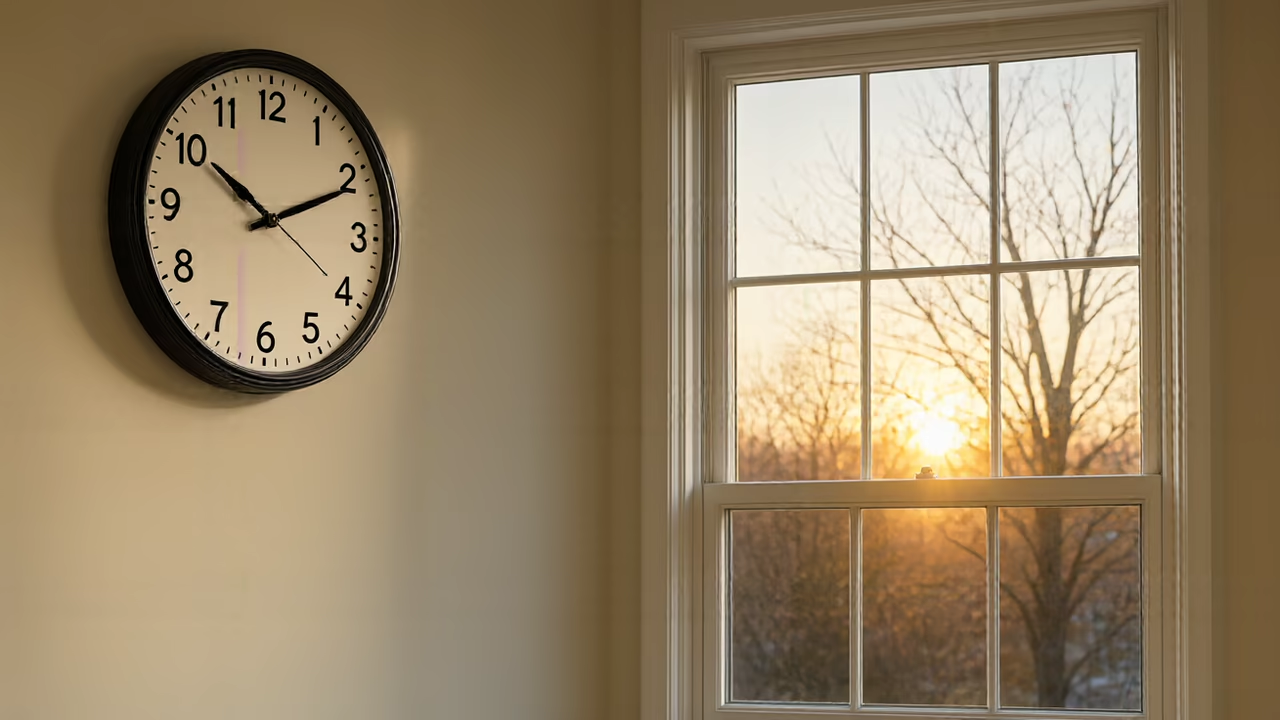
Early this Sunday, November 1, 2026, something strange will happen while most Ontario families are asleep. At 2:00 a.m., the time will suddenly become 1:00 a.m. again. The hour from 1:00 to 2:00 will happen twice.
This is called falling back, and it marks the end of daylight saving time for the year. The National Research Council of Canada, which keeps Canada's official time, explains the rule. Clocks are turned forward one hour on the second Sunday in March and turned back one hour on the first Sunday in November. In Ontario, the change happens at 2:00 a.m. local time. Some people remember it with a saying: spring forward, fall back.[1]
Why move the clocks at all?
The Canadian Encyclopedia says Canada brought in daylight saving time in 1918, near the end of the First World War, as a way to increase production. The idea was to take an hour of daylight that came early in the morning, before breakfast, when many people were still asleep, and move it to the evening, after supper, when people could use it.
The idea came back during the Second World War, when Canada used daylight time all year. Later, towns and cities set their own rules. That caused confusion when businesses close to each other kept different times.[2]
Who decides the time?
You might expect the Government of Canada to decide when every clock changes. It does not. The National Research Council says daylight saving time in Canada is determined by provincial legislation, meaning laws made by each province. The Canadian Encyclopedia adds that since 1987, time zones and daylight saving time have been set by provincial, territorial and municipal governments.
Most provinces still choose the same dates as the United States. The Canadian Encyclopedia explains that this keeps trade, travel and communication lined up with Canada's largest trading partner. The current dates began in 2007. They were chosen partly to save energy, although the encyclopedia notes that proof of energy savings has been hard to find.[1]
Not everyone changes
Because each province and territory makes its own rules, not all of Canada falls back on Sunday. Most of Saskatchewan stays on the same time all year. Yukon has also used one time all year since 2020.
British Columbia made a change this year. The Government of British Columbia says clocks there moved ahead on March 8, 2026, for the final time. On November 1, B.C. clocks will not fall back. The province will stay on the same time all year. The B.C. government gave its reasons: to improve people's health, reduce disruptions for families and make scheduling simpler. People in other places may weigh these reasons differently, and that is a choice each government makes.[3]
Ontario's law that is waiting
Ontario has a time law too, called the Time Act. In 2020, members of the Ontario legislature passed Bill 214, the Time Amendment Act. The Legislative Assembly of Ontario says the bill would make the time we now call daylight saving time Ontario's standard time all year. It received royal assent, the final step that turns a bill into a law, on November 30, 2020.
So why will Ontario clocks still fall back on Sunday? The bill says it comes into force on a day to be named by proclamation of the Lieutenant Governor. In other words, the law exists, but it does not start working until the government officially names a starting day. CBC News reported in 2020 that the government planned to bring it into force only if Quebec and New York State made a similar move. No starting day has been named, so Ontario still changes its clocks twice a year.[4]
Facts and opinions
When people talk about changing the clocks, they often mix facts with opinions. A fact can be checked, like the date the clocks change or the day a bill received royal assent. An opinion is what someone thinks is best, like whether children would sleep better without clock changes or whether evenings or mornings should get more light.
This reading does not take a side. Thoughtful people disagree, and governments listen to many views before deciding. What you can do is notice which statements are facts you could check, and which are opinions someone is giving. And this weekend, you can help your family find every clock in your home that does not change by itself.[2]
Fast lesson
Use these checks before you answer the practice questions.
Use a toy clock. Move the hands from 12:00 to 2:00, then back to 1:00, and move them to 2:00 again. Your child can see that the hour happens twice.
Compare it to a school rule that is written and approved but starts 'when the new playground opens'. The rule exists, but nothing changes until that day.
If your child asks which choice is best, explore reasons on different sides and point out that people disagree. The goal is to understand how decisions are made, not to pick a side.
Common mistakes
Why this fails: In Canada, provinces and territories make these rules through their own laws.
Why this fails: Some laws start only on a day named later by proclamation. Ontario's 2020 time law is one of them.
Why this fails: Most of Saskatchewan, Yukon and now British Columbia keep one time all year.
Word Lab
Use the meaning, hear the word, then try it in your own sentence.
daylight saving time
noun phrasethe part of the year when clocks are set one hour ahead
Daylight saving time ends on the first Sunday in November.
standard time
noun phrasethe regular time a place uses when daylight saving time is not in effect
After clocks fall back, Ontario uses standard time.
fall back
phrasal verbto move clocks back one hour in the fall
At 2 a.m., the clocks fall back to 1 a.m.
province
nounone of the large areas Canada is divided into, each with its own government
Ontario is a province.
legislation
nounlaws made by a government
Daylight saving time is set by provincial legislation.
legislature
nounthe group of elected members who make a province's laws
The bill was passed in the Ontario legislature.
bill
nouna written plan for a new law that lawmakers discuss and vote on
Bill 214 was about time in Ontario.
royal assent
noun phrasethe final approval that turns a bill into a law
The bill received royal assent in 2020.
proclamation
nounan official public announcement, such as the day a law starts
The law starts on a day named by proclamation.
in force
phraseworking and having to be followed
A law that is not in force does not change anything yet.
fact
nounsomething that can be checked and shown to be true
The date of the clock change is a fact.
opinion
nounwhat someone thinks or believes, which others may disagree with
Which season should get more evening light is an opinion.
Check your understanding
Choose an answer, explain your choice, and then check. Hints and retries are welcome.
Try the questions here. Public practice does not save a learning record.
Support · Find it in the text
Support · Find it in the text practice
Each answer is stated in the article. Point to the sentence.
1. Which agency keeps Canada's official time?
2. On which Sunday do clocks spring forward?
3. In what year did Canada bring in daylight saving time?
4. Which territory has used one time all year since 2020?
5. What is the name of Ontario's law about time?
6. On what date did Bill 214 receive royal assent?
Apply · Explain the rule
Apply · Explain the rule practice
Use 'because' and a detail from the article.
7. Why does the hour from 1:00 to 2:00 happen twice on Sunday?
8. Why do most provinces use the same dates as the United States?
9. Why will B.C. clocks not fall back this year?
10. Ontario passed a law in 2020. Why do clocks still change?
11. Why did different town rules cause problems long ago?
12. Why does the article say proof of energy savings has been hard to find?
Reason · Rules, laws and opinions
Reason · Rules, laws and opinions practice
Follow the steps, sort facts from opinions and apply the rule.
13. Put in order: royal assent; bill introduced; members vote to pass it; a starting day is named.
14. Sort: (a) Yukon uses one time all year. (b) Changing clocks is silly. (c) Clocks fall back at 2 a.m.
15. Which Sunday will clocks fall back in 2027? Use the rule.
16. How is Ontario's situation different from British Columbia's?
17. A classmate says, "Ontario already stopped changing clocks in 2020." Is that correct?
Practice answer key
- 1. The National Research Council of Canada.
See 'Sunday at 2 a.m.'. - 2. The second Sunday in March.
See 'Sunday at 2 a.m.'. - 3. 1918.
See 'Why move the clocks at all?'. - 4. Yukon.
See 'Not everyone changes'. - 5. The Time Act.
See 'Ontario's law that is waiting'. - 6. November 30, 2020.
See 'Ontario's law that is waiting'. - 7. Because at 2:00 a.m. the clocks go back to 1:00 a.m., so that hour is repeated.
See 'Sunday at 2 a.m.'. - 8. Because it keeps trade, travel and communication lined up with Canada's largest trading partner.
See 'Who decides the time?'. - 9. Because B.C. made its March 8, 2026 change the final one and now stays on the same time all year.
See 'Not everyone changes'. - 10. Because the law starts only on a day named by proclamation, and no starting day has been named.
See 'Ontario's law that is waiting'. - 11. Because businesses close to each other kept different times, which was confusing.
See 'Why move the clocks at all?'. - 12. Because The Canadian Encyclopedia notes that data showing energy savings has been elusive, even though saving energy was one reason for the 2007 dates.
A reason for a rule is not the same as proof it works. - 13. Bill introduced → members vote to pass it → royal assent → a starting day is named. In Ontario's case, the last step has not happened.
These are the steps from bill to law in force. - 14. Facts: (a) and (c). Opinion: (b).
Facts can be checked; opinions are views. - 15. The first Sunday in November 2027, which is November 7.
November 1, 2027 is a Monday, so the first Sunday is November 7. - 16. Both passed rules about keeping one time all year, but B.C.'s change has started, while Ontario's law is waiting for a starting day.
Compare what has happened, not what people think. - 17. No. Ontario passed a law in 2020, but it has not come into force, so Ontario still changes its clocks.
A law passed is not always a law in force.
Related skills
Put it in your own words
This draft is not saved when you leave or refresh the page.
Check your own explanation
This is self-review, not automatic marking.
Compare with a model response
On Sunday, November 1, 2026, Ontario's clocks fall back from 2:00 a.m. to 1:00 a.m., ending daylight saving time for the year. Canada first used daylight saving time in 1918 to increase wartime production by moving an hour of daylight to the evening. Today, the National Research Council says daylight saving time is set by provincial legislation, so each province and territory decides. Most choose the same dates as the United States to keep trade and travel lined up. Not everyone changes: most of Saskatchewan and Yukon keep one time all year, and British Columbia made its final change in March 2026. Ontario passed a time law in 2020, and it received royal assent. However, it comes into force only on a day named by proclamation, and no day has been named, so Ontario still falls back.
Sources and revision notes
Source check: 2026-10-29. Grade guidance is an editorial suggestion, not a standardised reading score.
- National Research Council Canada — Time zones and daylight saving time
- The Canadian Encyclopedia — Daylight Saving Time in Canada
- Government of British Columbia — Permanent daylight saving time
- Legislative Assembly of Ontario — Bill 214, Time Amendment Act, 2020
- CBC News — Ontario to move permanently to daylight saving time as long as Quebec, New York follow (2020)
What changed in this edition?
The second-Sunday-in-March and first-Sunday-in-November rule, the 2:00 a.m. local change, NRC's role in publishing official time, daylight saving time being determined by provincial legislation, most of Saskatchewan staying on one time and Yukon using one time since 2020 come from the National Research Council of Canada. The 1918 wartime start, the pre-breakfast hour moved to after supper, year-round use in the Second World War, municipal rules and confusion, regulation by provincial, territorial and municipal governments since 1987, matching U.S. dates for trade and travel, and the 2007 energy-saving rationale with elusive evidence come from The Canadian Encyclopedia. British Columbia's final change on March 8, 2026, no change on November 1, 2026, and the province's stated reasons come from the Government of British Columbia. Bill 214's purpose, royal assent on November 30, 2020, and coming into force on a day named by proclamation come from the Legislative Assembly of Ontario. The condition about Quebec and New York State is as reported by CBC News in November 2020. The November 1, 2026 date is calculated from the NRC rule. That no starting day has been named is based on NRC's current listing of Ontario's clock change; families can confirm on official sources. This lesson explains a process and does not endorse any position on daylight saving time.