Daily Read / Everyday Physics
Everyday Physics · Explain a mechanism step by step and use cause and effect to explain why static shocks happen more often in cold, dry weather
Why Do You Get Static Shocks in Winter?
Shuffle across a carpet, touch a doorknob, snap! Follow the electrons step by step and explain why static shocks are more common in dry winter air.
Device/browser voice. Pronunciation and availability vary.
Snap!
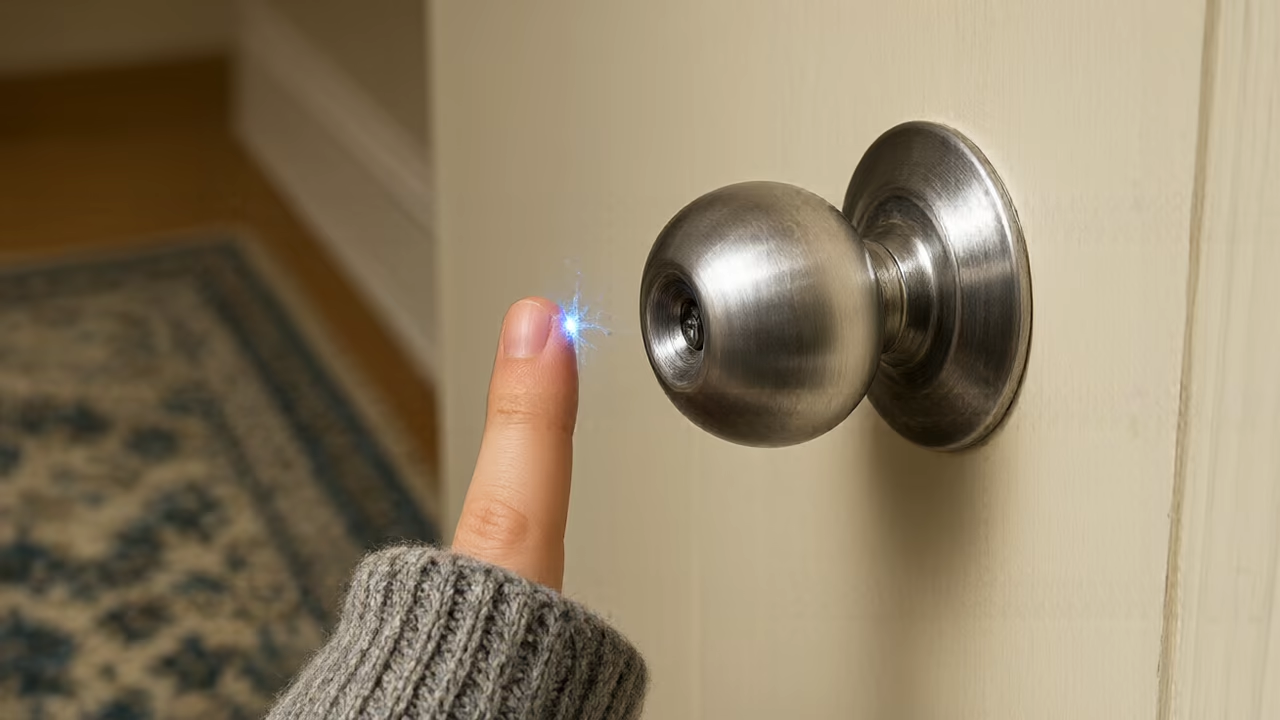
On a cold January morning, you shuffle across the living-room carpet in your socks and reach for the metal doorknob. Snap! You feel a tiny sting in your fingertip. On a warm, sticky day in July, the same walk often gives a much smaller shock, or none that you notice.
That sting is caused by static electricity. To understand it, we need to follow something far too small to see, step by step, from the carpet to your finger to the doorknob.[1]
Tiny charges inside everything
Everything around you is made of atoms. Atoms contain even smaller parts. Protons have a positive charge, electrons have a negative charge, and neutrons have no charge. Usually an object has the same number of positive and negative charges, so the charges balance out.
Electrons can move from one thing to another fairly easily. When an object gains extra electrons or loses some, its charges are no longer balanced. Static electricity builds up when charges are unbalanced. Things with opposite charges are always attracted to each other.[1]
Step 1: Rubbing moves electrons
Science World, a science centre in Vancouver, explains a famous demonstration. When you rub a balloon on your head, electrons move from your hair onto the balloon. Electrons are negative, so the balloon becomes negatively charged and your hair is left with a positive charge. The balloon and hair now attract each other.
Each strand of hair has the same kind of charge, and like charges repel. That is why the strands push away from each other and stand up. Science World points out that rubbing does not make the charge. It just brings more of the two surfaces into contact, so more electrons can move across.[2]
Step 2: The charge builds up on you
The carpet works like the balloon, but in the other direction. When you scuff your feet across a rug, you pick up extra electrons from it. Each step adds more. Now your body has more negative charge than positive charge, so you have a negative charge.
You cannot feel the charge while it sits on you. It stays there until it finds an easy way to leave.[1]
Step 3: The jump
Electrons move more easily through some materials, such as metal. Scientists call these materials conductors. When your fingertip gets very close to a metal doorknob, the extra electrons jump across the tiny gap of air to the metal all at once.
Millions of electrons rushing across the gap make the snap you feel. Science World describes a shock as gaining or losing electric charge in a hurry. After the jump, your charges are balanced again, so a second touch usually does nothing until you build up a new charge.[1]
Why winter makes it worse
Static shocks happen more often in colder seasons because the air is drier. In dry air, electrons can build up on your skin more easily. In warmer, more humid weather, the moisture in the air helps electrons move off you more quickly, so not as much charge builds up.
People who run static demonstrations know this too. Science World notes that humidity in the air can make it hard to build up charges, so a balloon demonstration that works well on a dry, cool day may not work as well on a muggy one.[1]
A giant cousin: lightning
NOAA, a United States government science agency, says the shock from a doorknob is the same idea as lightning, only far bigger. Inside a thunderstorm cloud, strong up and down air currents separate charges. The bottom of the cloud becomes negatively charged and the top becomes positively charged.
Air normally keeps charges apart. When the charge becomes strong enough to overpower the air, a huge spark of lightning flashes across. Your doorknob spark is tiny and lasts only an instant, but both are charges escaping in a hurry.[3]
Explore the instructional diagram
Fast lesson
Use these checks before you answer the practice questions.
Ask your child to point to the diagram and say where the extra electrons are at each step: on the carpet, on you, then on the doorknob. Most questions can be answered by tracing that path.
A common idea is that rubbing creates electricity. The article says rubbing only brings surfaces into contact so electrons can move. Ask: where did the electrons come from before they reached you?
For 'Why winter makes it worse', practise building a chain with a middle step: dry air → charge builds up more easily → more shocks. Ask your child to name the middle link out loud.
Common mistakes
Why this fails: The extra charge is on you. The metal doorknob is simply an easy path for the electrons to jump to.
Why this fails: Science World explains that rubbing only brings more surface into contact so that existing electrons can move across.
Why this fails: The article says the cause is dry air. Moisture in humid air helps electrons move off you, so less charge builds up.
Word Lab
Use the meaning, hear the word, then try it in your own sentence.
static electricity
noun phraseelectric charge that builds up on an object instead of flowing steadily
Static electricity can make your hair stand up.
atom
nounone of the tiny particles that everything is made of
A balloon is made of billions of atoms.
electron
nouna tiny part of an atom that has a negative charge and can move from one thing to another
Electrons moved from the carpet to my socks.
proton
nouna tiny part of an atom that has a positive charge
A proton has a positive charge.
neutron
nouna tiny part of an atom that has no charge
Neutrons have no electric charge.
charge
nounan amount of electricity that something carries; it can be positive or negative
After I rubbed the balloon, it had a negative charge.
attract
verbto pull toward
Opposite charges attract each other.
repel
verbto push away
Like charges repel, so the hairs spread apart.
conductor
nouna material that electricity moves through easily, such as metal
The metal doorknob is a good conductor.
humid
adjectivehaving a lot of water vapour in the air
On humid days, static shocks are less common.
spark
nouna tiny flash of light made when electric charge jumps across a gap
A tiny spark jumped from my finger to the doorknob.
mechanism
nounthe steps that explain how something happens
The article explains the mechanism of a static shock.
Check your understanding
Choose an answer, explain your choice, and then check. Hints and retries are welcome.
Try the questions here. Public practice does not save a learning record.
Support · Find it in the text
Support · Find it in the text practice
Each answer is stated in the article. Point to the sentence.
1. What are the three parts of an atom named in the article, and what charge does each have?
2. When you rub a balloon on your hair, which way do the electrons move?
3. What do scientists call materials, such as metal, that electrons move through easily?
4. What charge does your body have after you scuff your feet across a rug?
5. What does Science World say can make it hard to build up charges?
6. In a thunderstorm cloud, which part becomes negatively charged?
Apply · Explain the reason
Apply · Explain the reason practice
Use 'because' and a detail from the article.
7. Why do strands of hair stand up after you rub a balloon on your head?
8. Why does a rubbed balloon stick to your hair?
9. Why does the shock happen at a metal doorknob and not while you are walking?
10. Why might a balloon demonstration fail on a muggy summer day?
11. The article says rubbing does not make the charge. What does rubbing do instead?
12. Why does a second touch of the doorknob usually do nothing?
Reason · Order and compare
Reason · Order and compare practice
Put the mechanism in order, compare the steps and spot weak claims.
13. Put these in order: electrons jump to the metal; you shuffle on the carpet; you feel a snap; extra electrons build up on you; your hand nears the doorknob.
14. Compare the balloon and the carpet. Which one gains electrons in each case?
15. A classmate says, 'The doorknob was full of electricity and zapped me.' What is wrong with this explanation?
16. Complete the chain: dry winter air → ? → bigger chance of a shock.
17. Give one way lightning is like a doorknob shock and one way it is different.
Practice answer key
- 1. Protons are positive, electrons are negative and neutrons have no charge.
They are listed in 'Tiny charges inside everything'. - 2. From your hair onto the balloon.
This is in 'Step 1: Rubbing moves electrons'. - 3. Conductors.
'Step 3: The jump' gives the word. - 4. A negative charge.
'Step 2' says you pick up extra electrons, so you have a negative charge. - 5. Humidity in the air.
It is in 'Why winter makes it worse'. - 6. The bottom of the cloud.
The lightning section says the bottom becomes negative and the top positive. - 7. Because each strand has the same kind of charge, and like charges repel, so the strands push away from each other.
'Step 1' explains this. - 8. Because the balloon is negative and the hair is positive, and opposite charges attract.
Combine 'Tiny charges inside everything' with 'Step 1'. - 9. Because the extra electrons stay on you until they find an easy way to leave, and metal is a conductor that gives them that path.
See the end of 'Step 2' and the start of 'Step 3'. - 10. Because humidity makes it hard to build up charges; moisture helps electrons move away.
Both ideas are in 'Why winter makes it worse'. - 11. It brings more of the two surfaces into contact, so more electrons can move from one to the other.
Science World makes this point in 'Step 1'. - 12. Because after the jump your charges are balanced again, so there is no extra charge left to jump.
This is the last sentence of 'Step 3'. - 13. You shuffle on the carpet → extra electrons build up on you → your hand nears the doorknob → electrons jump to the metal → you feel a snap.
The charge is picked up, stored, then released, and only then do you feel it. - 14. With the balloon and hair, the balloon gains electrons. With the carpet and your feet, you gain electrons.
The same rule works in both cases; only the direction of the electrons is different. - 15. The extra charge was on the person, not on the doorknob. The electrons jumped from the person to the metal.
Follow the direction of the electrons through the three steps. - 16. Electrons can build up on your skin more easily, so more charge collects on you.
The missing link is the build-up of charge. - 17. Alike: charge builds up and escapes in a sudden spark. Different: lightning is far bigger, and its charges are separated by air currents in a cloud, not by rubbing on a carpet.
The lightning section supports both parts.
Related skills
Put it in your own words
This draft is not saved when you leave or refresh the page.
Check your own explanation
This is self-review, not automatic marking.
Compare with a model response
Everything is made of atoms, and atoms contain electrons, which have a negative charge and can move from one thing to another. When I shuffle my feet across a carpet, I pick up extra electrons from the rug. Rubbing does not make the electrons; it just helps them move across. Now my body has more negative charge than positive charge, and the extra electrons stay on me. When my finger gets close to a metal doorknob, the electrons jump across the tiny gap, because metal is a conductor. That sudden rush of electrons is the snap I feel. Shocks are more common in winter because the air is drier, so charge builds up on my skin more easily. In humid weather, moisture in the air helps electrons move off me before much charge can build up.
Sources and revision notes
Source check: 2026-10-27. Grade guidance is an editorial suggestion, not a standardised reading score.
- Nemours KidsHealth — Why Do I Get an Electric Shock? (published January 29, 2021)
- Science World (Vancouver) — Static Electricity (activity resource)
- NOAA National Environmental Satellite, Data, and Information Service — What Causes Lightning and Thunder? (August 27, 2025)
What changed in this edition?
The parts of the atom, picking up electrons from a rug, metal as a conductor, and the link between dry air in colder seasons and shocks come from Nemours KidsHealth. The balloon-and-hair demonstration, the point that rubbing increases contact rather than making charge, the description of a shock as charge moving in a hurry and the note that humidity makes charge hard to build up come from Science World. The comparison with lightning and the charge separation in storm clouds come from NOAA. The opening scene is an illustrative example, not a reported event. The diagram is a simplified schematic, not to scale.