Daily Read / Ontario geography
Ontario geography · Explain why ships need the Welland Canal to travel between Lake Erie and Lake Ontario, use numbers from the text (length, locks, height) to describe the canal, and put the four canals in time order
How Do Ships Get Past Niagara Falls? The Welland Canal
Lake Erie sits almost 100 metres higher than Lake Ontario. Learn how eight locks on the Welland Canal lift ships around Niagara Falls.
Device/browser voice. Pronunciation and availability vary.
A waterfall in the way
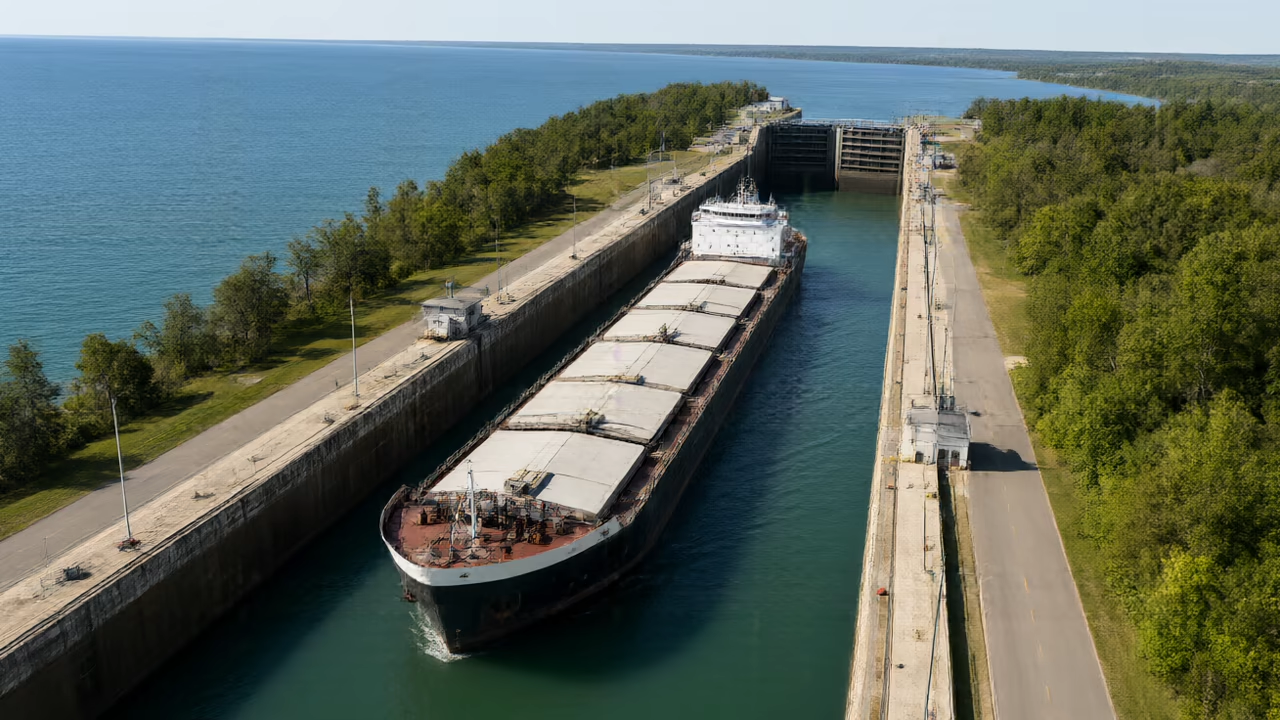
In the Daily Read on the Great Lakes, you learned that the lakes are connected. In the lesson on the Niagara Escarpment, you saw the Niagara River pour over hard caprock at Niagara Falls. Now imagine you are the captain of a long cargo ship on Lake Erie, and you need to deliver wheat to a port on Lake Ontario. The river between the two lakes has a giant waterfall in the middle. You cannot sail over it.
The Canadian Encyclopedia explains that the Welland Canal solves this problem. The canal bypasses the turbulent Niagara River and Niagara Falls, giving ships their own path between the two lakes. Turbulent means rough and full of swirling, fast water.[1]
Almost 100 metres of difference
The trouble is not only the falls. The two lakes are at very different heights. According to the Canadian Encyclopedia, the Welland Canal overcomes a height difference of 99.4 metres between Lake Erie and Lake Ontario. That is about as tall as a 30-storey building, an estimate made for this lesson.
Water cannot simply flow down a 99-metre slope in a canal without becoming a dangerous rapid. So the canal climbs in steps called locks. The same article says the canal is 43.5 kilometres long and runs across the Niagara Peninsula, the strip of land between the two lakes.[1]
How a lock lifts a ship
A lock is a giant concrete room with watertight gates at each end. To raise a ship, the lower gates open and the ship sails in. The gates close behind it. Water flows into the lock from the higher side, and the ship floats up with it, like a toy boat in a filling bathtub. When the water inside matches the higher level, the upper gates open, and the ship sails on. To go down, the steps run in reverse.
The Great Lakes St. Lawrence Seaway website says getting through a lock takes about 45 minutes. It describes the Welland Canal as eight Canadian locks linking Lake Ontario to Lake Erie. Of the seven at the north end, three are twinned and contiguous, which means side by side in pairs and joined end to end. The eighth lock, at the south end, controls the water level.[2]
The flight locks
The Canadian Encyclopedia counts seven lift locks between Thorold and Lake Ontario, plus one guard lock at Port Colborne on Lake Erie. It calls Locks 4, 5 and 6 a world-famous series of twinned flight locks. Together, these three locks stretch 1249.7 metres and lift ships 42.5 metres.
Notice what that number means. The whole canal climbs 99.4 metres, and these three locks do 42.5 metres of it, which is a bit less than half. The ship climbs them one right after another, like walking up a staircase without a landing. Because the flight locks are twinned, a ship going up can use one side while a ship going down uses the other.[1]
Four canals in 103 years
Today's canal is not the first. The Canadian Encyclopedia says the first Welland Canal opened in 1829. As ships grew bigger, people built new canals with bigger, fewer locks: a second canal in 1845, a third in 1887 and the modern, fourth canal in 1932. From 1829 to 1932 is 103 years. In 1973, a 13.4-kilometre bypass channel opened around the city of Welland.
The modern canal is big, but not unlimited. The same article gives the largest ship it can take as 222.5 metres long and 23.8 metres wide. That is more than twice the length of a 100-metre running track straightaway, a comparison made for this lesson.[1]
What the ships carry, and where to watch
The Canadian Encyclopedia lists the main cargoes as iron ore, wheat, corn, soybeans, coal and manufactured iron, steel and cement. It reports that the canal carries about 37 million tonnes of cargo in an average year.
If you visit St. Catharines, you can watch it happen. The St. Catharines Museum's visitor guide says visitors can watch ships lock through Lock 3 from a viewing platform at the Welland Canals Centre, where a ship schedule is posted in the lobby. The guide says admission is by donation. Seeing a ship rise or sink inside a lock makes the numbers in this article feel very real.[3]
Fast lesson
Use these checks before you answer the practice questions.
The article has many numbers (43.5, 99.4, 42.5, 1249.7). Ask your child to say each with its unit and what it measures before using it.
Use a sink, a plastic container and a small floating toy to show how filling raises the boat. The boat is never lifted; the water does the work.
This lesson follows the Great Lakes and the Niagara Escarpment. Ask your child how the escarpment and the falls explain why the canal needs so many locks.
Two sources count the locks differently (seven lift locks plus a guard lock, or eight locks). Both total eight. Ask your child why two careful sources might describe the same thing differently.
Common mistakes
Why this fails: The canal is 43.5 kilometres long but climbs 99.4 metres. Length and height are different measurements.
Why this fails: The water level changes and the ship floats up or down with it.
Why this fails: 1829 was the first canal; the modern canal is the fourth, from 1932.
Word Lab
Use the meaning, hear the word, then try it in your own sentence.
canal
nouna waterway dug by people so boats can travel through
The Welland Canal joins Lake Erie and Lake Ontario.
lock
nouna section of a canal with gates where the water level is raised or lowered to move boats up or down
The ship floated up inside the lock.
bypass
verbto go around something instead of through it
The canal bypasses Niagara Falls.
turbulent
adjectivemoving in a rough, swirling and fast way
Ships cannot travel the turbulent Niagara River.
cargo
noungoods carried by a ship, plane or truck
The ship's cargo was wheat.
watertight
adjectiveclosed so tightly that water cannot get through
The lock gates are watertight.
twinned
adjectivebuilt as a matching pair side by side
The flight locks are twinned, so two ships can use them.
flight locks
noun phraselocks built one right after another like a staircase
Locks 4, 5 and 6 are flight locks.
peninsula
nounland that is almost surrounded by water
The canal crosses the Niagara Peninsula.
tonne
nouna unit of mass equal to 1000 kilograms
The canal carries millions of tonnes of cargo.
port
nouna town or place where ships load and unload
The wheat was delivered to a port on Lake Ontario.
iron ore
noun phraserock that contains iron and is used to make steel
Many ships carry iron ore through the canal.
Check your understanding
Choose an answer, explain your choice, and then check. Hints and retries are welcome.
Try the questions here. Public practice does not save a learning record.
Support · Find it in the text
Support · Find it in the text practice
Each answer is stated in the article. Point to the sentence.
1. How long is the Welland Canal?
2. How many locks does the Seaway website say the Welland Canal has?
3. About how long does it take to get through a lock?
4. In what year did the first Welland Canal open?
5. Where is the guard lock?
6. At which lock can visitors watch ships from a viewing platform?
Apply · Numbers and order
Apply · Numbers and order practice
Use numbers from the text and put events in order.
7. Finish the sentence: Ships cannot sail down the Niagara River from Lake Erie, because …
8. Finish the sentence: Lake Erie is 99.4 metres higher than Lake Ontario, so …
9. Put these in order for a ship going UP: upper gates open · ship sails in · water flows in · gates close behind.
10. How many years passed between the first canal (1829) and the fourth canal (1932)?
11. The whole canal climbs 99.4 m and the flight locks climb 42.5 m. How much do the other locks climb together?
12. In one sentence, explain what flight locks are.
Reason · Canals, locks and trade-offs
Reason · Canals, locks and trade-offs practice
Use what you learned to reason about new situations.
13. A ship travelling from Lake Ontario to Lake Erie. Does it go up or down in the locks?
- Up
- Down
14. A ship carrying iron ore from Lake Erie toward the Atlantic Ocean. Up or down in the Welland Canal?
- Up
- Down
15. How is the Welland Canal like the Rideau Canal from an earlier Daily Read?
16. A ship is 230 metres long. Could it use the modern Welland Canal? Use the article.
17. Why might a company send grain by ship through the canal instead of by truck?
Practice answer key
- 1. 43.5 kilometres.
See 'Almost 100 metres of difference'. - 2. Eight.
See 'How a lock lifts a ship'. - 3. About 45 minutes.
See 'How a lock lifts a ship'. - 4. 1829.
See 'Four canals in 103 years'. - 5. At Port Colborne, on Lake Erie.
See 'The flight locks'. - 6. Lock 3, at the Welland Canals Centre in St. Catharines.
See 'What the ships carry, and where to watch'. - 7. … the river is turbulent and drops over Niagara Falls.
This is why the canal exists. - 8. … the canal needs locks to lift and lower ships in steps.
Locks act like a water staircase. - 9. Ship sails in → gates close behind → water flows in → upper gates open.
See 'How a lock lifts a ship'. - 10. 103 years.
1932 − 1829 = 103. - 11. 56.9 m.
99.4 − 42.5 = 56.9. - 12. Locks built one right after another, like a staircase, so a ship climbs them without stopping in open canal.
See 'The flight locks'. - 13. Up
Lake Erie is higher, so the ship is raised. - 14. Down
It moves from the higher lake to the lower one. - 15. Both use locks to raise and lower boats where the water changes height.
Both are lock canals. - 16. No, the largest ship the article gives is 222.5 metres long.
230 is more than 222.5. - 17. One ship can carry a huge amount of cargo at once, so fewer trips are needed.
This is a reasoned answer; costs and speed would need checking with real data.
Related skills
Put it in your own words
This draft is not saved when you leave or refresh the page.
Check your own explanation
This is self-review, not automatic marking.
Compare with a model response
Ships cannot sail between Lake Erie and Lake Ontario on the Niagara River, because the river is turbulent and drops over Niagara Falls. The Welland Canal bypasses the falls with a path 43.5 kilometres long. Lake Erie is 99.4 metres higher than Lake Ontario, so the canal uses eight locks to move ships in steps. When a ship goes up, it sails into a lock, the gates close and water flows in, so the ship floats higher. Locks 4, 5 and 6 are twinned flight locks that lift ships 42.5 metres together. The first Welland Canal opened in 1829, and the canal we use today is the fourth one, from 1932. As a result, ships can carry cargo like wheat and iron ore between the lakes.
Sources and revision notes
Source check: 2026-11-05. Grade guidance is an editorial suggestion, not a standardised reading score.
- The Canadian Encyclopedia — Welland Canal
- Great Lakes St. Lawrence Seaway System — Our Locks and Channels
- City of St. Catharines — St. Catharines Museum 2024 Visitor Guide
What changed in this edition?
The statements that the canal bypasses the turbulent Niagara River and Niagara Falls, is 43.5 km long, overcomes a height difference of 99.4 m, has seven lift locks between Thorold and Lake Ontario plus a guard lock at Port Colborne, that Locks 4, 5 and 6 are twinned flight locks with a length of 1249.7 m and a rise of 42.5 m, the opening years 1829, 1845, 1887 and 1932, the 13.4 km bypass opened in 1973, the largest ship dimensions of 222.5 m by 23.8 m, the list of main cargoes and the average of about 37 million tonnes a year come from The Canadian Encyclopedia. The description of the Welland Canal as eight Canadian locks linking Lake Ontario to Lake Erie, with three twinned and contiguous at the north end and a control lock at the south end, and the statement that getting through a lock takes about 45 minutes (given for Seaway locks in general) come from the Great Lakes St. Lawrence Seaway System. The Lock 3 viewing platform at the Welland Canals Centre, the ship schedule in the lobby and admission by donation come from the St. Catharines Museum 2024 visitor guide; check current hours before visiting. The ship-captain scene, the 30-storey comparison, the bathtub model, the staircase comparison, the running-track comparison and the activities are original illustrations or reasoning. Report errors through Sources and corrections.