Daily Read / Forces and simple machines
Forces and simple machines · Explain how a wheel and axle lets a small turning force on a big wheel make a bigger force at the small axle, compare wheel and axle sizes, and tell a true wheel and axle from a wheel that simply spins on a fixed rod
How Does a Wheel and Axle Work? Big Circle, Small Circle
Doorknobs, screwdrivers and old well cranks are wheels and axles. Learn why turning the big circle is easier, and what it costs in distance.
Device/browser voice. Pronunciation and availability vary.
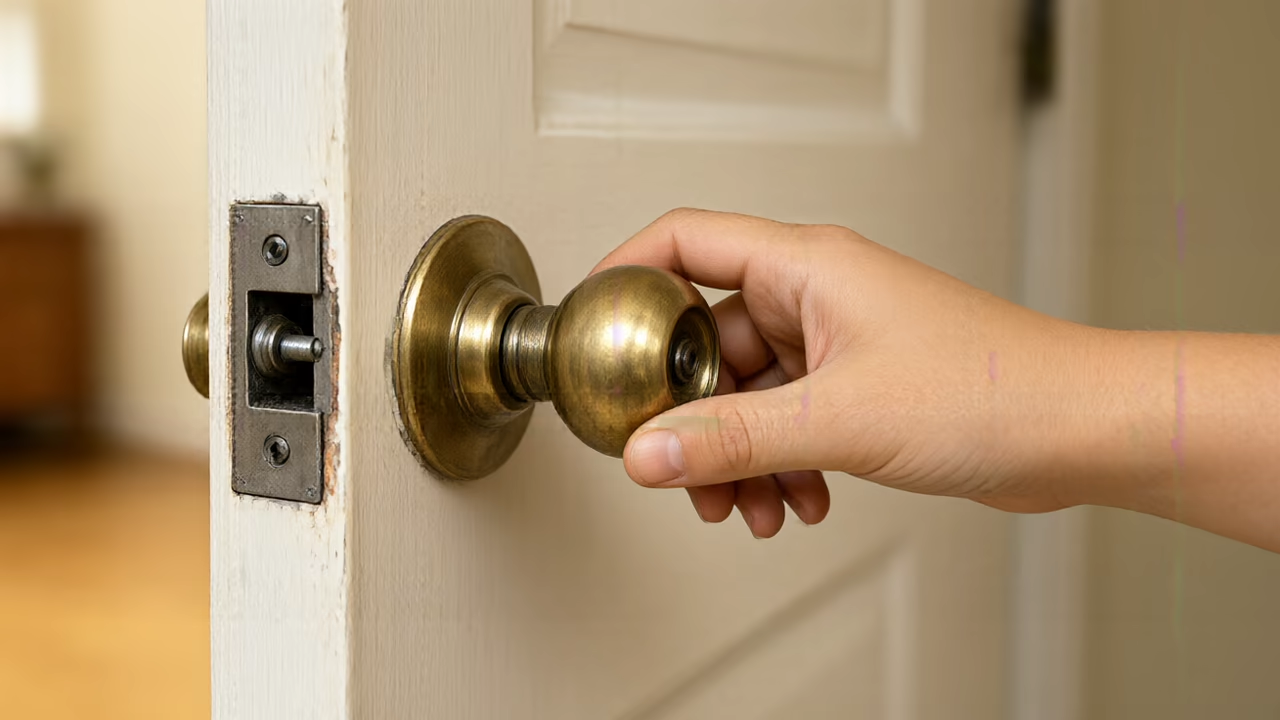
Try the doorknob test
Find a round doorknob and grab the narrow metal rod right behind it, if you can reach it, or imagine doing so. Turning that thin rod with your fingertips is hard work. Now turn the big round knob. The latch slides open easily. The knob and the rod are joined, so they turn together, but one is much easier to turn.
A U.S. Navy training manual called Basic Machines uses the doorknob as its first example of a simple machine called a wheel and axle. In the Daily Read lessons on levers, pulleys and ramps, you met three other simple machines. This one is hiding in almost every house.[3]
What is a wheel and axle?
The Navy manual explains that a wheel-and-axle machine is a wheel or a crank rigidly attached to an axle, which turns with the wheel. Rigidly attached means fixed tightly, so the two parts cannot turn separately. A crank is a handle that you push around in a circle, like the handle on a pencil sharpener.
Energy Education, an online science encyclopedia from the University of Calgary, calls the wheel and axle a type of simple machine used to make tasks easier. It also points out that the wheel and the axle rotate at the same rate. When the wheel makes one full turn, the axle makes one full turn in exactly the same time.[2]
Same turn, different circles
If both parts make one turn, what is different? The size of the circle. Put a dot on the edge of the big wheel and another dot on the edge of the thin axle. In one turn, the dot on the wheel travels all the way around a big circle. The dot on the axle travels around a tiny circle. Your hand on the wheel moves a long way, while the axle's edge moves only a short way.
Energy Education says a wheel and axle changes the force by changing the distance over which the force must be applied. Your hand pushes gently over a long path around the big circle. The axle turns with a stronger force over its short path. You win on force and pay with distance, the same deal you met with levers, pulleys and ramps.[2]
How much stronger?
Britannica describes the wheel and axle as a basic machine part for amplifying force, which means making a force bigger. It explains that the mechanical advantage depends on the size of the large circle compared with the small one. Energy Education gives the rule for an ideal wheel and axle as the radius of the wheel divided by the radius of the axle. A radius is the distance from the centre of a circle to its edge.
Here is an invented example with easy numbers. A knob has a radius of 3 centimetres, and the rod behind it has a radius of 1 centimetre. Three divided by one is three, so in an ideal machine the rod turns with about three times the force your hand gives the knob. Make the knob bigger, or the rod thinner, and the force grows even more.
Real machines never quite reach the ideal number. Britannica notes that friction makes the actual mechanical advantage lower. Parts rub as they turn, so some of your push is used up.[1]
Buckets, screwdrivers and steering wheels
Britannica says that in its earliest form, the wheel and axle was probably used for raising weights or water buckets from wells. Picture a rope wound around a thick log over a well, with a crank handle on the end. As someone turns the crank in a big circle, the log turns too, and the rope winds up, lifting the bucket.
The Navy manual works through a well like this: a crank handle with a radius of 8 inches turns a drum with a radius of 2 inches, so the ideal mechanical advantage is 4. The same manual lists a screwdriver and a car's steering wheel as wheels and axles. A screwdriver's fat handle is the wheel, and the thin metal shaft is the axle.[1]
Not every wheel counts
Here is a surprise. The Navy manual says a car's front wheel is not a wheel-and-axle machine, because the axle does not turn with the wheel. The wheel spins freely around a rod that stays still. Nothing is fixed together, so there is no small circle being turned with extra force.
So when you meet a wheel, ask two questions. Are the wheel and the rod fixed together so they turn as one? If yes, which part does your hand turn? Turn the big circle, and you get more force with a longer path. That is why a skinny screwdriver handle feels so much harder to use than a fat one.[3]
Explore the instructional diagram
Fast lesson
Use these checks before you answer the practice questions.
Before calling something a wheel and axle, ask whether the wheel and the rod turn as one. A wheel spinning on a still rod (a cart or car wheel) does not count.
Children often say 'bigger' loosely. Ask them to measure from the centre to the edge, so the ratio rule makes sense.
The 3 and 4 in the article are ideal values. Encourage your child to say 'about' because friction always takes a little.
This is the fourth simple machine in a row. Ask your child to state the force-for-distance rule for the lever, pulley, ramp and wheel and axle in their own words.
Common mistakes
Why this fails: They are fixed together, so they turn the same number of times; only the size of the circles differs.
Why this fails: If the rod stays still and the wheel spins around it, nothing is multiplied.
Why this fails: A bigger wheel means less force but a longer path for the hand.
Word Lab
Use the meaning, hear the word, then try it in your own sentence.
wheel and axle
noun phrasea simple machine made of a wheel or crank fixed to a rod so that both turn together
A doorknob is a wheel and axle.
axle
nounthe rod in the centre that a wheel turns with or around
The thin axle behind the knob moves the latch.
crank
nouna handle you push around in a circle to turn something
She turned the crank to lift the bucket.
radius
nounthe distance from the centre of a circle to its edge
The knob has a radius of 3 centimetres.
rigidly
adverbin a stiff, fixed way that does not bend or move
The wheel is rigidly attached to the axle.
rotate
verbto turn around a centre point
The wheel and the axle rotate at the same rate.
amplify
verbto make something bigger or stronger
A wheel and axle can amplify a force.
mechanical advantage
noun phrasehow many times a machine multiplies the force you put in
A bigger wheel gives a bigger mechanical advantage.
windlass
nouna machine with a crank and a turning drum that winds up a rope to lift things
An old well used a windlass to lift the bucket.
latch
nouna small bar that holds a door closed
Turning the knob pulls the latch back.
friction
nouna force that acts against motion when two surfaces rub together
Friction makes the real force a little smaller than the ideal one.
drum
nouna round, turning cylinder that a rope winds around
The rope wound around the drum as the crank turned.
Check your understanding
Choose an answer, explain your choice, and then check. Hints and retries are welcome.
Try the questions here. Public practice does not save a learning record.
Support · Find it in the text
Support · Find it in the text practice
Each answer is stated in the article. Point to the sentence.
1. What everyday object does the Navy manual use as its first example of a wheel and axle?
2. What does rigidly attached mean?
3. According to Energy Education, how do the rates of the wheel and the axle compare?
4. What is a radius?
5. What does Britannica say the earliest wheels and axles were probably used for?
6. Why is a car's front wheel not a wheel-and-axle machine?
Apply · Cause and effect
Apply · Cause and effect practice
Use because or so to connect a cause with its effect.
7. Finish the sentence: Turning the big knob is easier than turning the thin rod, because …
8. Finish the sentence: The wheel and the axle are fixed together, so …
9. Why does a bigger wheel on the same axle give more help?
10. Finish the sentence: Friction is always present, so …
11. In the invented doorknob example, how much stronger is the force at the rod in an ideal machine? Show the division.
12. In one sentence, explain what a crank is and give one example.
Reason · Wheels, axles and trade-offs
Reason · Wheels, axles and trade-offs practice
Use what you learned to reason about new situations.
13. A pencil sharpener with a handle that you turn in a circle, fixed to the cutter inside. Wheel and axle or not?
- Wheel and axle
- Not a wheel and axle
14. A shopping-cart wheel that spins on a bolt that does not turn. Wheel and axle or not?
- Wheel and axle
- Not a wheel and axle
15. You swap a tap's small round handle for one twice as wide on the same stem. Predict the ideal effect on the force and on how far your hand moves.
16. Why is a steering wheel much bigger than the steering column it turns?
17. How is the well windlass like a pulley lesson's movable pulley?
Practice answer key
- 1. A doorknob.
See 'Try the doorknob test'. - 2. Fixed tightly, so the two parts cannot turn separately.
See 'What is a wheel and axle?' - 3. They rotate at the same rate.
See 'What is a wheel and axle?' - 4. The distance from the centre of a circle to its edge.
See 'How much stronger?' - 5. Raising weights or water buckets from wells.
See 'Buckets, screwdrivers and steering wheels'. - 6. Because the axle does not turn with the wheel.
See 'Not every wheel counts'. - 7. … my hand moves a longer distance around the big circle, so it needs less force.
This is the force-for-distance trade. - 8. … they always make the same number of turns.
Rigidly attached parts turn as one. - 9. Because the ratio of wheel radius to axle radius gets bigger, so the force is multiplied more.
Ideal advantage = wheel radius ÷ axle radius. - 10. … the real mechanical advantage is a little less than the ideal one.
Britannica notes this. - 11. About 3 times stronger, because 3 cm ÷ 1 cm = 3.
Use the radius rule. - 12. A crank is a handle you push around in a circle to turn something, like the handle on a pencil sharpener or a well.
Both examples appear in the article. - 13. Wheel and axle
The crank is fixed to the part it turns, so they turn together. - 14. Not a wheel and axle
Like the car's front wheel, the wheel spins freely and the rod stays still. - 15. The force needed is about halved, and your hand moves about twice as far for each turn.
Doubling the wheel radius doubles the ratio. - 16. A big wheel lets the driver turn the column with less force, at the cost of moving the hands farther.
The Navy manual lists steering wheels as wheels and axles. - 17. Both let a person lift a heavy bucket or load with less force by pulling or turning through a longer distance.
Both trade force for distance.
Related skills
Put it in your own words
This draft is not saved when you leave or refresh the page.
Check your own explanation
This is self-review, not automatic marking.
Compare with a model response
A wheel and axle is a simple machine made of a big wheel or crank fixed to a thin rod called an axle. Because they are fixed together, they always make the same number of turns. When I turn a doorknob, my hand travels around a big circle, but the rod behind it only turns a tiny circle. As a result, my small push becomes a bigger force at the rod. However, my hand has to move farther, so I am trading distance for force. Friction always uses up some of the push, so the real help is a little less than the ideal number. That is why a screwdriver with a fat handle is easier to use than a skinny one.
Sources and revision notes
Source check: 2026-11-05. Grade guidance is an editorial suggestion, not a standardised reading score.
- Britannica — wheel and axle
- Energy Education (University of Calgary) — Wheel and axle
- U.S. Navy training manual Basic Machines, Chapter 3: The wheel and axle (reposted by Integrated Publishing)
What changed in this edition?
The description of the wheel and axle as a basic machine component for amplifying force, the statement that its earliest form was probably used for raising weights or water buckets from wells, the rule that mechanical advantage depends on the large radius compared with the small radius, and the note that friction makes the actual mechanical advantage lower come from Britannica. The description as a simple machine used to make tasks easier, the statement that the wheel and axle rotate at the same rate, the statement that it changes force by changing the distance over which force is applied, and the ideal mechanical advantage of wheel radius divided by axle radius come from Energy Education. The definition of a wheel or crank rigidly attached to an axle that turns with it, the doorknob, screwdriver and steering-wheel examples, the well crank with an 8-inch handle radius and a 2-inch drum radius giving a theoretical mechanical advantage of 4, and the statement that a car's front wheel is not a wheel-and-axle machine because the axle does not turn with the wheel come from the Navy manual. The doorknob test, the two-dot comparison, the 3-centimetre knob example, the pencil-sharpener crank, the skinny-screwdriver comparison, the invented force test and the home activity are original illustrations or reasoning. Report errors through Sources and corrections.