Daily Read / Short Story
Short Story · Describe a story's setting (place, time and weather) and explain how the setting causes the problem, shapes the characters' choices and helps solve the problem
Short Story: Lights Out on Floor Nine
Original fiction. A November windstorm knocks out the power, and Mr. Haddad is stuck in the lobby nine floors down. See how the setting shapes the plot.
Device/browser voice. Pronunciation and availability vary.
A wild November evening
This is an original short story. The characters and Birchwood Towers are invented.
The wind had been howling around Birchwood Towers since lunch. From the window of her apartment on the ninth floor, Amara could see the maple trees in the parking lot bending sideways. A shopping cart rolled across the lot all by itself. It was only 5:30 on a November evening, but the sky was already dark grey.
Her cousin Teo was sleeping over. They were halfway through a game of cards on the living-room floor when the lights flickered once, twice, and went out. The fridge stopped humming. The microwave clock went blank. The whole building was suddenly very quiet, except for the wind.[1]
Stuck in the lobby
Amara's mom found the flashlight in the kitchen drawer. Her phone buzzed with a message in the building's group chat. It was from Mrs. Lin on the third floor: Mr. Haddad from 9C is in the lobby with his groceries. Elevator is stuck. Can anyone help?
Amara knew Mr. Haddad. He lived across the hall, walked with a cane and always saved the comics from his newspaper for her. Nine floors was a lot of stairs for anyone. For Mr. Haddad, with a cane and four heavy bags, it would be very hard.
"His freezer food will melt," Teo said. "He told me last week he buys a whole month of frozen dumplings at once."
Amara's mom frowned. "And his fridge upstairs won't be working either."[1]
The dark stairwell
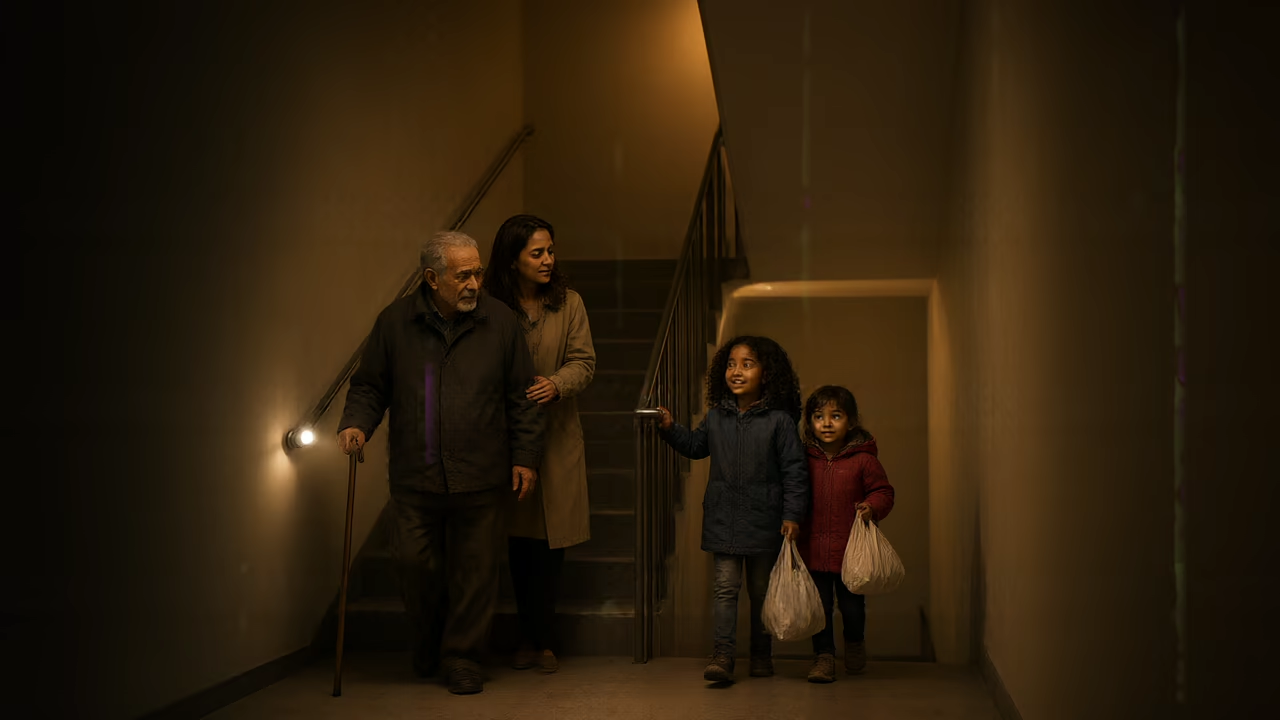
Amara, Teo and her mom took the flashlight and opened the door to the stairwell. It smelled like cold concrete. Small emergency lights glowed above each door, but between the floors the stairs were dim. Big black numbers were painted on the wall at every landing: 9, 8, 7.
By the time they reached the lobby, Teo's legs were wobbly. Mr. Haddad was sitting on the bench by the mailboxes with his bags around his feet. "I'm fine, I'm fine," he said, but he looked up at the stairwell door the way you look at a mountain.
Amara counted the bags. Four bags. Nine floors. One cane. She looked at the big painted numbers by the door, and an idea began to form.[1]
A relay up the stairs
"We don't have to carry everything all the way," she said. "We can do a relay, like in gym class. Kids on three, six and nine. Each person only carries the bags up three floors and passes them on."
Within ten minutes, the group chat had a plan. The Okonjo twins waited on the third-floor landing. Teo ran up to the sixth. Amara would take the last three floors to nine. Mrs. Lin carried a folding chair to the third-floor landing, and someone else put a kitchen chair on the sixth, so Mr. Haddad could sit down and rest on the way up.
It was slow. Mr. Haddad climbed one step at a time, holding the rail with one hand and his cane with the other. At each chair he sat, caught his breath and told a short joke. The bags went ahead of him, from hand to hand, up through the dim light.[1]
Using the cold
When everyone reached the ninth floor, there was still one problem. Mr. Haddad's fridge and freezer were dark and warm-ish. "My dumplings," he sighed.
Amara pressed her nose to his balcony door. The wind had calmed down a bit, but the thermometer stuck to the glass said 2°C. "It's as cold as a fridge out there," she said.
Teo dragged Mr. Haddad's cooler out of the closet. They packed the frozen food inside, closed the lid and set it on the balcony, in the corner where the wind could not knock it over. "A balcony fridge," Mr. Haddad said, and laughed. "In July this would never work."
At 9:15, the lights flickered back on. The fridge hummed. The elevator dinged in the hall. Mr. Haddad moved his food back into the freezer, and the next morning he knocked on Amara's door with a plate of warm dumplings, enough for both cousins.[1]
Fast lesson
Use these checks before you answer the practice questions.
Before reading, draw three boxes labelled Place, Time and Weather. As you read the first section, fill each box: Birchwood Towers, ninth floor; 5:30 on a November evening; howling wind.
Ask your child to finish the chain out loud: wind → power out → elevator stops → Mr. Haddad is stuck. Then ask: which link would break if the building had only one floor?
Children often think setting only causes trouble. Hunt for three places where the setting helps: the landings, the painted numbers and the cold balcony.
Move the story to July, a farmhouse or a school, and talk about how the problem and the solution would change. This shows why authors choose settings carefully.
Common mistakes
Why this fails: Setting also includes time and weather. In this story, the November cold and the evening darkness are just as important as the building.
Why this fails: Here the setting causes the problem (the storm and the tall building) and helps solve it (the landings and the cold balcony).
Why this fails: The story moves from the apartment to the stairwell, the lobby and the balcony, and the time moves from 5:30 pm to the next morning.
Word Lab
Use the meaning, hear the word, then try it in your own sentence.
setting
nounwhere and when a story happens, including the place, the time and often the weather
The setting is an apartment building on a windy November evening.
power outage
noun phrasea time when the electricity stops working
During the power outage, the fridge stopped humming.
stairwell
nounthe tall space inside a building where the stairs are
The stairwell was dim between floors.
landing
nounthe flat place at the top of a set of stairs or between two sets of stairs
Mrs. Lin put a chair on the third-floor landing.
lobby
nounthe large entrance area just inside the front door of a building
Mr. Haddad waited in the lobby by the mailboxes.
relay
nouna way of doing a job in parts, where each person does one part and passes it to the next person
The kids carried the bags in a relay.
emergency lights
noun phrasesmall lights that turn on by themselves when the power goes out
Emergency lights glowed above each door.
flicker
verbto shine on and off quickly and unevenly
The lights flickered and went out.
howl
verbto make a long, loud, wailing sound, like a strong wind
The wind howled around the building.
dim
adjectivenot bright; with only a little light
Between the floors, the stairs were dim.
cane
nouna stick that helps a person walk
Mr. Haddad walked with a cane.
balcony
nouna small platform with a railing on the outside of an upper floor of a building
They put the cooler on the balcony.
Check your understanding
Choose an answer, explain your choice, and then check. Hints and retries are welcome.
Try the questions here. Public practice does not save a learning record.
Support · Find it in the text
Support · Find it in the text practice
Each answer is stated in the story. Point to the sentence.
1. What time was it when the lights went out?
2. Who sent the message about Mr. Haddad?
3. Why was Teo worried about Mr. Haddad's food?
4. Which floors did the relay use?
5. What was put on the landings for Mr. Haddad?
6. What temperature did the balcony thermometer show?
Apply · Setting and plot
Apply · Setting and plot practice
Connect the place, time and weather to what happens.
7. Explain the chain from the wind to Mr. Haddad being stuck.
8. Why does it matter that Mr. Haddad lives on the ninth floor, not the first?
9. Which words in the first section make the setting feel tense or a little scary?
10. Name two parts of the setting that helped solve a problem.
11. How does Amara's choice show that she pays attention to her surroundings?
12. How long was the power out? Show your thinking.
Reason · What if the setting changed?
Reason · What if the setting changed? practice
Change one part of the setting and predict what happens to the plot.
13. If the story happened in a one-storey house, would there be the same problem? Explain.
14. If the power had gone out at noon in summer, name one thing that would be easier and one that would be harder.
15. Put in order: the cooler goes on the balcony; the lights flicker out; Mr. Haddad brings dumplings; the relay starts.
16. Sort these into place, time or weather: November evening, ninth floor, howling wind, 9:15, lobby, 2°C.
17. Write the story's message in one sentence of your own.
Practice answer key
- 1. It was only 5:30 on a November evening (the lights went out soon after, during the card game).
See 'A wild November evening'. - 2. Mrs. Lin on the third floor, in the building's group chat.
See 'Stuck in the lobby'. - 3. He buys a whole month of frozen dumplings at once, and they could melt.
See 'Stuck in the lobby'. - 4. Kids waited on floors 3, 6 and 9.
See 'A relay up the stairs'. - 5. A folding chair on the third floor and a kitchen chair on the sixth, so he could rest.
See 'A relay up the stairs'. - 6. 2°C.
See 'Using the cold'. - 7. The windstorm caused a power outage, the outage stopped the elevator, so Mr. Haddad could not ride up to the ninth floor.
Setting can start a cause-and-effect chain. - 8. Nine floors is a long climb for someone with a cane and heavy bags, so the high floor makes the problem much bigger.
The exact place in a setting can raise the stakes. - 9. Howling, bending sideways, rolled all by itself, dark grey, flickered, very quiet.
Setting words create a mood. - 10. The landings (places to rest and pass bags), the painted floor numbers (gave the idea), and the cold balcony (kept food cold).
Settings can help as well as hurt. - 11. She notices the painted numbers and turns nine floors into three short parts, and she reads the balcony thermometer before suggesting the balcony fridge.
Characters solve problems by noticing the setting. - 12. From about 5:30 (soon after) to 9:15, so close to four hours.
Time clues are part of the setting. - 13. No. With no elevator or stairs to climb, Mr. Haddad could just walk in. The tall building is what makes the problem.
Change the place, and the problem can disappear. - 14. Answers will vary. Easier: there might be daylight, so a flashlight might not be needed. Harder: the balcony would be too warm to keep frozen food cold.
Time and weather change both the problem and the solution. - 15. The lights flicker out → the relay starts → the cooler goes on the balcony → Mr. Haddad brings dumplings.
Follow the story from 5:30 pm to the next morning. - 16. Place: ninth floor, lobby. Time: November evening, 9:15. Weather: howling wind, 2°C.
A full setting has all three. - 17. Answers will vary, such as: Neighbours can solve a big problem by sharing the work and using what is around them.
A theme is a lesson about life, not a list of events.
Related skills
Put it in your own words
This draft is not saved when you leave or refresh the page.
Check your own explanation
This is self-review, not automatic marking.
Compare with a model response
The story takes place at Birchwood Towers, a tall apartment building, on a windy November evening. The wind is so strong that a shopping cart rolls across the parking lot by itself. Because of the storm, the power goes out, so the elevator stops working. As a result, Mr. Haddad is stuck in the lobby with four heavy bags, nine floors below his apartment. The dim stairwell makes the climb even harder. However, the setting also helps. Amara sees the big numbers painted at each landing and splits the climb into a relay of three floors at a time, with chairs on the landings so Mr. Haddad can rest. Then, because it is only 2°C outside, they keep his frozen food cold in a cooler on the balcony.
Sources and revision notes
Source check: 2026-11-02. Grade guidance is an editorial suggestion, not a standardised reading score.
What changed in this edition?
Original fiction. All characters, Birchwood Towers and the events are invented. The source supports the reading strategy, not the story: Reading Rockets' Story Maps page describes a story map as a graphic organizer that helps students learn the elements of a narrative, and says that identifying a story's characters, plot, setting, problem and solution prompts careful reading. The place–time–weather boxes, the setting-to-problem chain and the 'change the setting' activity are this lesson's teaching framing. The story is not about any real person or building.