Daily Read / Short Story
Short Story · Map a story's structure (character, setting, problem, events, solution), find the turning point, and infer how the main character changes and what the theme is
Short Story: The Volcano That Wouldn't Erupt
An original story: Noor's volcano fizzles the night before the science fair. Map the problem, attempts and turning point, then infer how she changes.
Device/browser voice. Pronunciation and availability vary.
The night before
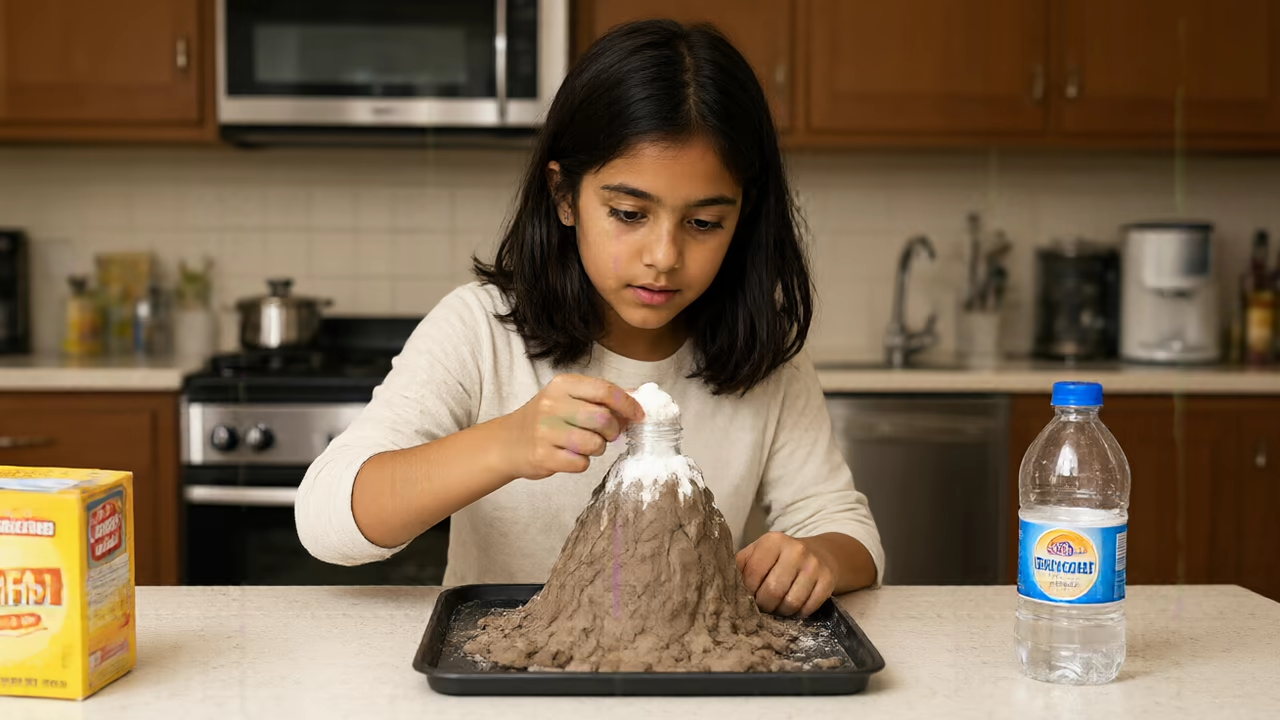
This is an original short story. The characters and events are invented. At seven-thirty on Wednesday night, Noor's volcano sat on a tray on the kitchen table. It was made of clay around a plastic bottle, painted brown, with orange lava painted down the sides. The Grade 4 science fair was the next morning. Her poster was already finished, and under the heading Results she had written in big red letters: HUGE ERUPTION! The lava shoots out of the top!
She had not actually tested it yet. Noor had watched videos of baking-soda volcanoes foaming over like a pot of boiling pasta, and she was sure hers would be the biggest in Grade 4. She spooned baking soda into the bottle hidden inside the mountain, poured in a cup of vinegar with red food colouring and stepped back. There was a small hiss. A little pink foam rose to the top, made one tired bubble and slid back down.[1]
Again, and again
"It's just warming up," said her older brother, Sami, from the couch. Noor rinsed the bottle and tried again with twice as much baking soda. Fizz, bubble, nothing. She added a squirt of dish soap, because one video said soap makes more foam. The foam was a little thicker, but it still did not pour over the top. She poked the opening wider with a pencil, in case the clay was blocking it. The mountain gave the same small burp.
By nine o'clock, the vinegar bottle was empty, her hands were sticky and her poster still said HUGE ERUPTION! Sami came to look. "Just leave the poster," he said. "Nobody's going to make you do it in the gym. Or print a picture from one of those videos." Noor looked at the bright red letters. It would be easy. Nobody would know.[1]
The notebook
When Noor went to pack her science notebook, it slipped out of her hand and fell open on the table. Earlier that week, Mr. Okafor had asked everyone to draw a table with three columns: What I changed, What I saw, What I think. Without really meaning to, Noor had filled in a row after every try. Trial 1: normal amounts, small fizz. Trial 2: double baking soda, small fizz. Trial 3: dish soap, thicker foam, no eruption. Trial 4: bigger hole, small fizz.
She read the table twice. It was the only thing on the kitchen table that told the truth. The poster said what she had wanted to happen. The notebook said what had actually happened. Noor imagined standing in the gym beside a picture of somebody else's volcano while a visitor asked, "How did you make it so big?" She would have to keep making things up all morning. She picked up a black marker and, before she could change her mind, drew a line through HUGE ERUPTION![1]
What really happened
Under the crossed-out words, she taped a fresh strip of paper and wrote a new heading: What Really Happened. She copied her four trials from the notebook. Then she added a box called My Guesses. Maybe the baking soda was old. Maybe I did not use enough of it for that much vinegar. Maybe I changed too many things too fast, so I cannot tell which one mattered. It was almost ten when she went to bed, and the volcano still had not erupted.
In the gym the next morning, the volcano at the next table foamed all the way onto the floor, and a group of Grade 2 students cheered. Noor's stomach felt tight. Then a Grade 5 student stopped at her poster and read the crossed-out words out loud. "Why didn't it work?" she asked. Noor took a breath and pointed to her table. "I don't know yet," she said. "But here's everything I tried, and here's what I think."[1]
One change at a time
Mr. Okafor read her poster for a long time. "If you tested it again, what would you do differently?" he asked. Noor did not even have to think. "Change only one thing each time," she said. "Last night I kept changing everything because I was in a hurry." Daniel, the boy with the overflowing volcano, had been listening. "I don't really know why mine worked," he admitted. "We just kept adding stuff until it did."
When Noor got home that afternoon, she did not throw the volcano away. She opened her notebook and wrote a new row: Trial 5: same as Trial 1, but with a brand-new box of baking soda. Change nothing else. She underlined it twice. On Wednesday night, she had wanted a volcano that looked amazing. Now she wanted to know why hers had not worked, and she was going to find out one change at a time.[1]
Fast lesson
Use these checks before you answer the practice questions.
Before the questions, sketch five boxes: characters, setting, problem, events and solution. Add one sticky note for each of Noor's trials under events, then move them into order.
Compare with 'Two Ideas, One Poster', where the poster finally works. Here the volcano never erupts. Ask your child whether a story's problem can be solved even when the experiment still fails.
Connect to real school work: write two columns, What I hoped and What actually happened, for a recent project, game or recipe. Talk about what the second column teaches that the first cannot.
Common mistakes
Why this fails: The problem is what Noor will report. It is solved when she tells the truth and plans a fair test.
Why this fails: Noor had already crossed out her false result the night before. The turning point is the notebook falling open.
Why this fails: A theme is a general lesson. If the answer needs the characters' names, it is probably a summary.
Word Lab
Use the meaning, hear the word, then try it in your own sentence.
erupt
verbto burst out suddenly, like lava or foam from the top of a volcano
Noor wanted her volcano to erupt.
fizz
nounsmall bubbles of gas, or the hissing sound they make
The volcano made only a small fizz.
trial
nounone try of a test or experiment
Trial 2 used double the baking soda.
result
nounwhat actually happens at the end of a test
Her poster listed the results before she had tested.
admit
verbto say that something is true, even if you would rather not
Daniel admitted he did not know why his worked.
honest
adjectivetelling the truth and not trying to trick people
Noor's new poster was honest about what happened.
persevere
verbto keep trying even when something is difficult or disappointing
Noor persevered by planning Trial 5.
story map
noun phrasea chart that shows a story's characters, setting, problem, events and solution
Use a story map to track Noor's attempts.
setting
nounwhere and when a story happens
The setting moves from Noor's kitchen to the school gym.
turning point
noun phrasethe moment in a story when things begin to change
The notebook falling open is the turning point.
theme
nounthe big lesson or message a story suggests about life
The theme is about honesty and perseverance.
Check your understanding
Choose an answer, explain your choice, and then check. Hints and retries are welcome.
Try the questions here. Public practice does not save a learning record.
Support · Find it in the story
Support · Find it in the story practice
Point to the sentence that gives the answer.
1. What did Noor write under Results before she tested her volcano?
2. What is hidden inside Noor's clay mountain?
3. Why did Noor add dish soap?
4. What were the three column headings in Noor's notebook table?
5. What new heading did Noor write on her poster?
6. What will Noor change in Trial 5?
Apply · Read the clues
Apply · Read the clues practice
Use clues from the story to explain what Noor thinks and feels.
7. Noor wrote her results before testing. What does this show about her at the start?
8. The foam made 'one tired bubble'. What feeling does this word choice create?
9. Why is Sami's idea tempting to Noor?
10. Why does Noor cross out HUGE ERUPTION! quickly, 'before she could change her mind'?
11. Noor's 'stomach felt tight' in the gym. Why?
12. Why does Noor answer Mr. Okafor's question without having to think?
Reason · Map the story
Reason · Map the story practice
Use a story map: characters, setting, problem, events and solution.
13. Fill in a story map: characters, setting, problem and solution.
14. Put in order: Noor plans Trial 5; the notebook falls open; Noor adds dish soap; the Grade 5 student asks why it did not work; Noor crosses out HUGE ERUPTION!
15. Compare Noor's poster and Daniel's volcano. What does each one show well, and what is missing?
16. Was the solution to Noor's problem making the volcano erupt? Explain.
17. State the theme in one sentence without using the names Noor, Sami or Daniel.
Practice answer key
- 1. HUGE ERUPTION! The lava shoots out of the top!
It is in the first paragraph, written in big red letters. - 2. A plastic bottle.
The first paragraph says the clay is built around a plastic bottle. - 3. One video said soap makes more foam.
The reason is given in 'Again, and again'. - 4. What I changed, What I saw, What I think.
Mr. Okafor asked the class to draw this table. - 5. What Really Happened.
It opens 'What really happened'. - 6. She will use a brand-new box of baking soda and change nothing else.
It is the new row in the last paragraph. - 7. She was so sure the volcano would work, and so focused on it looking impressive, that she skipped the actual test.
She expected hers to be 'the biggest in Grade 4'. - 8. Disappointment; the volcano seems weak and worn out instead of exciting.
Authors pick describing words to show a mood. - 9. It is late, the vinegar is gone, and she could look successful without anyone knowing.
The story says, 'It would be easy. Nobody would know.' - 10. She knows it is the right thing to do but still feels tempted, so she acts before the temptation wins.
The phrase shows she is still struggling inside. - 11. She was nervous that people would compare her small fizz with Daniel's big eruption.
The detail comes right after the Grade 2 students cheer for the other volcano. - 12. She had already noticed in her guesses that she changed too many things at once, so she knew what to do differently.
Her My Guesses box from the night before prepared her. - 13. Characters: Noor, Sami, Mr. Okafor, Daniel, a Grade 5 student. Setting: Noor's kitchen on Wednesday night, then the school gym the next day. Problem: the volcano will not erupt and the poster already says it did. Solution: Noor reports what really happened and plans a fairer test.
A story map shows how the parts of a story connect. - 14. Noor adds dish soap → the notebook falls open → Noor crosses out HUGE ERUPTION! → the Grade 5 student asks why it did not work → Noor plans Trial 5.
The attempts lead to the turning point, and the decision leads to the ending. - 15. Daniel's volcano shows a big eruption, but he cannot explain why it worked. Noor's poster has no eruption, but it shows every trial and her thinking.
A strong answer names one strength and one gap for each. - 16. No. The volcano never erupts. Her problem is solved when she reports honestly and finds a better way to keep testing.
In some stories the solution is a change in the character, not a perfect result. - 17. Example: Being honest about a disappointing result helps you learn what to try next.
A theme without names can apply to anyone.
Related skills
Put it in your own words
This draft is not saved when you leave or refresh the page.
Check your own explanation
This is self-review, not automatic marking.
Compare with a model response
The main character is Noor, a Grade 4 student, and the story happens in her kitchen the night before the science fair and then in the school gym. Her problem is that her baking-soda volcano only fizzes, but her poster already says HUGE ERUPTION! She tries double the baking soda, then dish soap, then a bigger hole, and each time it only gives a small burp. The turning point is when her notebook falls open and she sees that her trial table tells what really happened while the poster tells only what she wanted. She crosses out the false result and writes What Really Happened, with her trials and guesses. At the start Noor cares most about having the biggest volcano, but at the end she wants to know why hers did not work and plans to change one thing at a time. The theme is that being honest about a disappointing result helps you learn and keep going.
Sources and revision notes
Source check: 2026-10-27. Grade guidance is an editorial suggestion, not a standardised reading score.
What changed in this edition?
Original fiction. All characters, the school, the trial table and events are invented. The story does not claim to explain why the volcano fizzled; Noor's guesses are labelled as guesses. The source supports the story-map strategy used in the practice, not the story's events.