Daily Read / Canada & Community
Canada & Community · Sort details by category and explain how a community service is organized
What Can You Do at a Public Library? Free Services in Ontario
Libraries lend far more than books. Learn what Ontario public libraries offer, why borrowing is free, and who manages them for the community.
Device/browser voice. Pronunciation and availability vary.
More than books
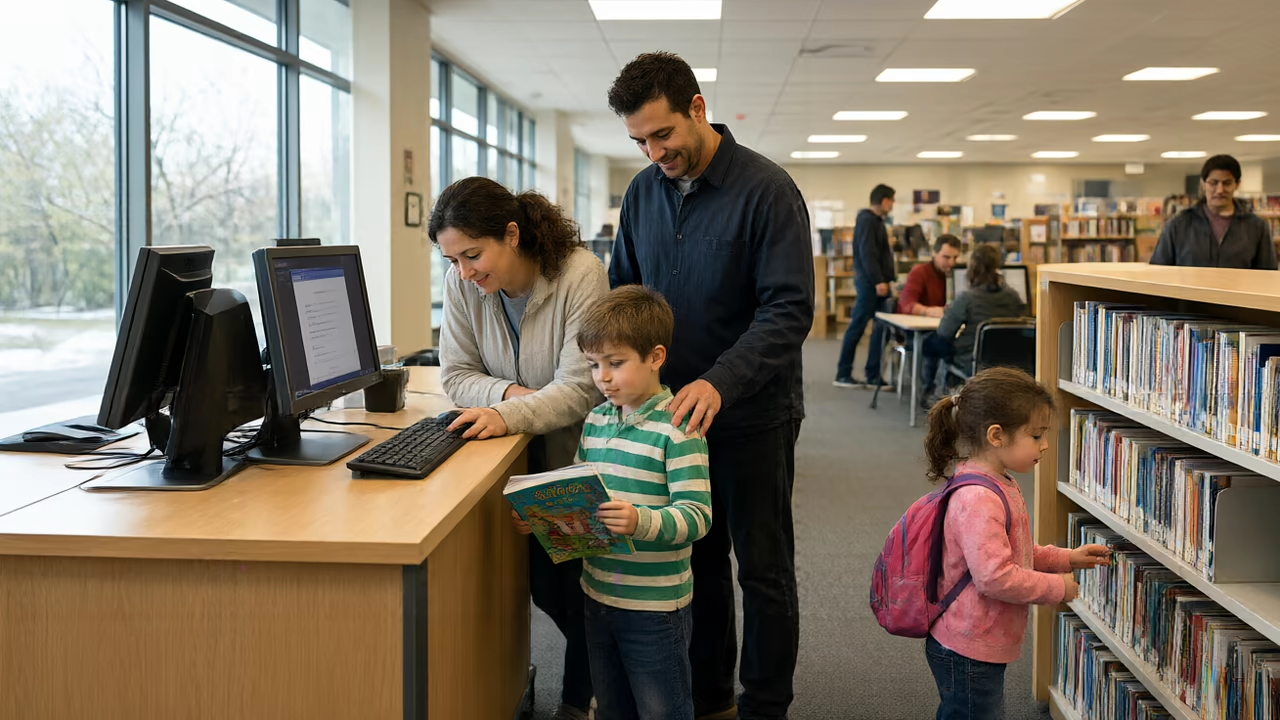
A library card can open a lot of doors. At an Ontario public library you can borrow books, e-books, audiobooks, movies, newspapers and magazines. Some items are in languages other than English. Loan periods are usually one to three weeks, and many items can be renewed.
If the item you want is at another branch, you can often ask for it to be sent to your library. Delivery usually takes a few days. A small fine may be charged for late items, so it helps to check your due date.[2]
A place to learn and meet
Libraries also hold programs. Ontario's 2022 library statistics counted 33,647 early literacy and learning sessions for young children. They also counted 3,611 programs for immigrants and new Canadians, 6,306 maker space, digital media and self-publishing programs, and 614 career and job-skills programs.
Many libraries offer homework clubs, book clubs, free internet and Wi-Fi, and help for people with disabilities who want to use devices. Some have rooms you can book for studying or working. Printing and photocopying usually cost a little money.[1]
Why borrowing is free
The first free public libraries in Ontario were set up in Toronto and Guelph in 1883. Today a law called the Public Libraries Act helps keep library services free. It says a library board cannot charge for walking in, for using materials inside the library, or for borrowing and reserving most items.
Free does not mean the library costs nothing to run. Staff, buildings and new books still have to be paid for, and the municipality approves the library board's budget. A board may charge a fee to people who do not live in its area.[3]
Who runs the library
In Ontario, a municipal by-law creates a public library, and a public library board manages it. The board sets rules for how the library runs and what services it offers. The municipality can appoint board members and approve the board's budget.
This connects the library to local government. Like a town council, the board makes decisions on behalf of the people in the community it serves.[3]
Libraries by the numbers
In 2022, Ontario had 1,176 library service points, including main libraries, branches and bookmobile stops. Libraries lent about 110.7 million items that year. More than 99 per cent of Ontarians lived in a community served by a public library, and about 3.9 million people, nearly 27 per cent of the population, held a library card.
A card is usually free if you live, work, own property or go to school in the area the library serves. You may need to show identification that proves this. If you do not qualify, you may be able to join for a fee.[1]
Fast lesson
Use these checks before you answer the practice questions.
Fees, loan limits and library cards differ between libraries. The article gives general patterns, so check your own library's website for details.
This reading explains how libraries are organized. It does not argue for or against any level of funding. Keep to the facts if your child asks about budgets.
The statistics are from 2022. Ask your child why numbers need a year attached to them.
Common mistakes
Why this fails: Staff, buildings and new books still have to be paid for; the municipality approves the board's budget.
Why this fails: Libraries lend other items and run programs, offer internet and more.
Why this fails: Each library board sets its own policies within the law, so details differ.
Word Lab
Use the meaning, hear the word, then try it in your own sentence.
library
nouna place that lends books and other materials and offers programs
The library has a reading hour on Saturdays.
branch
nounone of several locations of the same library or organization
Our branch is close to the school.
borrow
verbto take something for a short time and then return it
You can borrow six books with your card.
loan
nounsomething lent for a set time
The loan period is three weeks.
renew
verbto extend the time you may keep a borrowed item
I renewed my book online.
fine
nounmoney you pay as a penalty, such as for a late item
The fine for a late book was small.
program
nouna planned activity or series of events
The library program teaches coding.
literacy
nounthe ability to read and write
Story time builds early literacy.
board
nouna group chosen to manage an organization
The library board meets once a month.
by-law
nouna local rule made by a municipality
A by-law created the town library.
budget
nouna plan for how money will be spent
The council approves the library's budget.
eligible
adjectiveallowed to have something because you meet the rules
People who live in town are eligible for a free card.
Check your understanding
Choose an answer, explain your choice, and then check. Hints and retries are welcome.
Try the questions here. Public practice does not save a learning record.
Support · Find it in the text
Support · Find it in the text practice
Each answer is in the article. Point to the sentence.
1. Name three kinds of items you can borrow from a library.
2. How long is a loan period usually?
3. In what year were Ontario's first free public libraries set up, and where?
4. What law helps keep library services free in Ontario?
5. What group manages an Ontario public library?
6. About how many Ontarians held a library card in 2022?
Apply · Explain the ideas
Apply · Explain the ideas practice
Use the article to explain why and how.
7. Why might a library keep a list of due dates and charge small fines?
8. Why does the article say 'free does not mean the library costs nothing'?
9. Sort these into 'borrowing' or 'programs': audiobook, homework club, newspaper, book club.
10. How are a library board and a town council connected?
11. Who might have to pay a fee to use a library?
12. Name two things a library might help a newcomer to Canada with.
Reason · Use the ideas
Reason · Use the ideas practice
Apply what you learned to new situations.
13. You need a quiet place to do homework and have no Wi-Fi at home. What could the library offer?
14. Your book is due tomorrow but you are not done. What could you try?
15. A classmate says libraries only have books. Use the article to answer.
16. A friend moves to a new town. What should they ask the library to get a card?
17. Which library service would you use most, and why?
Practice answer key
- 1. Any three: books, e-books, audiobooks, movies, newspapers, magazines.
They are listed in 'More than books'. - 2. One to three weeks.
It is stated in the first paragraph. - 3. 1883, in Toronto and Guelph.
This is in 'Why borrowing is free'. - 4. The Public Libraries Act.
It is named in the first paragraph of 'Why borrowing is free'. - 5. A public library board.
See 'Who runs the library'. - 6. About 3.9 million, nearly 27 per cent.
This is in 'Libraries by the numbers'. - 7. So items come back on time and others can borrow them.
The article says fines may be charged for late items. The reason given here is an inference. - 8. Staff, buildings and new books still have to be paid for, and the municipality approves the board's budget.
The article names these costs. - 9. Borrowing: audiobook, newspaper. Programs: homework club, book club.
Items you take home are borrowing; activities you attend are programs. - 10. The municipality creates the library by by-law, appoints board members and approves the board's budget.
See 'Who runs the library'. - 11. People who do not live in the area the board serves.
The article says a board may charge them. - 12. Any two: programs for new Canadians, other-language materials, English and literacy help, free internet.
These appear in the article's program lists. - 13. Free Wi-Fi and internet, and possibly a bookable study room.
Both are mentioned in 'A place to learn and meet'. - 14. Renew it, if the library allows, or return it on time.
The article says many items can be renewed. - 15. Libraries also lend movies and audiobooks, offer programs, free internet and more.
Several sections list non-book services. - 16. What proof of address or school they need, and whether the card is free.
Cards are usually free if you live, work, own property or go to school there, and ID may be required. - 17. Answers vary. A good answer names a service from the article and gives a reason.
Linking a service to your own life shows why it matters.
Related skills
Put it in your own words
This draft is not saved when you leave or refresh the page.
Check your own explanation
This is self-review, not automatic marking.
Compare with a model response
An Ontario public library offers much more than books. People can borrow audiobooks, movies and magazines, use free Wi-Fi, and join programs such as homework clubs or sessions for newcomers to Canada. A public library board manages the library and sets its rules. The municipality appoints board members and approves the budget. A law called the Public Libraries Act helps keep services free, so a board cannot charge for walking in or for borrowing most items. Free for the user does not mean free to run, because staff, buildings and collections still cost money.
Sources and revision notes
Source check: 2026-11-07. Grade guidance is an editorial suggestion, not a standardised reading score.
- Government of Ontario — Ontario public libraries
- Settlement.Org — What services can I get at the library?
- Government of Ontario — About the Public Libraries Act
What changed in this edition?
The 1883 libraries, 2022 statistics and by-law and board governance come from the Government of Ontario libraries page; borrowing, programs, card eligibility and late fines from Settlement.Org; free access rules, board duties and non-resident fees from the Government of Ontario Public Libraries Act summary. The 2022 numbers are the latest on that page when checked. Details vary by library; check your own library. The reading explains how libraries work and does not support any position on funding.