Daily Read / Community services
Community services · Put the steps of a 9-1-1 call in order, use numbers and facts from several sources, tell when to call 9-1-1 and when another number is better, and notice when two sources describe a topic slightly differently
What Happens When You Call 9-1-1? How Emergency Calls Work
9-1-1 is Canada's emergency number. Follow a call from your phone to a call centre, learn what the call-taker asks and why staying on the line helps.
Device/browser voice. Pronunciation and availability vary.
One number for help
Imagine you see smoke coming out of a neighbour's window. You need help fast, and you do not have time to look up a phone number. In Canada, you dial one number for police, fire or ambulance help: 9-1-1.
The Canadian Radio-television and Telecommunications Commission (CRTC) describes 9-1-1 as Canada's emergency phone number. Its page says that telephone and wireless companies look after the network that carries your call, and that 9-1-1 call centres are operated by municipal and provincial or territorial governments. So the call travels over phone company lines, but the people who answer work in government-run call centres.[1]
Where are you?
A call-taker cannot send help without knowing where to go. The CRTC explains two levels of service. With Basic 9-1-1, the call goes to a call centre, but the caller must say where they are. With Enhanced 9-1-1, the caller's phone number and location also reach the call-taker.
For cellphones, the CRTC says the system can use GPS or a method called trilateration to estimate the phone's location, generally within 50 to 300 metres. Trilateration means estimating a position from its distance to several known points, a definition added for this lesson. An estimate that wide could cover many houses, which is a reason made for this lesson why a clear address is still the best information you can give.[1]
Inside the call
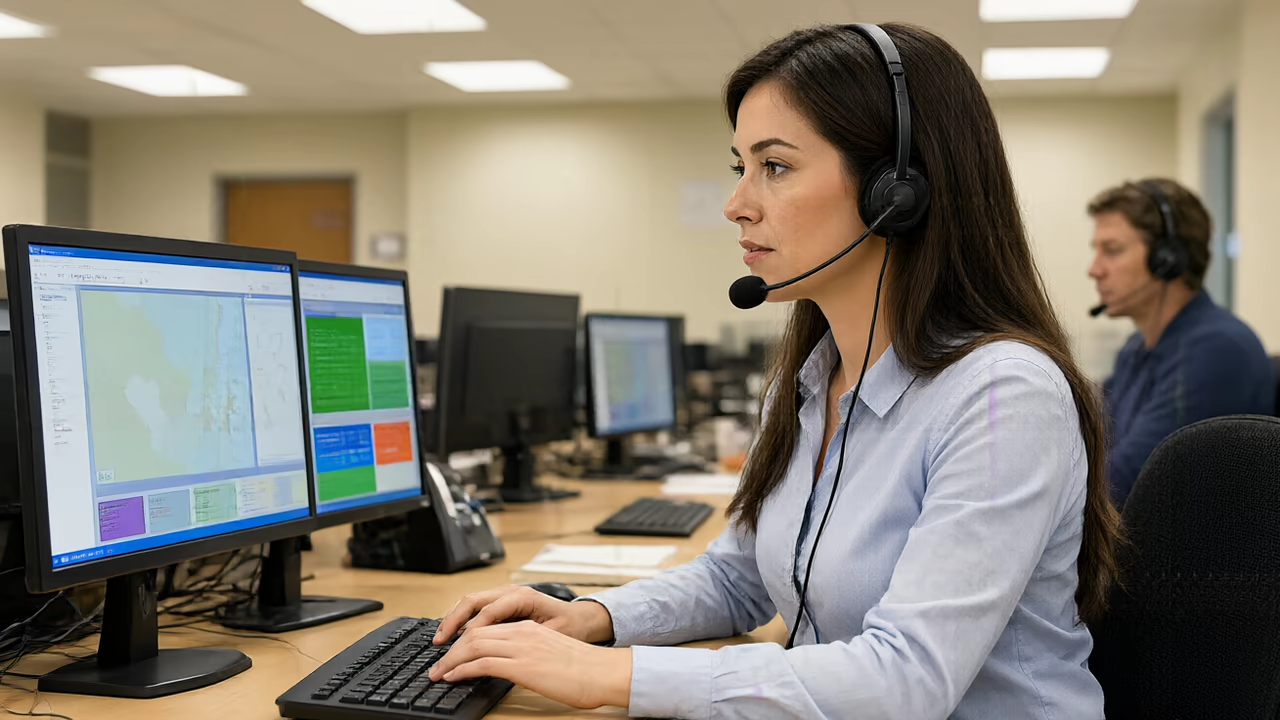
The Richmond RCMP in British Columbia describes what happens at one local call centre. First, an operator answers and asks whether you need police, fire or ambulance, and which municipality you are in. Your call is then routed to the right call-taker. The RCMP says this whole step usually takes less than a minute.
A police call-taker then asks about the location (an exact address is best, but landmarks and cross streets help), what is happening, descriptions of any people or vehicles, when it happened, and whether anyone is hurt or there are weapons. At the same time, the call-taker passes the information to a dispatcher, the person who contacts the officers who will respond. Call centres in other places may follow their own steps.[3]
Stay on the line
Both the CRTC and the Toronto Police Service give similar advice. Tell the operator what the emergency is and where it is, give your phone number in case the call is cut off, and stay on the line unless the operator tells you to hang up. If you are disconnected, call back.
Toronto Police say that about 27 per cent of 9-1-1 call volume in 2024 was misdialled or pocket-dialed calls. To handle this, a wireless call that disconnects before reaching a call-taker is removed from the queue, and the caller gets an automatic text asking them to reply 1 if there is an emergency or 9 if there is not. Toronto Police advise people not to redial, because the call is already in the queue.[2]
When to call, and who else to call
Toronto Police say to call 9-1-1 only for life-and-death emergencies. The RCMP's list is a little wider: it says to call when life, safety or property is in immediate danger or a crime is happening, and that if you are unsure, you can call anyway and the call-taker will help decide what is needed. Two careful sources can word the same rule differently, so it helps to read both.
For other situations, Toronto Police list 416-808-2222 for police non-emergencies, 3-1-1 for City services, 2-1-1 for mental health supports and 8-1-1 for minor medical concerns. These are the numbers listed for Toronto, and other communities may have different non-emergency numbers.[2]
Help for everyone, and an upgrade
Toronto Police say 9-1-1 offers service in 180 languages: a caller who needs an interpreter should name their language at the start of the call and stay on the line. The CRTC says text with 9-1-1 is available in most areas for people who are deaf, hard of hearing or speech impaired. They must register with their wireless provider first.
Canada's system is also being upgraded to Next Generation 9-1-1. Toronto Police say the first phase began on July 10, 2024, and that the upgrade gives call-takers faster access to more accurate location and phone number data. They add that Toronto residents should not expect any change in how they call 9-1-1.[2]
Fast lesson
Use these checks before you answer the practice questions.
Do not dial 9-1-1 to practise. Use a toy phone or role-play: one person is the call-taker and asks where, what, who, when and whether anyone is hurt.
Help your child say their full address, the name of their town or city, and a parent's phone number. Add a landmark near home.
Toronto Police and the Richmond RCMP word the rule for when to call slightly differently. Ask your child which words are the same in both and why careful sources may differ.
The non-emergency numbers in this lesson are Toronto numbers listed by Toronto Police. Look up the numbers for your own community and keep them with the family contacts.
Common mistakes
Why this fails: 9-1-1 is for emergencies. For City services, Toronto Police list 3-1-1, and they list a separate number for police non-emergencies.
Why this fails: The call-taker may need more information, and the sources say to stay on the line unless told to hang up.
Why this fails: The CRTC says wireless location is an estimate, generally within 50 to 300 metres.
Word Lab
Use the meaning, hear the word, then try it in your own sentence.
emergency
nouna sudden, dangerous situation that needs help right away
A fire is an emergency.
operator
nouna person who answers calls and connects them to the right place
The operator asked if you need police, fire or ambulance.
call-taker
nouna person at a call centre who asks questions and records what the caller says
The call-taker asked for the address.
dispatcher
nouna person who sends police, fire crews or ambulances to where they are needed
The dispatcher contacted the officers.
municipality
nouna city, town or other local area with its own local government
The operator asked which municipality you are in.
provincial
adjectivebelonging to a province
Some call centres are run by provincial governments.
network
nouna system of connected lines or towers that carries phone calls
The phone network carries your call.
location
nounthe place where someone or something is
Tell the operator your location.
estimate
verbto work out an amount or position that is close but not exact
The system can estimate where a phone is.
misdial
verbto call a number by mistake
People sometimes misdial 9-1-1.
queue
nouna line of calls or people waiting their turn
The call stays in the queue until someone answers.
interpreter
nouna person who translates spoken words from one language to another
Name your language to ask for an interpreter.
Check your understanding
Choose an answer, explain your choice, and then check. Hints and retries are welcome.
Try the questions here. Public practice does not save a learning record.
Support · Find it in the text
Support · Find it in the text practice
Each answer is stated in the article. Point to the sentence.
1. What number do you dial in Canada for police, fire or ambulance help?
2. What does Enhanced 9-1-1 send to the call-taker besides your voice?
3. How long does the RCMP say the first step usually takes?
4. What number is listed for City of Toronto services?
5. How many languages does Toronto Police say 9-1-1 offers service in?
6. On what date did Toronto's first Next Generation 9-1-1 phase begin?
Apply · Order and numbers
Apply · Order and numbers practice
Put steps in order and use numbers from the text.
7. Put these in order: dispatcher contacts responders · operator asks police, fire or ambulance · you dial 9-1-1 · call-taker asks where and what.
8. Finish the sentence: A caller should give an address, because …
9. Finish the sentence: A wireless call disconnects before anyone answers, so …
10. If 100 calls came in and 27 were misdialled or pocket-dialed, how many were not?
11. Which number would you use for a question about a City of Toronto service, 3-1-1 or 9-1-1?
12. In one sentence, explain what a dispatcher does.
Reason · Emergency or not?
Reason · Emergency or not? practice
Use what you learned to decide. These situations are invented for practice.
13. A kitchen is on fire and the family is outside. Call 9-1-1 or use a non-emergency number?
- Call 9-1-1
- Non-emergency number
14. You want to ask when the City picks up large garbage items. Call 9-1-1 or another number?
- Call 9-1-1
- Another number
15. How is a 9-1-1 call like the Town Council reading, where many people work together to provide a service?
16. A caller says only 'help' and the call drops. What might the call-taker use to find the caller?
17. Why might it be useful to know your home address by heart?
Practice answer key
- 1. 9-1-1.
See 'One number for help'. - 2. The caller's phone number and location.
See 'Where are you?'. - 3. Less than a minute.
See 'Inside the call'. - 4. 3-1-1.
See 'When to call, and who else to call'. - 5. 180 languages.
See 'Help for everyone, and an upgrade'. - 6. July 10, 2024.
See 'Help for everyone, and an upgrade'. - 7. Dial 9-1-1 → operator asks police, fire or ambulance → call-taker asks where and what → dispatcher contacts responders.
See 'Inside the call'. - 8. … the phone estimate may be 50 to 300 metres wide, so an address helps responders find the exact place.
Estimates are not exact. - 9. … the caller gets an automatic text and should not redial.
See 'Stay on the line'. - 10. 73 calls.
100 − 27 = 73. This is an invented example for practice; it does not use real call totals. - 11. 3-1-1.
9-1-1 is for emergencies. - 12. A dispatcher contacts the police, fire crews or ambulance staff who will respond.
See 'Inside the call'. - 13. Call 9-1-1
Fire puts life and property in immediate danger. - 14. Another number
A City service question fits 3-1-1 in Toronto. - 15. Both are community services run by governments, with different people doing different jobs.
A call-taker, a dispatcher and responders each do one part. - 16. The phone number and estimated location, if the service is Enhanced 9-1-1.
See 'Where are you?'. - 17. A call-taker needs a clear location, and a phone's estimate may be 50 to 300 metres wide.
This is a reasoned answer, not a quoted rule.
Related skills
Put it in your own words
This draft is not saved when you leave or refresh the page.
Check your own explanation
This is self-review, not automatic marking.
Compare with a model response
In Canada, a person dials 9-1-1 to reach police, fire or ambulance help. The call centres are operated by municipal and provincial or territorial governments, so the people who answer work for governments. First, an operator asks whether you need police, fire or ambulance, and then the call is sent to the right call-taker. The call-taker asks where you are and what is happening, and the information goes to a dispatcher, who contacts the responders. A cellphone's location is only an estimate, generally within 50 to 300 metres, so a caller should give a clear address. A caller should also stay on the line, because the call-taker's questions help send the right help. As a result, help can reach the right place faster.
Sources and revision notes
Source check: 2026-11-06. Grade guidance is an editorial suggestion, not a standardised reading score.
- CRTC — 9-1-1 Services for Traditional Wireline, VoIP and Wireless Phone Services
- Toronto Police Service — Next Generation 911
- Richmond RCMP — What happens when you call 9-1-1? Go behind the scenes with Richmond RCMP and E-Comm 9-1-1
What changed in this edition?
The statements that 9-1-1 is Canada's emergency number, that telephone and wireless companies handle the network side while 9-1-1 call centres are operated by municipal and provincial or territorial governments, the Basic and Enhanced 9-1-1 descriptions, the wireless location estimate generally within 50 to 300 metres using GPS or trilateration, the advice to give the nature and location of the emergency, give a phone number, stay on the line and call back if cut off, and the text-with-9-1-1 service for people who are deaf, hard of hearing or speech impaired who register with their wireless provider come from the CRTC page. The statements about Toronto Police Next Generation 9-1-1 (Phase 1 on July 10, 2024), the 27 per cent misdialled or pocket-dialed share of 2024 call volume, the automatic text asking callers to reply 1 or 9, the advice not to redial, the call-9-1-1-only-for-life-and-death-emergencies guidance, the numbers 416-808-2222, 3-1-1, 2-1-1 and 8-1-1, service in 180 languages and the advice that Toronto residents should not expect changes in how they call come from the Toronto Police Service page. The operator question, routing in usually less than a minute, call-taker questions, simultaneous passing of information to a dispatcher, the wider list of reasons to call and the advice to call if unsure come from the Richmond RCMP page, which describes one British Columbia call centre. The smoke scene, the definition of trilateration, the comment that a 300-metre circle can hold many houses, the 100-call example, the role-play and all activities are original illustrations or reasoning. This lesson explains how a public service works; it does not take a position on any government policy. Call 9-1-1 in a real emergency and follow the instructions of the call-taker. Report errors through Sources and corrections.