Daily Read / Short Story
Short Story · Follow a chain of causes and effects in a story: find what made each event happen, connect events with because and so, and explain which cause led to the solution
Short Story: Forty Cans and a Plank
An original story about a class food drive, a split box and a stage with three steps. Trace each cause and effect, then explain how the problem got solved.
Device/browser voice. Pronunciation and availability vary.
A wall of cans
This is an original short story. The characters, Birchview Public School and the food drive are invented.
By Thursday afternoon, the back corner of Room 9 looked like a grocery store. For two weeks, Ms. Adeyemi's Grade 4 class had been collecting food for the neighbourhood food bank, and the cans had piled up faster than anyone expected. Soup, beans, tomatoes, corn. Mateo had counted them twice: three hundred and twelve.
"Tomorrow is the assembly," Ms. Adeyemi reminded everyone. "We need all the boxes up on the gym stage by 9 o'clock, so the whole school can see what we collected. The food bank van comes right after."
Mateo looked at the stage in his mind. It was only about as high as his waist, but it had three narrow steps at the side. Then he looked at the boxes. "That's a lot of trips," he said.[1]
The first plan
Hana had an idea. "Let's save time. We'll put more cans in each box, so we'll only have to make a few trips."
Everybody liked the idea of fewer trips. They packed the cans in tight. Mateo squeezed forty cans into the biggest box and taped the flaps shut with a grin.
Friday morning, Mateo and Hana lifted the forty-can box together. It was so heavy that their arms shook before they even reached the gym doors. At the bottom of the stage steps, Hana's fingers slipped. The box dropped onto the first step, and its bottom split open.
Cans rolled everywhere. A can of corn bounced off the step and spun under the piano. Two soup cans raced each other across the gym floor. The Grade 1 class, lining up for the assembly, cheered.[1]
The second plan
While the class chased cans, Jordan pointed at the red wagon by the gym door. "We can put the boxes in the wagon," he said. "Then nobody has to carry anything."
The wagon worked perfectly across the floor. Then it reached the steps and stopped. Its wheels bumped against the first step and would not climb. Three kids tried to lift the whole wagon, boxes and all, up the steps, but it was even heavier than the forty-can box.
"We have twenty minutes," Ms. Adeyemi said, checking the clock. Her voice was calm, but Mateo saw her glance at the door where the principal would soon walk in.[1]
A long board and a short one
Mateo stared at the steps. Something from science class tugged at his memory: the ramp beside the front stairs of the school was much longer than the stairs, and his class had learned that a longer slope needs a smaller push.
"We don't need to lift the wagon," he said. "We need a ramp."
Mr. Ferreira, the custodian, was setting up chairs. When he heard the plan, he went to the storage room and came back with two boards. "Short one or long one?" he asked.
They tried the short board first, because it was lighter to carry. Mr. Ferreira set it from the floor to the edge of the stage, and it tilted up sharply. When Jordan pushed the wagon, it rolled halfway up and then rolled right back down. The slope was too steep.
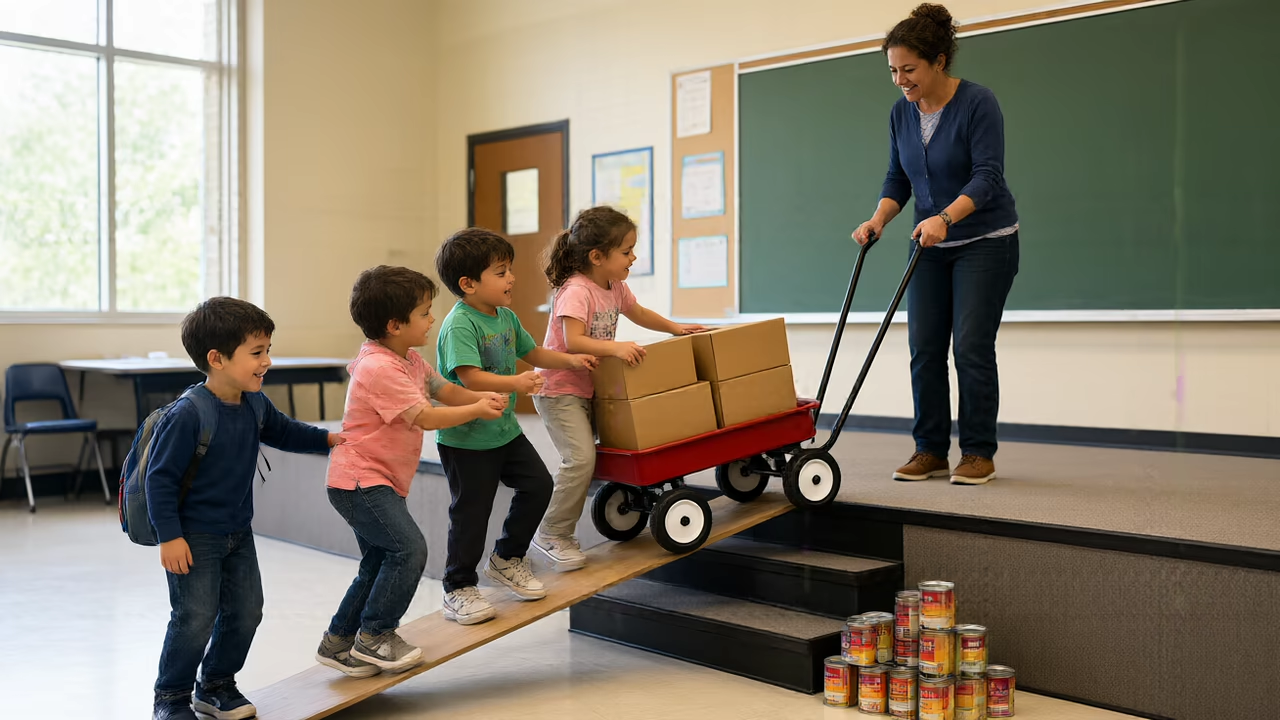
Mr. Ferreira set the long board in its place, checking that both ends were steady. This time the slope was gentle. Jordan and Hana pushed together, and the wagon rolled slowly up, up and onto the stage. It was a longer trip, but the push was easy.[1]
Lighter boxes, steady wheels
There was one more change. Hana repacked the cans from the split box into three smaller boxes. "Less in each box, so no more splitting," she said. Mateo nodded. This time he did not argue for fewer trips.
By 8:55, every box was lined up on the stage, and the corn can from under the piano was back where it belonged. When the principal announced the total, the whole gym clapped for three hundred and twelve cans.
Afterward, Ms. Adeyemi asked the class to think about the morning. "What made it go wrong, and what made it go right?"
Mateo thought about the forty cans, the stuck wagon and the long board. "Every time we changed one thing," he said, "it changed the next thing."[1]
Fast lesson
Use these checks before you answer the practice questions.
A list of events shows order. A chain with arrows shows that one event made the next happen. Ask your child, "Did this happen just after, or because of?"
The split box led to rolling cans and to a new plan. Point out that causes can branch.
The story uses the same idea as the Daily Read on ramps: a longer, gentler slope needs a smaller push. Ask your child to find the sentence that shows this.
The school and the people are invented, but the science of ramps in the story is real. Ask which parts are invented and which ideas are true in real life.
Common mistakes
Why this fails: Some events only follow in time. An effect must happen because of the cause.
Why this fails: The heavy load and the slipping fingers worked together.
Why this fails: The wagon alone got stuck; the gentle ramp is what let it reach the stage.
Word Lab
Use the meaning, hear the word, then try it in your own sentence.
food bank
noun phrasea place that collects food and gives it to people who need it
The class collected cans for the food bank.
food drive
noun phrasea time when people collect food to give away
Our school food drive lasted two weeks.
assembly
nouna meeting of the whole school, often in the gym
The principal announced the total at the assembly.
custodian
nouna person who takes care of a school building
The custodian brought two boards from the storage room.
split
verbto break open or come apart
The bottom of the heavy box split open.
plank
nouna long, flat piece of wood
They used a long plank as a ramp.
slope
nouna surface that goes up or down at an angle
The long board made a gentle slope.
steep
adjectiverising sharply
The short board was too steep, so the wagon rolled back.
steady
adjectivefirm and not moving or shaking
Mr. Ferreira made sure both ends of the board were steady.
cause
nounsomething that makes another thing happen
The heavy box was the cause of the spill.
effect
nounwhat happens because of a cause
The effect was cans rolling across the gym.
repack
verbto put things into a container again, often in a new way
Hana repacked the cans into three smaller boxes.
Check your understanding
Choose an answer, explain your choice, and then check. Hints and retries are welcome.
Try the questions here. Public practice does not save a learning record.
Support · Find it in the text
Support · Find it in the text practice
Each answer is stated in the story. Point to the sentence.
1. How many cans did the class collect?
2. By what time did the boxes need to be on the stage?
3. How many cans did Mateo squeeze into the biggest box?
4. Who suggested using the wagon?
5. Where did Mr. Ferreira get the boards?
6. How many smaller boxes did Hana use for the cans from the split box?
Apply · Link causes and effects
Apply · Link causes and effects practice
Use because or so to join each cause to its effect.
7. Finish the sentence: The box split open because …
8. Finish the sentence: The wagon could not climb the steps, so …
9. Why did the wagon roll back down the short board?
10. Finish the sentence: The long board made a gentle slope, so …
11. Put these in cause-and-effect order: wagon stuck at steps · class wanted fewer trips · box split · boxes packed with many cans.
12. In one sentence, explain how Mateo's science memory changed the story.
Reason · Causes that matter
Reason · Causes that matter practice
Decide which causes matter most and test your ideas.
13. Is "A can of corn spun under the piano" an important cause in the chain, or a detail?
- An important cause
- A detail
14. Is "Hana's fingers slipped" an important cause, or a detail?
- An important cause
- A detail
15. If the class had packed smaller boxes from the start, which event might not have happened?
16. How were the first two plans alike, and why did both fail?
17. What lesson could a reader take from the story?
Practice answer key
- 1. Three hundred and twelve.
See 'A wall of cans'. - 2. 9 o'clock.
See 'A wall of cans'. - 3. Forty.
See 'The first plan'. - 4. Jordan.
See 'The second plan'. - 5. From the storage room.
See 'A long board and a short one'. - 6. Three.
See 'Lighter boxes, steady wheels'. - 7. … it was packed with forty cans and dropped onto a step.
Two causes worked together: the heavy load and the drop. - 8. … the class needed another way to get it onto the stage.
The stuck wagon caused the search for a new plan. - 9. Because the short board made a slope that was too steep.
A steep slope needs a bigger push. - 10. … the wagon rolled up with an easy push.
The gentle slope caused the success. - 11. Class wanted fewer trips → boxes packed with many cans → box split → (new plan) wagon stuck at steps.
Each event leads to the next. - 12. Because Mateo remembered that a longer slope needs a smaller push, the class used a ramp instead of lifting the wagon.
The memory caused the turning point. - 13. A detail
It is a fun effect of the spill, but it does not cause anything that changes the plan. - 14. An important cause
It made the heavy box drop and split. - 15. The box splitting open on the step.
Changing a cause can remove its effect. - 16. Both tried to avoid extra work, but both still needed someone to lift a heavy load up the steps.
The ramp was the first plan that avoided lifting. - 17. When a plan fails, look at what caused the problem and change that one thing.
Answers vary; the theme should match events in the story.
Related skills
Put it in your own words
This draft is not saved when you leave or refresh the page.
Check your own explanation
This is self-review, not automatic marking.
Compare with a model response
The class wanted to make fewer trips, so they packed forty cans into one big box. The box was very heavy, so when Hana's fingers slipped, it dropped and split open. Next, Jordan put the boxes in a wagon, but the wagon got stuck because its wheels could not climb the steps. Mateo remembered that a long slope needs a smaller push, so Mr. Ferreira brought two boards. The short board was too steep, so the wagon rolled back down. The long board made a gentle slope, so the wagon rolled up easily. I think the long board mattered most, because it let the class move the boxes without lifting them.
Sources and revision notes
Source check: 2026-11-04. Grade guidance is an editorial suggestion, not a standardised reading score.
What changed in this edition?
Original fiction. All characters, Birchview Public School, the food drive and the events are invented, and the story is not about any real school, food bank or person. The source supports the reading strategy, not the story: Reading Rockets' Story Maps page describes a story map as a graphic organizer that helps students learn the elements of a narrative, including characters, plot, setting, problem and solution, and says story maps improve comprehension of narrative text. The cause-and-effect chain with because and so arrows, the "just after or because of" test and the activities are this lesson's teaching framing. The ramp idea in the story matches the Daily Read lesson on inclined planes. Initial short story created 2026-11-04.