Daily Read / Short Story
Short Story · Summarize a story with Somebody–Wanted–But–So–Then: pick the main character, goal, problem, key actions and ending, and leave out small details
Short Story: The Buddy Bench
Original fiction. Jonah wants a buddy bench for his schoolyard, but there is no money. Read the story, then summarize it in five short parts.
Device/browser voice. Pronunciation and availability vary.
The wall by the portable
This is an original short story. The characters and Maple Hill Public School are invented.
Every day at recess, Jonah played four square with the same group of friends near the big doors. And every day he noticed the same thing: one or two kids standing alone by the wall of the portable, hands in their pockets, watching.
On Monday it was a Grade 2 girl with a purple hat. On Tuesday, the day it drizzled, it was a boy Jonah did not know. Jonah thought about walking over, but the bell rang before he did. He felt bad about that all through math.
That night, his older cousin Leena told him about her school in Ottawa. "We have a buddy bench," she said. "If you sit on it, it means you're looking for someone to play with. Anyone who sees you can come and ask."[1]
A big no
On Wednesday, Jonah went to the office with his friend Priya. Ms. Okafor, the principal, listened to the whole idea while she ate a granola bar.
"I like it," she said. "But I have to be honest. A new outdoor bench costs a lot of money, and our budget for this year is already spent. Also, anything we put in the yard has to be safe and approved first."
Jonah's shoulders dropped. On the way back to class, Priya kicked a pebble down the hall. "So that's a no," she said.
"It's a no to a new bench," Jonah said slowly. "She didn't say no to a bench."[1]
The proposal
Their teacher, Mr. Tran, helped the class turn Jonah's idea into a proposal letter. The class listed the problem (kids standing alone at recess), the idea (a bench that means "I'd like someone to play with"), and three ways to keep it cheap and safe.
There was a long argument about what colour to paint the bench. Half the class wanted blue. The other half wanted yellow with stars. In the end they wrote "colour to be decided" and moved on.
Mr. Reyes, the school caretaker, read the letter on Thursday. Then he scratched his chin. "There's an old wooden bench in the storage room," he said. "Solid legs. Rough top. Nobody has used it in years."[1]
Sanding and painting
Ms. Okafor checked the bench with Mr. Reyes and said yes. Mr. Reyes did the jobs that needed tools: he tightened every bolt and fixed one loose board. The students, wearing gloves and dust masks, sanded the rough top with sandpaper until it felt smooth under their hands.
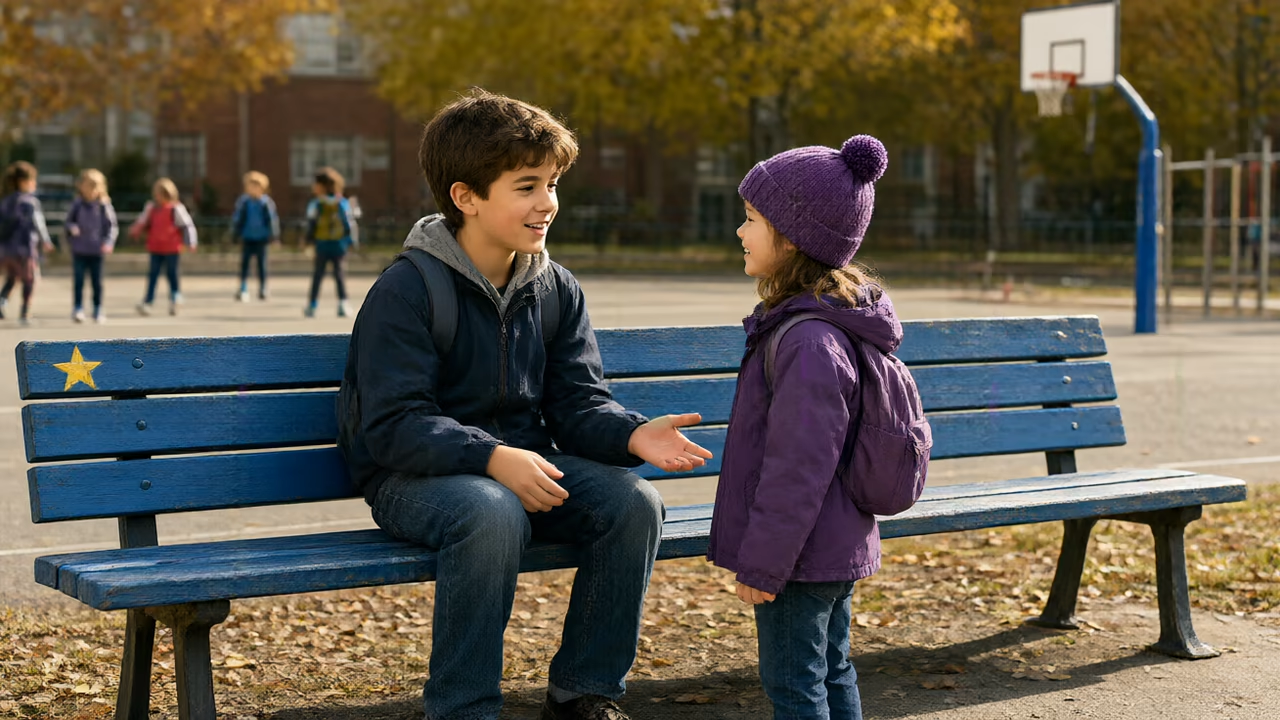
They painted it blue, with one small yellow star on the end, which made everyone happy. Priya painted the words BUDDY BENCH on the back in neat white letters. Jonah's job was to make a poster for every classroom that explained what the bench meant.
The paint took two days to dry. Jonah checked it so many times that Mr. Tran started calling him the Bench Inspector.[1]
The first person to sit
On the first Monday, Mr. Reyes set the bench by the portable wall, exactly where Jonah used to see kids standing alone. All recess, nobody sat on it. Jonah's stomach sank. Maybe the idea was silly after all.
On Tuesday, about ten minutes into recess, the girl with the purple hat walked slowly across the yard and sat down on the very end of the bench, next to the yellow star.
Jonah caught the four-square ball and held it. Then he jogged over. "Hi," he said. "Do you want to play four square? We need one more."
She nodded. By the end of the week, the bench had been used by six different kids, and two of them had sat down together and ended up playing tag. Jonah never had to wonder about the portable wall again.[1]
Fast lesson
Use these checks before you answer the practice questions.
Before reading, write Somebody, Wanted, But, So and Then on five sticky notes. After reading, fill one note at a time, out loud first, then in writing.
When your child is unsure whether something belongs in the summary, ask: if we took this out, would the story still make sense? The granola bar can go; the old bench in storage cannot.
Set a limit, such as one sentence or 30 words. A limit forces your child to choose what matters most instead of retelling everything.
Children often slip their opinion into a summary ('It was a nice story'). Keep the summary to what happened, then talk about what they thought of it separately.
Common mistakes
Why this fails: A summary keeps only the most important parts. If it is almost as long as the story, it is a retell.
Why this fails: Details like the granola bar or the paint argument are fun but do not change the plot, so they belong in a retell, not a summary.
Why this fails: The 'Somebody' is the character whose goal the story follows. Ms. Okafor and Mr. Reyes help, but the story follows Jonah's goal.
Why this fails: The bench being set out on Monday is not the end; nobody sat that day. The summary needs the 'Then', when the bench finally works.
Word Lab
Use the meaning, hear the word, then try it in your own sentence.
summary
nouna short telling of only the most important parts of a story, in your own words
Jonah's summary of the story was only five sentences long.
summarize
verbto tell the most important parts of something in a much shorter way
Can you summarize the story in five parts?
recess
nouna break in the school day when students play outside or in the gym
At recess, Jonah played four square.
portable
nouna small classroom building in a schoolyard that can be moved
Some kids stood alone by the wall of the portable.
principal
nounthe person in charge of a school
Ms. Okafor, the principal, listened to the idea.
budget
nouna plan for how much money can be spent and what it will be spent on
The school's budget for this year was already spent.
proposal
nouna plan or idea that is written or said so others can decide whether to agree
The class wrote a proposal letter about the bench.
caretaker
nounthe person who looks after a school building and fixes things in it
Mr. Reyes, the caretaker, found an old bench.
approved
adjectiveofficially said to be acceptable or allowed
Anything in the yard has to be safe and approved.
sand
verbto rub a surface with sandpaper to make it smooth
The students sanded the rough top of the bench.
drizzle
verbto rain lightly in very small drops
On Tuesday, it drizzled at recess.
inspector
nouna person whose job is to look at something carefully to check it
Mr. Tran called Jonah the Bench Inspector.
Check your understanding
Choose an answer, explain your choice, and then check. Hints and retries are welcome.
Try the questions here. Public practice does not save a learning record.
Support · Find it in the text
Support · Find it in the text practice
Each answer is stated in the story. Point to the sentence.
1. Where did Jonah see kids standing alone at recess?
2. Who told Jonah about buddy benches?
3. What two reasons did Ms. Okafor give for not buying a new bench?
4. What three things did the class put in its proposal letter?
5. Which jobs did Mr. Reyes do, and which jobs did the students do?
6. How many different kids used the bench by the end of the first week?
Apply · Build the summary
Apply · Build the summary practice
Fill in each part of Somebody–Wanted–But–So–Then, then join them.
7. Write one sentence that tells who the story is about and what he wanted.
8. Write the 'But' part in your own words.
9. Write the 'So' part. Use no more than two actions.
10. Write the 'Then' part.
11. This summary has two small details that do not belong. Find them: 'Jonah, who likes math, wanted a buddy bench, but there was no money, so the class fixed up an old blue bench, and then a girl sat on it.'
12. Why should a summary use your own words instead of copying sentences from the story?
Reason · Important or not?
Reason · Important or not? practice
Decide what belongs in a summary, and test it.
13. Sort into IMPORTANT or SMALL DETAIL: no money for a new bench; the paint argument; the old bench in storage; the granola bar; the girl sits on the bench; it drizzled on Tuesday.
14. Try the 'take it out' test: if you remove 'Mr. Reyes found an old bench', does the story still make sense? What does that tell you?
15. Put in order: the class writes a proposal; the girl sits on the bench; Leena tells Jonah about buddy benches; the students sand the bench.
16. How is a retell different from a summary?
17. After you summarize, write the story's message in one sentence of your own.
Practice answer key
- 1. By the wall of the portable.
See 'The wall by the portable'. - 2. His older cousin Leena, who goes to school in Ottawa.
See 'The wall by the portable'. - 3. The budget for the year was already spent, and anything in the yard has to be safe and approved first.
See 'A big no'. - 4. The problem, the idea, and three ways to keep it cheap and safe.
See 'The proposal'. - 5. Mr. Reyes tightened the bolts and fixed a loose board; the students sanded the top (with gloves and dust masks), painted it and made posters.
See 'Sanding and painting'. - 6. Six.
See 'The first person to sit'. - 7. Jonah wanted a buddy bench at his school so kids who were alone at recess could find someone to play with.
Name the main character and his goal. - 8. But the principal said there was no money for a new bench, and it had to be safe and approved.
The 'But' is what gets in the way of the goal. - 9. So his class wrote a proposal and fixed up an old bench from storage with the caretaker.
Pick the actions that solve the problem. - 10. Then a girl who was alone sat on the bench, Jonah invited her to play, and other kids started using it too.
The 'Then' tells how it ends. - 11. 'who likes math' and 'blue' are small details. Remove them; the summary still makes sense.
If a detail does not change the plot, cut it. - 12. Using your own words shows you understood the story, and it keeps the summary short because you only say what matters.
Summarizing means telling the important parts, in your own words, in a much shorter way. - 13. Important: no money for a new bench, the old bench in storage, the girl sits on the bench. Small details: the paint argument, the granola bar, the drizzle.
Important events change what happens next. - 14. No. Without the old bench, there is no way around the money problem, so it is an important event.
If removing an event breaks the story, it belongs in the summary. - 15. Leena tells Jonah → the class writes a proposal → the students sand the bench → the girl sits on the bench.
A summary keeps events in the order they happened. - 16. A retell tells most of the events in order, often with details. A summary is much shorter and keeps only the most important parts.
Summarizing means choosing, not repeating. - 17. Answers will vary, such as: When the answer is no, you can look for another way, and small actions can help someone feel included.
A theme is a life lesson; a summary is what happened.
Related skills
Put it in your own words
This draft is not saved when you leave or refresh the page.
Check your own explanation
This is self-review, not automatic marking.
Compare with a model response
Jonah noticed that some kids stood alone at recess, so he wanted a buddy bench where they could find someone to play with. But the principal said the school had no money for a new bench, and it had to be safe and approved. So Jonah's class wrote a proposal, and the caretaker found an old bench in storage. The students sanded and painted it while the caretaker did the tool jobs. Then a girl who used to stand alone sat on the bench, Jonah invited her to play, and soon other kids used it too. I left out the paint argument because the bench would have been made no matter which colour they chose.
Sources and revision notes
Source check: 2026-11-03. Grade guidance is an editorial suggestion, not a standardised reading score.
What changed in this edition?
Original fiction. All characters, Maple Hill Public School and the events are invented, and the story is not about any real school or person. The source supports the reading strategy, not the story: Reading Rockets' Summarizing page describes summarizing as telling the most important parts of a text, in your own words, in a much shorter way, says that teaching students to summarize improves memory for what they read and acts as a check for comprehension, and names Somebody Wanted But So (Then) as a structured way to summarize fiction. The 'take it out' test, the word limits and the activities are this lesson's teaching framing.