Daily Read / Matter and cleaning
Matter and cleaning · Use a labelled diagram together with the text to put the steps of how soap lifts grease in order, explain why water alone does not wash grease away, and match each hand-washing step to the job it does
How Does Soap Clean? Grease, Water and the Two-Ended Molecule
Why does water alone leave greasy hands greasy? Use a labelled diagram to follow how soap lifts grease and germs away, and why 20 seconds of rubbing matters.
Device/browser voice. Pronunciation and availability vary.
Why water alone is not enough
Picture a greasy pizza box. You wipe your fingers on it, then hold them under the tap. The water runs over your skin, but your fingers still feel slippery. Water and oil do not mix, so the stream slides right past the grease.
A Popular Science article by a chemist explains it this way. Water alone washes away only the dirt that loves water. Oils and grease are the opposite, so they cling to skin unless soap is added.[2]
A molecule with two different ends
Britannica explains that a soap molecule has two ends that behave in opposite ways. One end is hydrophilic, which means it is attracted to water. The other end is a long chain of fatty acids that is hydrophobic: it is repelled by water but drawn to grease.
The Popular Science article describes the shape as a round head and a long tail. Look at the first box of the diagram. The head is blue because it loves water. The tail is brown because it avoids water and sticks to oily things.
Britannica calls soap a molecular bridge. One end holds onto the water, and the other end holds onto the greasy dirt. A bridge can connect two things that would not otherwise meet.[1]
Surround, trap and rinse
Now follow the diagram from left to right. When you rub soap and water on greasy hands, the soap molecules gather around each bit of grease. Their tails dig into the grease, and their heads point outward toward the water. This ball-like cluster is called a micelle. The Popular Science article describes it as bubble-like, with the grime trapped inside.
Britannica adds that once the grease is surrounded this way, the micelles keep it from sticking back onto your skin. The heads are friendly with water, so the moving water can carry the whole micelle away down the drain.
Here is the order in three short steps. First, soap molecules find the grease. Second, they surround it, tails in and heads out. Third, running water rinses the micelles away. If you skip the rinse, the trapped dirt is still on your hands.[2]
What about germs?
Some bacteria and viruses have a fatty outer layer. According to Britannica, soap can attach to those fatty membranes, lifting the germs off and even breaking them apart. The Popular Science article also says soap and water can disrupt the membrane around a microorganism so that it bursts, and the water then carries the remains away.
Britannica compares this with water and hand friction alone. They remove some dirt and germs, but soap removes many more. The sources do not claim that soap removes every germ, so washing is one good habit among several, not a magic shield.[1]
Wash like it matters: the steps
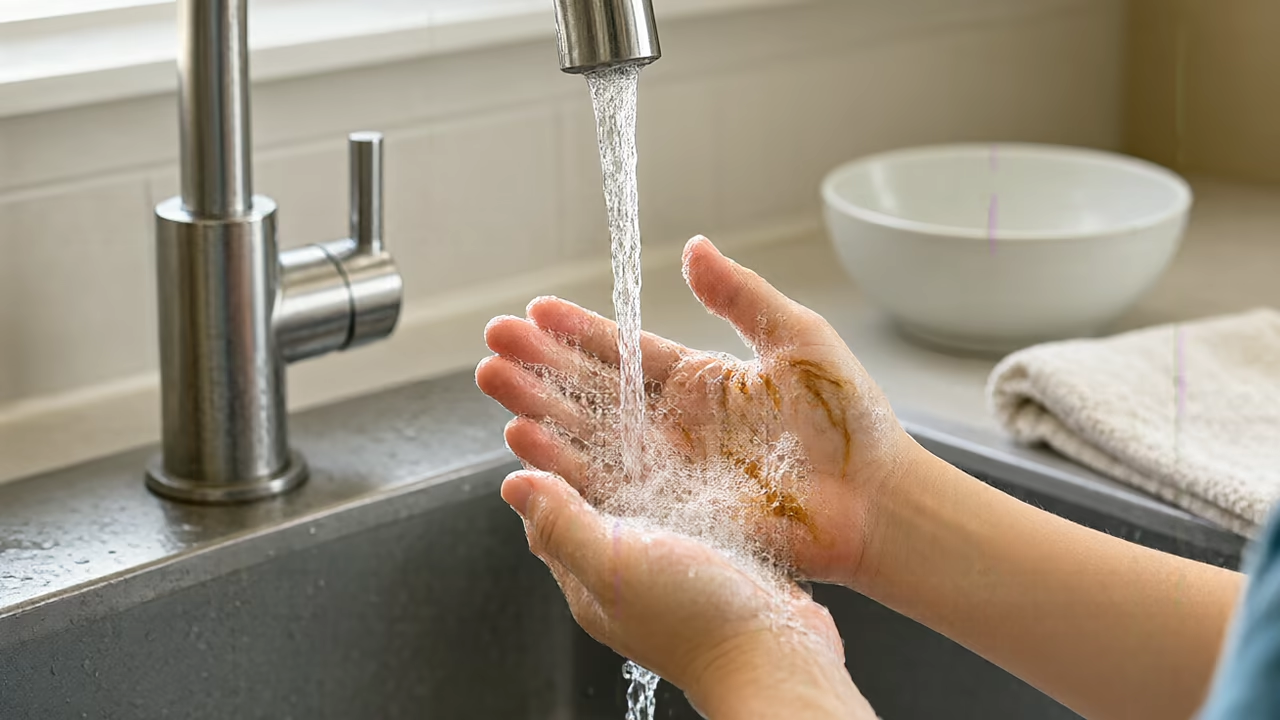
The Public Health Agency of Canada lists the steps for washing with soap and water. Wet your hands. Apply soap while your hands are out of the water. Rub for at least 20 seconds, covering the palms, backs of the hands, between the fingers, the thumbs and under the nails. Rinse thoroughly with clean water. Dry with a clean cloth or paper towel, and use the same towel to turn off the tap.
You can match these steps to the science. Rubbing gives the soap time to reach the grease and break it up; Popular Science says the rubbing helps, and it cites a recommendation of at least 20 seconds. Rinsing carries the micelles away. The agency also says to choose soap and water when your hands look dirty, because hand sanitizer may be less effective on visibly dirty hands.
Soap is old technology. Popular Science says it goes back about 5,000 years to ancient Babylon. The way it cleans is the same idea whether the soap is a bar, a liquid or a foam.[3]
Explore the instructional diagram
Fast lesson
Use these checks before you answer the practice questions.
Seeing oil bead up on water and then change when a drop of dish soap is added makes the two-ended idea concrete. Do it with an adult and keep soap out of eyes.
The head-and-tail picture is a simplified model. Real molecules are far too small to see and are not shaped like lollipops. Say 'the diagram shows' rather than 'soap looks like this'.
Ask your child why each hand-washing step exists: wet, soap, rub, rinse, dry. Rubbing helps the soap reach grease; rinsing carries it away. Steps with reasons are easier to remember.
The sources say soap removes many more germs than water alone, not every germ. Practise saying 'many' and 'some' rather than 'all'.
Common mistakes
Why this fails: Soap does not turn grease into water. It surrounds the grease so the water can carry it away.
Why this fails: Only the head loves water. The tail avoids water and sticks to grease, which is why the molecule can join them.
Why this fails: The micelles still hold the dirt. Rinsing carries them away; without it the dirt can stay on the skin.
Word Lab
Use the meaning, hear the word, then try it in your own sentence.
soap
nouna cleaning substance whose molecules have one end that loves water and one end that sticks to grease
Soap and water lift grease off your hands.
molecule
nouna tiny group of atoms joined together; too small to see
A soap molecule has two different ends.
hydrophilic
adjectiveattracted to water
The head of a soap molecule is hydrophilic.
hydrophobic
adjectiverepelled by water and drawn to grease
The tail of a soap molecule is hydrophobic.
grease
nouna thick, oily substance that does not mix with water
Grease stays on your skin when you rinse with water alone.
micelle
nouna tiny ball of soap molecules with grease trapped inside, tails in and heads out
The micelle was rinsed down the drain.
membrane
nouna thin outer layer around a cell or germ
Soap can break apart the membrane around some germs.
bacteria
nounvery small living things made of one cell; some cause illness
Soap and water help remove bacteria from hands.
virus
nouna tiny germ that can make living things sick
Some viruses have a fatty outer layer.
rinse
verbto wash away soap or dirt with clean water
Rinse your hands thoroughly after rubbing.
sanitizer
nouna liquid or gel used to kill germs on hands when soap and water are not available
Sanitizer may work less well on visibly dirty hands.
bridge
nounsomething that connects two things that would not otherwise meet
Soap is a bridge between grease and water.
Check your understanding
Choose an answer, explain your choice, and then check. Hints and retries are welcome.
Try the questions here. Public practice does not save a learning record.
Support · Find it in the text
Support · Find it in the text practice
Each answer is stated in the article. Point to the sentence.
1. What does a hydrophilic end of a molecule do?
2. What does Britannica call soap, because one end holds water and the other holds grease?
3. What is a ball-like cluster of soap molecules around grease called?
4. How long does the Public Health Agency of Canada say to rub your hands?
5. Where should you apply soap, according to the agency: with your hands in the water or out of the water?
6. About how long ago does Popular Science say soap goes back, and where?
Apply · Process and cause
Apply · Process and cause practice
Use first, then, because or so to explain how soap cleans.
7. Finish the sentence: Water alone cannot wash away grease, because …
8. Finish the sentence: The soap tails point into the grease, so …
9. Finish the sentence: We rinse after rubbing, because …
10. Put in order: rinse away, find the grease, surround the grease.
11. Why does rubbing help soap work?
12. In one sentence, explain what makes soap a bridge between grease and water.
Reason · New situations
Reason · New situations practice
Use what you learned to reason about new situations.
13. The soap head: is it hydrophilic or hydrophobic?
- Hydrophilic
- Hydrophobic
14. The soap tail: is it hydrophilic or hydrophobic?
- Hydrophilic
- Hydrophobic
15. Cooking oil is spilled on a plate. You rinse it with cold water only. Predict what will be left and say why.
16. What does soap do that water alone cannot?
17. How is a soap molecule like a bridge, a handshake or a translator?
Practice answer key
- 1. It is attracted to water.
See 'A molecule with two different ends'. - 2. A molecular bridge.
See 'A molecule with two different ends'. - 3. A micelle.
See 'Surround, trap and rinse'. - 4. At least 20 seconds.
See 'Wash like it matters: the steps'. - 5. Out of the water.
See 'Wash like it matters: the steps'. - 6. About 5,000 years, to ancient Babylon.
See 'Wash like it matters: the steps'. - 7. … water and grease do not mix, so the water slides past it.
Water-loving and grease-loving things stay apart. - 8. … the water-loving heads point outward toward the water.
This arrangement is a micelle. - 9. … running water carries the micelles, with the trapped grease and germs, down the drain.
Without rinsing, the dirt stays on the skin. - 10. Find the grease, surround the grease, rinse away.
Each step needs the one before it. - 11. It helps the soap reach the grease and break it up.
Popular Science says rubbing helps; the micelle forms around grease the soap can reach. - 12. One end of a soap molecule holds onto water and the other end holds onto grease, so it joins two things that do not mix.
The bridge image comes from Britannica; the wording should be your own. - 13. Hydrophilic
The head is attracted to water. - 14. Hydrophobic
The tail avoids water and sticks to grease. - 15. Most of the oil will stay, because water and oil do not mix.
Soap would be needed to give the oil a water-friendly outside. - 16. Soap surrounds grease in micelles that water can carry away, and it can break the fatty outer layer of some germs.
Compare the 'Surround' and 'germs' sections. - 17. It connects two things that would not otherwise connect: here, water and grease.
Any answer that names two unlike sides joined by a middle link is reasonable.
Related skills
Put it in your own words
This draft is not saved when you leave or refresh the page.
Check your own explanation
This is self-review, not automatic marking.
Compare with a model response
A soap molecule has two different ends. The head is attracted to water, but the tail avoids water and sticks to grease. Water alone cannot wash grease away, because water and grease do not mix. First, when I rub soap and water on my hands, the soap molecules find the grease. Then they surround it with their tails pointing in and their heads pointing out, which forms a micelle. Finally, running water carries the micelles down the drain, so the trapped grease goes too. Rubbing gives the soap time to reach the grease, and rinsing carries it away, so both steps matter.
Sources and revision notes
Source check: 2026-11-07. Grade guidance is an editorial suggestion, not a standardised reading score.
- Britannica — How does soap work?
- Popular Science — How does soap keep you clean? A chemist explains the science of soap
- Public Health Agency of Canada — Hand washing and staying healthy
What changed in this edition?
The two-ended soap molecule with a hydrophilic end and a hydrophobic fatty-acid chain, the 'molecular bridge' wording, the lifting and breaking apart of fatty germ membranes, the point that micelles keep dirt from sticking back, and the comparison with water and friction alone come from Britannica. The round-head-and-long-tail description, the point that water alone removes only water-loving dirt, the bubble-like micelle, the bursting of microorganism membranes, the remark that rubbing helps and the 20-second and 5,000-year figures come from Popular Science. The hand-washing steps, the 20-second minimum, the list of body parts to cover and the advice to use soap and water on visibly dirty hands come from the Public Health Agency of Canada. The pizza-box opening, the kitchen test, the invented tests, the diagram shapes and the home activity are original illustrations or reasoning. Report errors through Sources and corrections.