Daily Read / Short Story
Short Story · Find similes, metaphors and personification in a story, explain what each one compares, tell literal meaning from figurative meaning, and explain how figurative language helps a reader picture a scene and feel a character's fear
Short Story: The Rink Before Sunrise
An original story set at a frozen community rink at dawn. Spot the similes, metaphors and personification, then explain what each one makes you see and feel.
Device/browser voice. Pronunciation and availability vary.
Six o'clock at Birchwood Park
This is an original short story. The characters, Birchwood Park and the events are invented.
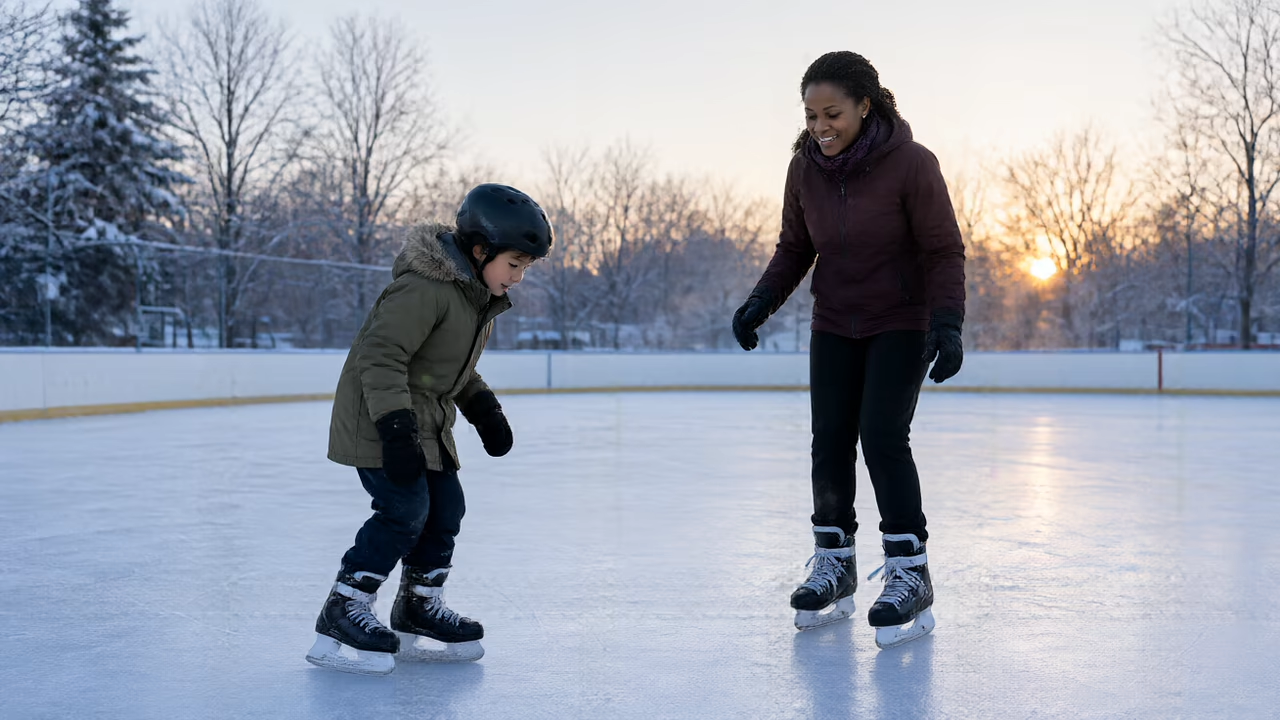
Tomás stands at the gate of the rink and does not move. The morning is a cold blue bowl, and the ice shines like a dark window. His borrowed skates feel as heavy as bricks. Fear is a cold stone in his stomach.
Behind him, the parking lot is almost empty. A tall floodlight hums on its pole, though the sky is turning pink at the edges. "Go on," says Dad. "I'll watch from the fence." He holds a steaming cup of tea, and he looks small and far away already.
On the bench, a woman in an orange toque is lacing up her skates. A sign behind her says SATURDAY LEARN-TO-SKATE, FREE. "Morning!" she calls. "I'm Ms. Okafor. First time?" Tomás nods. His voice has gone somewhere far away.[1]
Along the boards
He steps onto the ice with both hands on the boards. The wood creaks and grumbles under his fingers, as if it is complaining about the cold. The wind nips at his ears.
He tries a tiny shuffle. The blades scrape and whisper. A little boy in a puffy red snowsuit tumbles beside him, pops up like a cork and keeps going. Tomás's cheeks burn, even though the air is freezing. He wishes he could be a cork too.
A girl his age zooms past, laughing. Other skaters glide by like swallows. Tomás slides one foot forward, then the other. He is a snail in a race of rabbits.
"You're doing it!" says Ms. Okafor, skating up backwards. "Now comes the hard part. You have to let go of the boards."
Tomás shakes his head. "The boards are my friends," he whispers.[1]
The tiny invisible chair
Ms. Okafor does not tell him to be brave. Instead, she bends her knees and sinks down, as if she is sitting on a tiny invisible chair. "Try it," she says. "Sit on the little chair, hold your arms out like airplane wings, and take three small steps. Penguin steps."
"When I first learned," she adds, "I held the boards so tightly my mittens got splinters." Tomás almost smiles. It is hard to be afraid of something that frightened a grown-up too.
Tomás bends his knees. His legs are wobbly noodles. He lets go with one hand, then the other. One penguin step. Two. On the third, his skate slips, and he sits down hard on the ice.
For a moment, nobody breathes. Then Tomás starts to laugh. The cold ice tickles through his jacket, and the stone in his stomach is gone.[2]
Gold on the ice
Ms. Okafor skates over and holds out a mitten. "Everyone falls," she says. "The trick is getting up. Roll onto your knees, put one skate down, then the other." Tomás pushes, wobbles and stands.
Over the trees, the sun climbs up and spills gold across the ice. The whole rink seems to wake up and stretch. Tomás takes three penguin steps, then four, then ten. He does not touch the boards once.
On the other side of the fence, Dad has forgotten his tea. He is clapping in his big winter mittens, and it sounds like soft thunder rolling across the rink.
At the gate, he hands back the borrowed skates. "Will you come next Saturday?" asks Ms. Okafor. "Yes," says Tomás, and this time his voice is right there, big as the morning.[2]
Fast lesson
Use these checks before you answer the practice questions.
Read the story aloud once. Then re-read it and ask your child to hold up one finger each time a comparison pops up. Write each on a sticky note and sort them into simile, metaphor and personification.
For each comparison, ask: could this really be true? If not, what is the author trying to help me see or feel? This habit is the heart of reading figurative language.
Similes use like or as. Metaphors skip those words and say one thing is another. If your child mixes them up, circle like and as in each sentence.
The turning point is a small, doable task (three penguin steps), not a speech about courage. Ask your child when a small first step helped them with something scary.
Common mistakes
Why this fails: Tomás does not have noodle legs or a stone in his stomach. The author compares how things feel to something you can picture.
Why this fails: Only comparisons that use like or as are similes. Fear is a cold stone is a metaphor.
Why this fails: Personification gives human actions to things that are not human, such as wood that grumbles.
Word Lab
Use the meaning, hear the word, then try it in your own sentence.
figurative language
noun phrasewords used to mean something different from their ordinary meaning, to make a picture or feeling
"Wobbly noodles" is figurative language.
simile
nouna comparison that uses the word like or as
"The ice shines like a dark window" is a simile.
metaphor
nouna comparison that says one thing is another thing
"Fear is a cold stone" is a metaphor.
personification
noungiving human actions or feelings to something that is not human
The boards "grumble" in an example of personification.
literal
adjectivemeaning exactly what the words say
Nobody has literal noodles for legs.
toque
nouna warm knitted hat; a word Canadians commonly use for it
Ms. Okafor wore an orange toque.
borrowed
adjectivetaken to use for a short time and then given back
Tomás wore borrowed skates.
glide
verbto move smoothly and easily
Skaters glide across the ice.
wobbly
adjectiveshaking or unsteady from side to side
His legs felt wobbly.
creak
verbto make a long, squeaky sound
The old boards creak in the cold.
volunteer
nouna person who does a job to help others without being paid
The learn-to-skate volunteer helped beginners.
mood
nounthe feeling a piece of writing gives the reader
The cold, quiet rink gives the story a nervous mood.
Check your understanding
Choose an answer, explain your choice, and then check. Hints and retries are welcome.
Try the questions here. Public practice does not save a learning record.
Support · Find it in the text
Support · Find it in the text practice
Each answer is stated in the story. Point to the sentence.
1. What colour is Ms. Okafor's toque?
2. What does the sign say the lesson costs?
3. Where does Tomás put his hands when he first steps onto the ice?
4. What kind of steps does Ms. Okafor tell him to take?
5. What happens on his third step?
6. What does Ms. Okafor say the trick is?
Apply · Simile, metaphor, personification
Apply · Simile, metaphor, personification practice
Sort the comparisons and explain what each one means.
7. Sort these into SIMILE and METAPHOR: (a) the ice shines like a dark window (b) fear is a cold stone (c) heavy as bricks (d) he is a snail in a race of rabbits.
8. "He is a snail in a race of rabbits." What does it tell you about Tomás?
9. Finish the sentence: The author says the boards "grumble" because …
10. Is "the sun spills gold across the ice" literal or figurative? Explain.
11. Find one example of figurative language in the last section and say what it makes you picture.
12. In one sentence, say how the stone in Tomás's stomach changes in the story.
Reason · Why use a comparison?
Reason · Why use a comparison? practice
Think about the author's choices.
13. "Other skaters glide by like swallows." Simile or metaphor?
- Simile
- Metaphor
14. "His legs are wobbly noodles." Simile or metaphor?
- Simile
- Metaphor
15. Rewrite "The wind nips at his ears" in plain, literal words.
16. Which is stronger for showing fear: "Tomás is scared" or "Fear is a cold stone in his stomach"? Give a reason.
17. Write one new simile for the rink at sunrise using like or as.
Practice answer key
- 1. Orange.
See 'Six o'clock at Birchwood Park'. - 2. It says the lesson is free.
See 'Six o'clock at Birchwood Park'. - 3. On the boards.
See 'Along the boards'. - 4. Penguin steps.
See 'The tiny invisible chair'. - 5. His skate slips and he sits down hard on the ice.
See 'The tiny invisible chair'. - 6. Getting up.
See 'Gold on the ice'. - 7. SIMILE: a, c. METAPHOR: b, d.
A simile uses like or as; a metaphor says one thing is another. - 8. He is moving very slowly compared with the other skaters.
A snail is slow and rabbits are fast. - 9. … she wants the cold wood to sound like a person complaining, which is personification.
Boards cannot really complain. - 10. Figurative. The sun does not pour real gold; the light looks golden and spreads across the ice.
Spills gold compares light to something poured. - 11. Examples: the sun spills gold; the rink seems to wake up and stretch; his voice is big as the morning.
Any real example with a reasonable picture is correct. - 12. It is there at the start as fear, and it is gone after he laughs about falling.
The metaphor shows his feeling changing. - 13. Simile
It uses the word like. - 14. Metaphor
It says his legs are noodles, with no like or as. - 15. The cold wind makes his ears feel sore or stingy.
The plain sentence is clear, but the figurative one adds a small, sharp feeling. - 16. The stone sentence, because you can picture and feel the weight; the plain sentence only names the feeling.
Either choice is fine if the reason is clear. - 17. Example: The ice glows like a sheet of warm glass.
Check for like or as and a clear picture.
Related skills
Put it in your own words
This draft is not saved when you leave or refresh the page.
Check your own explanation
This is self-review, not automatic marking.
Compare with a model response
The author uses figurative language to help readers picture the rink and feel Tomás's fear. A simile is "the ice shines like a dark window," which compares smooth, dark ice to a window you could look into. A metaphor is "Fear is a cold stone in his stomach." It compares fear to a heavy, cold stone, so the reader feels how it weighs him down. An example of personification is that the boards "creak and grumble," because wood cannot really complain about the cold. I think the stone metaphor works best, because it shows Tomás's feelings without just saying he is scared. Later the stone is gone, which helps the reader feel his fear shrink.
Sources and revision notes
Source check: 2026-11-06. Grade guidance is an editorial suggestion, not a standardised reading score.
- Del Mar College Writing Center — Figurative Language (literal versus figurative background only)
- Britannica Kids — Figure of Speech (simile, metaphor and personification definitions)
- ReadWriteThink — Story Elements Alive! (story-structure background only)
What changed in this edition?
Original fiction. All characters, Birchwood Park and the events are invented, and the story is not about any real person or rink. The sources support the reading skill, not the story: the Del Mar College Writing Center page explains that figurative language uses words to mean something other than their normal meaning, contrasts it with literal language, and says it should not be read literally. Britannica Kids defines a metaphor as a figure of speech that indicates resemblance, a simile as a stated resemblance signalled by like or as, and personification as the application of human qualities to something that is not human. ReadWriteThink's Story Elements Alive! lesson for Grades 3–5 defines setting as the place and time of a story, problem and solution as the conflict in the story and plot as the sequence of events. The sorting tasks, the skill-by-skill questions and the activities are this lesson's teaching framing. Safety note for the activity is general common-sense guidance written for this lesson, not taken from a source. Initial short story created 2026-11-06.