Daily Read / Short Story
Short Story · Identify a first-person narrator, tell what the narrator knows and thinks from what other characters might know or feel, and explain how a narrator's first impression can be wrong
Short Story: The Tap That Wouldn't Turn
An original story told by a girl who thinks her neighbour is grumpy. Find the narrator's clues, then decide what she got wrong and why.
Device/browser voice. Pronunciation and availability vary.
The man next door
This is an original short story. The characters, the street and the events are invented.
I always thought Mr. Lindqvist was the grumpiest person on Maple Crescent. He never waved. He kept the curtains closed. Once, when my soccer ball rolled onto his lawn, he picked it up, looked at it for a long time and set it on the sidewalk without saying a word. My brother Ali said he was probably a spy. I said he was probably just mean.
So on Saturday morning, when I heard banging and a loud "Come ON!" from his side yard, I knew exactly what was happening. Mr. Lindqvist was being grumpy again.[1]
What I saw over the fence
I was supposed to be raking leaves. Instead, I stood on the recycling bin and peeked over the fence.
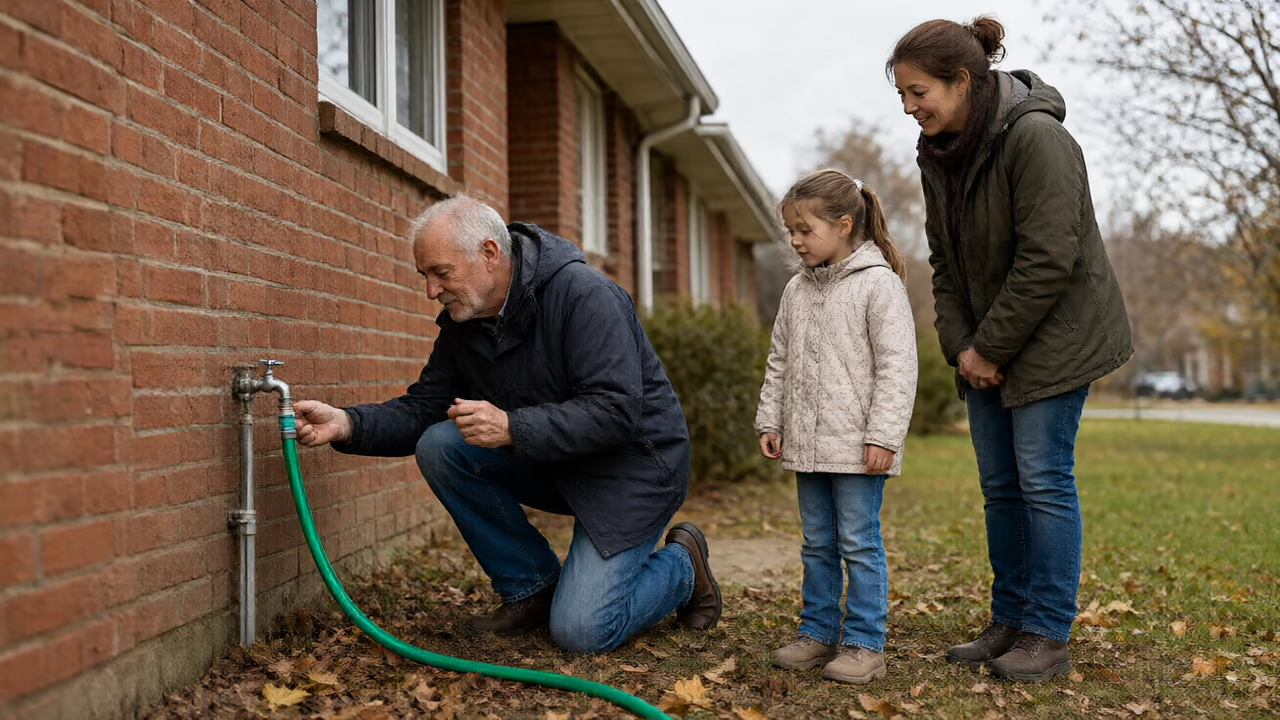
Mr. Lindqvist was kneeling beside his house, next to the outdoor tap. A green garden hose was still screwed onto it. He was twisting the small round handle with both hands, and his face was red. The handle did not move at all.
"Is everything okay?" I called. I said it in my most polite voice, in case he was about to yell.
He looked up, surprised. "The weather says minus eight on Tuesday," he said. "I have to get the water out of this pipe before then. My hands are not as strong as they used to be."
I did not know what water in a pipe had to do with minus eight. But I did know that his voice did not sound mean. It sounded tired.[1]
A trip to the basement
My mom came out when I told her, and she knew right away. "If water freezes in that pipe, it can crack it," she said. "Then you get a flood inside the wall when it thaws." She explained that you have to shut off the valve inside the house first, then open the outdoor tap so the last water can drain out.
Mr. Lindqvist let us into his basement. It smelled like cedar and old books. The inside valve was on a pipe near the ceiling. Its little round handle was even smaller than the one outside, and it was stiff with rust. Mom tried. I tried. It would not budge.
Then I noticed something on his workbench: an old wooden steering wheel from a toy go-kart, with a square hole in the middle. In science class, we had just read about the wheel and axle. A big wheel fixed to a thin rod turns it with more force, because your hands travel around a bigger circle.[1]
The bigger circle
"Could we put a bigger handle on it?" I asked. "Like a wheel?"
Mr. Lindqvist looked at me for a long time, the same way he had looked at my soccer ball. Then he smiled. It was the first time I had ever seen him smile. "My grandson made that wheel with me," he said. "Let's see if it still has a job."
The square hole did not fit the valve. But Mr. Lindqvist found a wider metal handle in a coffee can full of spare parts, and Mom helped him fit it onto the valve stem. I pushed on the edge of the big handle. My hands went a long way around, and the valve turned, one slow quarter turn after another, until the water was off.
Outside, I unscrewed the hose and opened the tap. A little stream of water trickled out and then stopped. The pipe was empty.[2]
What I know now
Later, Mr. Lindqvist brought over a tin of cardamom buns. He told Mom that his wife used to do the winter jobs, and that this was his first fall doing them alone. He said the curtains stayed closed because the sun hurt his eyes. He said he had kept my soccer ball for a minute because his grandson used to have one just like it.
I had been sure I knew what kind of person he was. But I only knew what I could see from my side of the fence.
Now, when I walk past his house, he waves. I wave back. And when Ali says Mr. Lindqvist is a spy, I tell him he is wrong, and that I know, because I was there.[1]
Fast lesson
Use these checks before you answer the practice questions.
Before reading closely, ask your child to circle every I, me and my in the first section. Then ask: who is I?
First-person narrators mix facts and opinions. Make a two-column chart: what Nadia saw, and what Nadia thought.
Retelling from Mr. Lindqvist's side shows how much a narrator can leave out. Encourage your child to add his feelings and reasons.
The people are invented, but draining an outdoor tap with the inside valve shut is real home advice. Ask which parts are invented and which are true.
Common mistakes
Why this fails: A first-person narrator can misjudge people because she only sees part of what happens.
Why this fails: Nadia tells the story and changes the most; Mr. Lindqvist is seen through her eyes.
Why this fails: It is Ali's guess, reported by Nadia, and the story shows it is wrong.
Word Lab
Use the meaning, hear the word, then try it in your own sentence.
narrator
nounthe person who tells a story
Nadia is the narrator of this story.
first person
noun phrasea way of telling a story where the narrator is a character and uses I, me and my
The story is told in the first person.
point of view
noun phrasethe position from which the events of a story are seen and told
From Nadia's point of view, the neighbour seemed grumpy.
impression
nounan idea or feeling you get about someone or something, often quickly
Her first impression of Mr. Lindqvist was wrong.
grumpy
adjectivein a bad mood and easily annoyed
Nadia thought her neighbour was grumpy.
valve
nouna part that opens or closes to control the flow of water or air in a pipe
Mom shut off the valve inside the house.
drain
verbto let liquid flow out of something until it is empty
They opened the tap to drain the pipe.
budge
verbto move a little, usually used when something will not move
The rusty handle would not budge.
thaw
verbto become warmer so that ice melts
A cracked pipe can leak when the ice thaws.
rust
nouna reddish-brown coating that forms on iron or steel when it gets wet
The old handle was stiff with rust.
crescent
nouna curved shape like a thin moon; also a curved street
They live on Maple Crescent.
trickle
verbto flow slowly in a thin stream
Water trickled out of the tap and stopped.
Check your understanding
Choose an answer, explain your choice, and then check. Hints and retries are welcome.
Try the questions here. Public practice does not save a learning record.
Support · Find it in the text
Support · Find it in the text practice
Each answer is stated in the story. Point to the sentence.
1. What street does Nadia live on?
2. What did Ali think Mr. Lindqvist probably was?
3. What temperature was forecast for Tuesday?
4. Where was the inside valve?
5. What did Mr. Lindqvist bring over later?
6. Why did the curtains stay closed?
Apply · Narrator and point of view
Apply · Narrator and point of view practice
Separate what Nadia saw from what she guessed or felt.
7. Sort these into SAW and GUESSED: (a) his face was red (b) he was being grumpy again (c) the handle did not move (d) he was probably a spy.
8. List three words from the first paragraph that tell you the narrator is in the story.
9. Finish the sentence: At first Nadia thinks Mr. Lindqvist is yelling in anger, because …
10. Which detail first makes Nadia doubt that he is mean?
11. Name one thing Mr. Lindqvist was feeling that Nadia could not know until he told her.
12. In one sentence, explain what Nadia means by "I only knew what I could see from my side of the fence."
Reason · Change the narrator
Reason · Change the narrator practice
Think about how a different narrator would change the story.
13. "He was twisting the handle, and his face was red." First person or not?
- First person
- Not first person
14. "I pushed on the edge of the big handle." First person or not?
- First person
- Not first person
15. If Ali told the story, what might he say about Mr. Lindqvist at the start?
16. If Mr. Lindqvist told the soccer-ball moment, what might he say?
17. Why is it safer to drain an outdoor tap before a hard freeze?
Practice answer key
- 1. Maple Crescent.
See 'The man next door'. - 2. A spy.
See 'The man next door'. - 3. Minus eight.
See 'What I saw over the fence'. - 4. On a pipe near the ceiling of the basement.
See 'A trip to the basement'. - 5. A tin of cardamom buns.
See 'What I know now'. - 6. Because the sun hurt his eyes.
See 'What I know now'. - 7. SAW: a, c. GUESSED: b, d.
Seeing is evidence; guessing is an opinion. - 8. I, my, me (for example: I always thought, my soccer ball, my brother).
First-person pronouns. - 9. … she already believes he is grumpy, so she expects him to be angry.
Her first impression shapes what she expects. - 10. His voice did not sound mean; it sounded tired.
See 'What I saw over the fence'. - 11. He was sad or lonely doing the winter jobs alone for the first time (or he missed his grandson).
A first-person narrator cannot see inside other characters. - 12. She means she judged him from a small part of the story and did not know his reasons.
The fence is both real and a symbol. - 13. Not first person
This sentence alone uses he and has no I, so it could come from any narrator. - 14. First person
The narrator says I and is doing the action. - 15. That he was a spy, or that he was mysterious.
Each narrator brings his or her own ideas. - 16. He might say the ball reminded him of his grandson's ball, so he held it and remembered.
His point of view includes his memories. - 17. Because water left in the pipe can freeze and crack it, causing a leak when it thaws.
Mom explains this in the story; the City of Toronto also lists draining outdoor taps as a frozen-pipe prevention step.
Related skills
Put it in your own words
This draft is not saved when you leave or refresh the page.
Check your own explanation
This is self-review, not automatic marking.
Compare with a model response
The narrator of the story is Nadia, and I know because she says I, me and my. She saw that Mr. Lindqvist kept his curtains closed, but she guessed that he was mean. If Mr. Lindqvist told the story, he would know that the curtains were closed because the sun hurt his eyes. He would also know that the soccer ball reminded him of his grandson. His version would feel sadder at the start, because he was doing the winter jobs alone for the first time. It would also show that he was not yelling at anyone; he was frustrated with the stuck tap. The point of view changes what the reader understands about the same events.
Sources and revision notes
Source check: 2026-11-05. Grade guidance is an editorial suggestion, not a standardised reading score.
- Reading Rockets — Story Maps (reading-strategy background only)
- Del Mar College Writing Center — Point of View (narrator background only)
- City of Toronto — Prevent or Thaw Frozen Pipes
What changed in this edition?
Original fiction. All characters, Maple Crescent and the events are invented, and the story is not about any real person or street. The sources support the reading strategy and the home-safety detail, not the story: Reading Rockets' Story Maps page describes a story map as a graphic organizer that helps students learn the elements of a narrative, including characters, plot, setting, problem and solution. The Del Mar College Writing Center page explains that point of view is the position from which the events of a story are observed, that a first-person story is told through the thoughts and feelings of the narrator and not anyone else's, and that a narrator can present a distorted picture of events. The City of Toronto's frozen-pipe page advises disconnecting outdoor hoses, turning off the outdoor water supply where there is a separate shut-off valve and opening outdoor taps to drain the remaining water. The saw-versus-guessed chart, the change-the-narrator tasks and the activities are this lesson's teaching framing. The wheel-and-axle idea in the story matches the Daily Read lesson on wheels and axles. Initial short story created 2026-11-05.